Monday, July 19, 2010

Non-belief, Pt. 4: Theodicy

Why do bad things happen to good people?

Well, why wouldn't they? Why wouldn't bad things happen to good people sometimes? Why in the world would we expect good people to be immune to such things? You see, this isn't a problem for atheists, since it's exactly what we should expect. Of course bad things happen to good people. We wish it weren't that way, but it's certainly not anything that has to be explained away.

Remember when Christianity was clinging desperately to the Earth as the center of the universe, with the sun and stars and planets all revolving around us, as clearly indicated in the Bible? When better telescopes began to show the errors in that, Christians developed increasingly elaborate models to try to explain what astronomers were seeing while still maintaining their faith that the Bible was true. Of course, there was a relatively simple explanation, that the Earth was not the center of the universe, but believers simply couldn't accept it.

(Ptolemaic astronomy, from Wikipedia)

Likewise, there's an obvious explanation for why bad things sometimes happen to good people, but Christians won't accept that, either. For any believer in an omnipotent, omniscient, and benevolent god, it's a profound problem. Countless essays and books have been written about it, and theologians have been pondering the question for centuries. But the debate resembles the argument about how many angels can dance on the head of a pin. If you recognize that angels don't exist, there's nothing to debate.

Historically, I don't believe it was a problem. Long ago, gods were capricious, jealous, self-centered, vindictive, and cruel. And randy, always very randy. In fact, they were very much like powerful human beings (not surprisingly). You had to placate the gods with sacrifices - generally to their priests, of course - in self-defense. But for the most part, you just wanted them to leave you alone. Coming to the attention of a powerful deity - or a powerful human king, for that matter - rarely turned out well.

You wanted to keep your god pleased with you just so he might pester some other mortal instead. And, unfortunately, you also needed him for defense against other gods. Your god might be dangerous, but your neighbor's god was positively malicious. You needed your own god just like you needed your own king, but you never expected either of them to love you. And like your king, your god was far from perfect.

Back then, gods were neither omniscient nor omnipotent. They could be tricked (though seldom for long). They could be defeated by other gods. They could be distracted by lovely mortal virgins, or just lose control in a jealous rage. So it was no surprise at all when bad things happened to good people. No matter how much you sacrificed, it was just to give yourself the best possible chance. There were no guarantees.

But our ideas of deities slowly changed. The Old Testament god is as jealous, vindictive, and blood-thirsty as they get, and it's pretty clear that he wasn't the only god around. He was the tribal god of the Jews, but other peoples had their own deities. Eventually, though, he evolved into the only god of Abrahamic religions, the all-powerful, all-knowing god of everyone (whether they realized it or not). And in this modern interpretation, he supposedly loved his creations.

But this interpretation had a serious flaw. If God was omniscient, omnipotent, and perfectly benevolent, why was there evil in the world? More importantly, why did bad things happen to good people? A Pandora's Box kind of mythology might serve to explain the existence of evil - well enough for people who wanted to believe, at least. But if God was all-knowing and all-powerful - and if he actually loved his creation - why did bad things happen to his faithful worshipers? That's been a problem for Christians, and all sorts of explanations have been advanced to try to explain it.

Naturally, it's not a big problem when bad things happen to other people. In that case, clearly, they just weren't good enough. They must not have given enough money to the church. Or their faith just wasn't strong enough. Did they have doubts? Well, that explains it, right? Satan can sneak through the tiniest crack. Obviously, if bad things happen to other people, it must be their own fault. That's simple enough.

Unfortunately, bad things don't just happen to other people. Sometimes, they happen to you. Sometimes, they even happen to God's priests. Theologians were never too eager to advance that "personal error" explanation then. And seriously, we all know that bad things do happen to good people. You'd have to be the world's biggest cynic not to recognize that. We don't always deserve what happens to us. In fact, we seldom do.

For a long time, magic was used as an excuse. Christian churches always believed in magic (they opposed it, but they always believed it existed). Maybe it was your neighbor, giving you the evil eye. Maybe it was the witch down the street who regularly cavorted with Satan (in your dreams, at least). Human beings always like to find a scapegoat. So when bad things happen, just burn a few witches, just torch the ghetto. What could be simpler?

But God is omniscient and omnipotent, so how could a witch hope to overcome his protection, even with Satan's help? If you really believed, if you faithfully worshiped your god, if you did everything you were supposed to,... why didn't God protect you? Why did he let your children die, one after another, before they even had a chance to grow up? Why were your crops stricken with disease, flattened by wind and hail, and dessicated by drought? If God had both the power and the will to defend you, why didn't he?

OK, maybe there are still some bad people in your neighborhood. Maybe you haven't driven out every Jew. But is God so inept that he can't target the bad guys and leave the good ones alone? Can't he use a blocked artery, rather than a region-wide famine? And when he does use a blocked artery, or some painful, disfiguring disease, why is his aim so poor? Why does he so often strike down the good, rather than the bad.

Free will has been the traditional explanation. Mankind has to be allowed to make the wrong choices, not just the right ones, and suffering is the inevitable consequence of this. But that doesn't explain natural disasters (so-called "acts of God") and it doesn't explain disease. The bad things that happen to good people aren't always due to human errors. Sometimes, they just happen.

Furthermore, is that much suffering really necessary? Coveting your neighbor's wife is supposed to be a sin - just the thought itself. So certainly the intention of committing rape should be enough free will for God's purposes, don't you think? Why should some innocent woman have to suffer the rape itself, just to allow the rapist free will? And if the act itself really is necessary, why should rapes sometimes result in pregnancy, venereal disease, and/or subsequent death in childbirth? Surely those are things God could easily prevent, without the slightest effect on the free will of a rapist.

Frankly, when it comes to a vengeful god, free will doesn't make any sense anyway. If a mugger sticks a gun in your face, threatening to blow your head off if you don't give him your wallet, you'll probably comply with his demands. So are you giving him your money of your own free will then? Of course not! So when God threatens to torture you for eternity if you don't do exactly what he wants, where exactly is your "free will" in that?

Below the fold, I'll continue looking at religious explanations for why bad things happen to good people. Click to continue...

Saturday, July 17, 2010

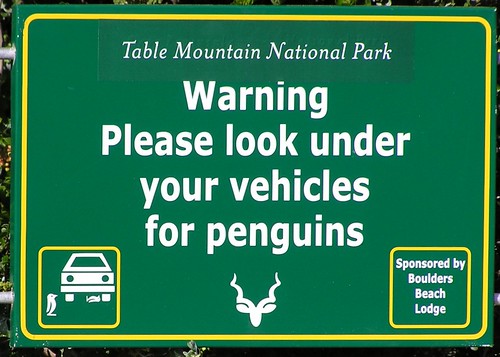
Best sign ever?


According to the photographer, Susan Renee, "This sign wasn't a joke ... there were hundreds of penguins on the beach, under bushes, and wandering in the adjacent parking lot." The park is in South Africa.

Is the Tea Party racist? Is the sky blue?

OK, this started July 13th when delegates of the NAACP unanimously passed a resolution asking for the repudiation of racist Tea Party leaders:

The resolution condemns the bigoted elements within the Tea Party and asks for them to be repudiated. The NAACP delegates presented this resolution for debate and passage after a year of vitriolic Tea Party demonstrations during which participants used racial slurs and images. In March, members of the Congressional Black Caucus were accosted by Tea Party demonstrators and called racial epithets. Civil rights icon John Lewis was spit on, while Congressman Emanuel Cleaver was called the “N” word and openly gay Congressman Barney Frank was called an ugly anti-gay slur.

“We take no issue with the Tea Party movement. We believe in freedom of assembly and people raising their voices in a democracy. What we take issue with is the Tea Party’s continued tolerance for bigotry and bigoted statements. The time has come for them to accept the responsibility that comes with influence and make clear there is no place for racism & anti-Semitism, homophobia and other forms of bigotry in their movement,” stated NAACP President and CEO Benjamin Todd Jealous.

The right-wing hit the ceiling, of course. Here's how Mark Williams of the Tea Party Express put it:

We are dealing with people who are professional race-baiters who make a very good living off this kind of thing. They make more money off of race than any slave trader, ever. It's time groups like the NAACP went to the trash heap of history where they belong along with all the other vile, racist groups that emerged in our history.

So the NAACP is a "vile, racist group" that "makes more money off of race than any slave trader, ever." Wow! Inflammable, you think? Well, not compared to what he said next, on his blog. It's in the form of a mock letter to Abraham Lincoln, supposedly from NAACP president Todd Jealous:

Perhaps the most racist point of all in the tea parties is their demand that government "stop raising our taxes." That is outrageous! How will we Colored People ever get a wide screen TV in every room if non-coloreds get to keep what they earn? Totally racist! The tea party expects coloreds to be productive members of society?

Mr. Lincoln, you were the greatest racist ever. We had a great gig. Three squares, room and board, all our decisions made by the massa in the house. Please repeal the 13th and 14th Amendments and let us get back to where we belong.

Yes, as TPM notes, this is how an official of the Tea Party Express points out how not racist the Tea Party is. Incredible, isn't it?

Stop the stoning!


Sign the petition here.

"The Dragon Masters" by Jack Vance

(image from Amazon.com)

The Dragon Masters, first published in 1962, is our July reading selection in the ClassicScienceFiction Yahoo group. It's actually a novella in length, and contrary to the cover on my Ace Double paperback, it won the Hugo Award for best short fiction, not best novel. (The 1963 best novel award was given, deservedly, to Philip K. Dick for The Man in the High Castle.)

This story is set on a rocky planet settled by human refugees, perhaps the only humans left in the galaxy following a war with reptilian aliens. They have no spaceflight capability themselves, and they suffer under periodic alien raids. But at the start of the book, the last raid had been generations previously, at which time they'd captured 23 aliens. Since then, they've bred their captives into different bizarre forms to fight for them (the "dragons" of the title). Of course, being human, these people mostly just fight among themselves.

There's also another human culture on the planet, the strange "sacerdotes" who settled there originally. Unclothed in all kinds of weather, they will answer any question with the truth, but with such circumlocution and evasion that their answers tend to be completely useless. Seemingly unconcerned about the human/alien conflict, they just want to be left alone. But that's not going to happen.

[Note that "sacerdote" isn't an English word, but it means "priest" in Spanish and Portuguese (from the Latin sacerdos: literally, "one who presents sacred offerings"). Sacerdotalism is the idea that priests are needed to mediate between humans and God, apparently by offering propitiatory sacrifices to atone for sin. I don't see any religious implications in this book, and I wonder at the use of the word. These sacerdotes want nothing to do with other humans. In fact, they hope for all other humans to become extinct, so they're certainly not interested in mediation. And there's no sign that anyone in the book believes in gods. If there's a reason why Vance used this word, I'm missing it.]

I thought this was a fun little story, and quite unique. I'd read the book years ago, but I didn't remember anything about it until I started reading it again this month. But as soon as I began, I remembered the "dragons" - the Termagants, Fiends, and Juggers, the Long-horned Murderers, Striding Murderers, and Blue Horrors. As I mentioned, these are descendants of alien prisoners bred into various fighting forms (mostly for fighting between the groups of humans living in different valleys).

But the aliens have done the same thing with their own captives, creating bizarre forms of human beings to fight for them. So when the aliens return, as we know they will, we see transformed humans fighting on their side against transformed aliens on the human side. It's not at all plausible (not, at least, without advanced genetic engineering), but the imagery is great. It's a unique idea that still seems typical of classic science fiction.

Why else did I like the book? Hmm,... this might involve spoilers, so I'll put it below the fold.

Thursday, July 15, 2010

What, me worry?


Ed Stein's commentary:
It’s becoming increasingly clear that global warming is real, and that human activity does have a profound effect on the global environment. Remember the recent dustup over the veracity of climate change experts, in which emails seemed to show that some scientists were doctoring the results? Two independent analyses have absolved them completely, and confirmed that the scientific findings of accelerated global warming are indeed accurate. The only people left who still believe that climate change is a hoax are those who don’t want to pay the price of cleaning up their businesses and their political allies (and the gullible citizens they continue to manipulate). Yet we dither, as the damage mounts, and reaches a point at which it is irreversible. We continue to believe that new technologies will somehow bail us out at the eleventh hour.  We also believed that the space shuttle wouldn’t fail. And that our understanding of the economy, aided by number-crunching super computers, had become so sophisticated that the markets were immune to risk. And we believed that oil drilling was safe, that the technology was so advanced that something like the disaster unfolding in the Gulf of Mexico was highly improbable, if not impossible.

OK, there's no bigger fan of science and technology than me, but that doesn't mean we shouldn't use our brains. Generally, this "What, me worry?" attitude doesn't really come from people who value science or know anything about it. It's just an excuse for doing nothing. In fact, it's an attempt to cover up greed, laziness, and short-term thinking. These people want to leave their problems for someone else to fix, while grabbing any short-term value for themselves.

We mine the oceans for cheap seafood and leave the resulting devastation for our descendants to worry about. We keep fossil fuels cheap and dump massive amounts of carbon dioxide into the atmosphere, and let our children and grandchildren cope with a planet short of energy and less hospitable to human life. We clear-cut forests for cheap lumber. We blow up mountains for cheap coal. We shrug as millions of species go extinct from our actions and also while man-made chemicals accumulate in our own bodies.

Right now, we could be living in the peak years of human civilization. It's not inevitable, not at all. But it's certainly possible. After this, overpopulation, resource depletion, pollution, and energy shortages could lead us into a spiral of decay. Does this make you feel good, knowing that you yourself lucked out? Not me. I appreciate my luck in being born when and where I was, but I'm embarrassed as hell at what we're doing with all our advantages.

Wednesday, July 14, 2010

All you ever wanted to know about sewage treatment

(free clip art from CoolClips.com)

Seriously, this is a fascinating account of sewage treatment in Scientific American. Ten pages long, but in a light, entertaining style, it covers the history of sewage disposal, the complexity of the problem in large cities, the continual maintenance required, and the actual process of sewage treatment.

Sure, this is a problem we'd prefer to flush and forget, but it's a serious health issue. And with more than six billion people on the planet, the poop really adds up. We can ignore it ourselves, but only if we've got skilled people doing what must be done. An article like this - which really is very entertaining - helps to remind us that we live in a complex, interrelated society that requires careful planning and some esoteric knowledge.

Give it a try. You might be surprised.

PS. My continued apologies for the slowdown here. I've got lots to discuss, just little time for it right now. So you might have to make do with cartoons and videos, rather than my usual long-winded monologues. (Hmm,... that might not be such a sacrifice after all.)

Saturday, July 10, 2010

Automatics for the people

The Colbert ReportMon - Thurs 11:30pm / 10:30c
Automatics for the People - Ilya Shapiro & Jackie Hilly<a>
www.colbertnation.com
Colbert Report Full Episodes2010 ElectionFox News

What's with this gun worship these days? Do you understand it? I certainly don't. It's not just a weapon, a tool, a possession, it's become a holy relic. You can't be parted from your gun, even for an instant. Nothing else seems to be as important as the almighty gun.

Is it just insecurity, timidity, cowardice? Are gun owners so easily scared that they can't bear to be unarmed? Or is it more a symbol of manliness, of potency. I've often heard it called a penis substitute. Is it that in truth? Do gun nuts feel emasculated without their steel penis?

Clearly, it's more than just a weapon. You can defend yourself with a knife or a steel pipe, but no one treats those objects as divine. The thought of leaving your knife at home won't make you hysterical. You don't insist on carrying a baseball bat with you everywhere you go. Almost anything can be used as a weapon, but nothing else has this effect on people. Why not?

And what's the point? If you enjoy hunting (I used to hunt, myself), I'm sure you'd hate to give up your gun. But do you really need a fully-automatic assault rifle and cop-killer bullets to hunt rabbits? No one has ever been talking about banning legitimate hunting weapons. And even then, it's just entertainment. I didn't get hysterical at the thought of giving up my binoculars, back when I was an avid birder. What's the difference? Binoculars weren't gifts from Jesus?

And you can't be dumb enough to think that you could hold off the U.S. army - or any army - with your beloved pistol, can you? Or even your submachine gun? Do you really think that your gun is keeping the government from attacking? Why is it essential that you can carry a gun everywhere - in church, in bars, in schools? This kind of obsession just seems really weird, don't you think?

Yes, there's the Second Amendment, which talks about a "well regulated militia." But what part of a private citizen carrying a gun in church or in school has anything to do with that? OK, sure, according to the right-wing, God gave us guns, and apparently it's part of their faith to never be parted again. But the government is supposed to be neutral when it comes to religion. And that seems to have nothing to do with a militia, well regulated or not.

Note that the First Amendment says, in part, "Congress shall make no law... abridging the freedom of speech." But despite this, freedom of speech still isn't absolute. Libel is still illegal. Treason is still against the law. You still can't falsely yell "fire!" in a crowded theater. Despite the First Amendment, there are reasonable laws limiting our freedom of speech. And none of that is controversial at all.

But when it comes to the Second Amendment, the slightest, most reasonable, most sensible restrictions are rejected with horror. No, you've absolutely got to be able to carry your automatic weapon to political rallies, right? Leave your bazooka at home when attending church? How could you? And if you can't carry your flamethrower into your child's elementary school, well, there's no telling what might happen!

As far as I can tell, the left has nearly given up on this issue. (Certainly, politicians have!) Legal experts used to argue that the Second Amendment applied to militias - the National Guard - not individuals. They used to claim that weapons of mass destruction - like machine guns and assault rifles - could still be regulated. Like the First Amendment, the Second also could have reasonable restrictions. But I hardly ever hear anyone arguing those things these days. The loonies seem to have won.

OK, then, I'll be happy as soon as I get my pocket nuke. Don't worry, I just want a nuclear bomb for hunting purposes and personal protection. If everyone had a nuke of their own, people would be a lot more polite, I'll bet. My neighbor probably wouldn't let his dogs bark so much. I wouldn't be flipped off on the highway, and fewer people would argue in bars. Never more than once, at any rate.

And why not? Nuclear bombs don't kill people; people kill people. And if you outlaw nukes, only outlaws will have nukes. Don't worry, though. I'm not interested in taking my pocket nuke to church.

Friday, July 9, 2010

More crazy from Arizona

The Daily Show With Jon StewartMon - Thurs 11p / 10c
Latino 911!
www.thedailyshow.com
Daily Show Full EpisodesPolitical HumorTea Party

These are two related video clips from The Daily Show, both dealing with Arizona's immigration law (and both very funny). Above, we see Arizona's attempt to make a racial-profiling law seem politically correct. No one can be arrested for not having papers, but if you don't have papers, you'll be "detained" by police. Nice distinction, huh?

And just think of the bullet we dodged two years ago. We could have had Insane McCain - new slogan: Just Tell Me What to Say And I'll Say It - and Caribou Barbie in the White House right now. (Admittedly, Palin would probably have quit by now, since the vice-presidency doesn't pay enough.)

We get a nice slam at Fox "News" there, too. (I always love that!) But the second clip is, if anything, even funnier. White Republicans in Arizona are up in arms about an unconstitutional law. No, they don't care how many Hispanic Americans are hassled by police. That's their fault for looking Mexican anyway. But cameras checking for speeding vehicles on the highway? Man the barricades!

Yes, this is a "gross invasion of privacy"! Because we all have an expectation of privacy when we're driving down the highway, right? And this system targets speeders by... seeing who is actually speeding. How can you get more unfair than that? How about all of us law-abiding speeders? Benjamin Franklin would be outraged!

I loved Olivia Munn's realization that "speeding is probable cause for checking immigration status, but speeding is not probable cause to give you a ticket for... speeding." Honestly, could Republicans be any more ridiculous if they tried?

Tragically, the murder of a rancher, presumably by illegal immigrants, was one impetus for the immigration bill. Well, the GOP has always found it easy to scare people (and all too many of us Americans seem to have become hopeless cowards.) But these radar cameras are apparently cutting highway deaths by 19%. Doesn't that matter? Well, not alongside the fact that even white people are getting ticketed, apparently.

"Clearly it's better to have officers issuing tickets," according to State Rep. Carl Seel. I mean, a real human being can tell if the violator is white or Hispanic. I guess that's the American - or at least the Arizonian - way. And if you start handing out speeding tickets to truckers, well, just imagine the potential for disaster!


The Daily Show With Jon StewartMon - Thurs 11p / 10c
Arizona's Photo Radar
www.thedailyshow.com
Daily Show Full EpisodesPolitical HumorTea Party

Thursday, July 8, 2010

Muslims in Space

The Daily Show With Jon StewartMon - Thurs 11p / 10c
Wish You Weren't Here
www.thedailyshow.com
Daily Show Full EpisodesPolitical HumorTea Party

Funny, isn't it? Fox "News" claims to be worried about Muslims trying to legislate Islamic religious views - and even about Muslim missionaries - while being eager for Christians in America to demand government support for their own religion. How could any American be this dumb, more than 200 years after our forefathers established a nation of complete religious freedom and the strict separation of church and state?

And that's especially the case now, when our worst enemies are religious fanatics. Why do so many Americans want to imitate the Taliban? Why do we see so much "fatwa envy" among American Christians? Are right-wing Christians still upset that they can no longer burn witches? Get over it!

Our founders had seen religious wars devastate Europe. For centuries, war had raged over the most minor differences in belief (none having any evidence backing them up). Wisely, our forefathers didn't want this for America, and their solution was revolutionary: the strict separation of church and state. That wonderful experiment became a model for the whole world.

In America, you could believe whatever you liked. Your religion, if any, was your own business, not your neighbor's and not the government's. You couldn't force anyone to follow your own religious beliefs, but they couldn't force you to follow theirs, either. You couldn't use the sword - or government taxes - to convert anyone. If you wanted to convince them in the free marketplace of ideas, you were welcome to try. But the government would remain strictly neutral.

Of course, Christians were always a majority in America, so there were always some eager to force their beliefs on the minority. That's just human nature. Some people tend to be authoritarian, even in a liberal democracy. And politicians, being natural cowards, allowed some chipping away of our protections. Luckily, we also had the Supreme Court, so the worst of these were not allowed. It hasn't been a perfect protection, but by and large, we've maintained our freedom of religion.

However, the separation of church and state traditionally enjoyed bipartisan support in America. Both political parties used to support our Constitution. These days, that's less true. And as the Republican Party lurches further and further to the right, it becomes less and less true. They've almost succeeded in packing the Supreme Court with far-right extremists. So how much longer will our freedoms last? Recently, the right-wing has launched a relentless attack on freedom of religion, and we Americans seem to be too dumb, or at least too ignorant, to understand how dangerous this is. How could we let this happen?

I guess I could understand the previous assault on religious freedom in America, during the McCarthy era of the 1950's. After all, our enemy then was "godless" Communism, specifically the officially atheist regimes of Red China and the Soviet Union. So I suppose it was natural, at least for people who weren't too bright, to equate religion - and specifically Christianity - with patriotism. (In reality, of course, freedom of religion was the real difference between our societies. We let people decide for themselves.)

But these days, our enemies are clearly religious nuts determined to force their own beliefs on everyone else. Obviously, the opposite of that is freedom of religion and the strict separation of church and state. It's certainly not becoming religious nuts ourselves! I don't get it. Why would we want to imitate our enemies? Do we admire the Taliban that much? Why isn't there now a renewed appreciation for our religious freedoms? Why isn't it more clear than ever that the strict separation of church and state is the way to go?

Are religious believers that insecure that they think they can't win in a free marketplace of ideas? Do they really think that their beliefs make so little sense that they must force people to believe them? How can Americans look at the Taliban and think, "Yes, that's the way we need to run our country"? I really don't get it.

I guess the opposition to building mosques in America seems particularly bizarre to me. Why in the world is it any of your business? Do you really think that your children will flock to Islam if there's a mosque in the neighborhood? How insecure is that? Is your own religion really that unappealing? OK, I suppose a lot of it is just fear, irrational fear of terrorism pushed by right-wing ideologues. But that brings up another question. How come that tactic works? How did we Americans become such hopeless cowards, anyway?

I'm an atheist, but I'd object just as strongly to the idea that the government should favor atheism as I would - as I do - to the suggestion that it should favor Christianity, Islam, or even just religion in general. I stand with our founding fathers on this issue. Church and state should remain strictly separate. That's the American way.

Wednesday, July 7, 2010

Obama wouldn't have done this for you


Ed Stein's commentary:
I’ve been accused of blindly blaming the Republican Party for too many things. But this is one even my most conservative friends agree on. Both parties have always agreed to extend unemployment benefits during recessions. It makes economic sense, and it’s the most humane thing government can do when its citizens are economically stressed. First of all, the money goes immediately into circulation–it gets spent, both alleviating the pain of the unemployed, and acting as an economic stimulus to the broader economy. This Republican Party, though, either can’t understand the benefits, or more likely, is quite willing to inflict untold pain on the people of this country if it sees an electoral benefit. The economy will get worse, Obama will be blamed, and the Republicans will reap the gains in November. Never mind the suffering. The cynicism is staggering, and shameful.

Some of the rhetoric is beyond belief. The new talking point is that extending unemployment benefits will only discourage people rom looking for jobs. Oh, we lazy Americans. Fifteen million of us thrown out of work since the recession began, and we just don’t want to go back on the job because of those cushy benefits. Unemployment is our fault. And there are all those high-paying jobs out there just going begging because Obama is too generous with our tax money. Give me a break!

Personally, I'm just astonished that it seems to be working. I thought we Americans were stupid during the Bush years, especially after re-electing the worst president in U.S. history, a man who presided over an administration that was so clearly wrong about pretty much everything. But now we want to put the GOP back in power? Already? Are our memories really that short? Really, is there no limit at all to our stupidity?

Frankly, it's hard to believe we could be this stupid and still function, even marginally. But what other answer is there? Gullibility? Racism? The media? At some point, all these things must boil down to a lack of intelligence, don't you think? But it really is astonishing.

I's on Edjukashun

The Colbert ReportMon - Thurs 11:30pm / 10:30c
I's on Edjukashun - Loyola, Texas Textbooks & Wal-Mart<a>
www.colbertnation.com
Colbert Report Full EpisodesPolitical HumorFox News

Monday, July 5, 2010

Fatter than ever


OK, these maps (from the Robert Wood Johnson Foundation, via Treehugger.com) are just astonishing. The top map shows America's state-by-state obesity rate in 1991. Not one American state had an adult obesity rate of greater than 20%. Some states had an obesity rate of less than 10%. (There are no records from three states, those shown in white.)

The bottom map shows the most recent data on adult obesity. Now, only one state has a rate of less than 20% (that's Colorado, at 19.1%). More than two-thirds of our states have an adult obesity rate of greater than 25% - and eight of them have rates above 30%. Mississippi, the fattest state in the Union, has an obesity rate of 33.8%. More than two-thirds of Mississippi adults are overweight.

What is going on here? After all, we're not talking about the days of our grandparents (or the contrast would be even greater). We're fatter - far fatter - than we were even in the 1990's - and the obesity rate back then was certainly nothing to be proud of. I don't get it. Are we really eating more junk food now than we were in the 1990's? Are we really getting even less exercise? It's hard to imagine that this is all that's going on.

After all, we've had television almost universally in America since the 1960's (almost 90% of American households had a TV in 1960). As a child, I spent my Saturdays pretty well glued to the TV, making myself half sick from staring at the screen for hour after hour. We didn't have computers back then, but we certainly had TV. (And since the obesity rate is highest among the poor, it's hard to imagine that computers are the problem.) And junk food? That's nothing particularly new, either. Has our junk food addiction really changed appreciably from the 1990's? That's hard to imagine, too.

OK, obviously I'd prefer to find a magic bullet here. I'd like to see us identify a chemical, some food additive or artificial ingredient, that's causing these soaring rates of obesity, because that would be an easy fix. As a skeptic, I know that we always want to find simple answers - and I know how very easy it is to believe what we really want to believe. We look for simple answers, when we should be looking for the truth. So I'm not going to jump to any firm conclusions about this.

But it's still hard to believe that our lifestyles have changed that much since the 1990's, don't you think? That wasn't ancient times, for Jebus' sake. Americans didn't walk everywhere, laboring in the fields, tending their crops by hand. We were Cheeto-munching couch potatoes in the 1990's, too, I assure you. Do you really think we had more discipline back then? I don't think so. So why have we become even fatter as a nation than we were then? What has changed? What is continuing to change? After all, this trend certainly hasn't stopped. (Adult obesity rates increased in 28 states over the past year.)

I'll tell you one thing: personal discipline isn't going to solve this problem. Oh, sure, if you're really disciplined and determined, you can probably solve your own personal weight problem. It won't be easy, but it can be done if you really stick with it. But it's only the rare person who's that disciplined and determined, and even then, it seldom lasts long. No, a nationwide problem like this requires deliberate government policies. There's a reason for this explosion in obesity. We need to find that reason - or those reasons - and we need to attack the problem as a society.

I don't know the solution. As I say, there probably isn't a magic bullet. However, it would greatly help if our government policies didn't actually contribute to the problem. Our government subsidizes the worst kinds of food, so that our cheapest food is also the most fattening and the least healthy. Well, farm subsidies are based on political power, not science, not even common sense. For example, we subsidize the domestic sugar industry, which not only keeps sugar cheap but also damages the economies of our neighbors in the Caribbean, some of the poorest nations on the planet. Yeah, one of the wealthiest countries on Earth keeps the poorest from competing, just to keep big corporations happy!

Republican businessmen and farmers talk a lot about the magic of the marketplace and the benefits of competition, but it's generally just talk. When it comes to their own pocketbooks, they insist on their God-given right to suck at the government teat. Yeah, government welfare is pure and beautiful when the money comes to you, isn't it? Try to change farm policy and you'll have every rural senator in the nation - from both parties - screaming bloody murder. Well, that's just because their constituents demand it. (And since the number of senators doesn't vary by population, rural states have far more political power than they should.)

Would this solve the problem? Of course not. But it would help, or at least not make the problem worse. Right now, the poorest Americans are also the fattest, and part of that is because the cheapest food is the most fattening and the least healthy. And that's the kind of food we serve in our schools, too - partly because it's cheap and partly because corporations who make money selling junk food have a lot of political power. Ketchup as a vegetable, anyone? Oh, now that's a healthy meal!

(image from Wikipedia Commons)

Personally, I doubt if most obesity-prevention programs will work, but we have to try them. And more importantly, we need to examine the results. Throw out what doesn't work, or what isn't cost effective, and concentrate on what does.

Also, I'm skeptical about PE in schools. All too often, it doesn't encourage activity people can - or will - continue as adults. (And at worst, it just encourages the passive watching of televised sports.) I'd rather see free-form recess than organized PE. And to combat obesity, I'd rather concentrate on strict nutritional standards for school lunches and vending machines. But maybe I'm wrong. I'm certainly no expert. Again, we need careful scientific investigations of everything we do. Find out what really works, not just what has the most popular (or corporate) support.

Personally, I think that encouraging gardening might help, too. For me, at least, I like to eat what I grow myself. I rarely buy vegetables in the grocery store, because they just don't sound good (not compared to all the junk food available, anyway). But if I grow it myself, I eat it and I like it. OK, this isn't going to solve the obesity epidemic, but it might help. Try it yourself, if you can.

But again, we need smarter policies at the federal level. Here's an interesting argument about attacking the problem from a supply side, rather than the demand side. I already talked about this, but it bears repeating.

Because current market incentives, imposed by the government, encourage factory production of protein and mass production of high fructose corn syrup, we have (surprise) super-cheap, mass-produced chicken, pork, beef, and sweet treats.

Changing those policies won’t be easy, because there’s a vast industry — much of it now geared to export — that has grown fat on those policies.

Companies like Tyson Foods, Smithfield Foods and Archer Daniels Midland have grown fat on our current system of subsidies. So have our fast food chains. So have our food manufacturers. ...

Because we subsidize exports of grain, sugar and protein, African, Asian and South American markets can’t develop. And because we subsidize for export, we can’t either.

The answer to the obesity epidemic lies in changing our production incentives. Take the price supports off mass produced grain and feed, give them to small local truck farms and sustainable production methods. Then export expertise, which is more valuable than corn syrup anyway.

Can we do this? Yes. Will we? No, probably not. But let's keep trying. I become increasingly pessimistic the older I get, but it's cowardly to give up. And it's lazy to stop trying to make a difference. (If you don't vote, you should be ashamed of yourself! I mean it. No excuses are sufficient. Vote, damn it!)

Sunday, July 4, 2010

Homeopathy and Star Trek


Gobbledygook is fine in fantasy and science fiction - at least on television or in the movies, where plausibility isn't a serious consideration anyway. But don't allow yourself to be fooled in real-life, just because some explanation seems sciency or includes real words like "proton" or "quantum."

A scam artist must seem sincere and even likable, or he's not going to be successful. It's a requirement for that kind of con. And whether these people are just trying to fool you or are also fooling themselves, you don't want to be that kind of fool. They're peddling fantasy, nothing more.

If you want a simple explanation of homeopathy, without all that nonsense gobbledygook, you might try this comic book. Can't get much simpler than that, right? And when it comes to information, simple - understandable - is good.

"Slow Train to Arcturus" by Eric Flint and Dave Freer


Eric Flint has been one of my favorite authors since his first SF novel, Mother of Demons, in 1997. I like his optimistic attitude and I love his characters, who tend to be very likable people. It's easy to care what happens to them. Plus, his heroes aren't supermen who single-handedly solve every problem that comes their way. Instead, it's usually teamwork - a bunch of appealing characters working together - that wins out in the end. And finally, his villains aren't supermen, either, and sometimes they're not even all that villainous, just wrong.

At his best, Flint's novels are superbly entertaining. But sadly, he's been rather hit or miss lately. The thing is, he's been very prolific, apparently writing several books at the same time, with many different collaborators. I really think he's overextended himself. Too many of his recent books are just... OK. Yes, they're entertaining, but nothing special. And since special is what I expect from him, it's always disappointing when I don't get it.

Dave Freer has been a frequent collaborator with Flint, first with Rats, Bats, and Vats, a humorous and very entertaining SF novel - and the sequel, The Rats, the Bats, and the Ugly, which was even more fun - and with fantasy like The Shadow of the Lion (also co-authored by Mercedes Lackey). He was also the sole author of A Mankind Witch, set in the same fantasy world as the latter novel, which was lots of fun.

Given all that, I guess I was a bit disappointed with Slow Train to Arcturus. It was an entertaining read, certainly, but it wasn't one of their best efforts. Still, it wasn't bad, either. Generation ships used to be a staple of science fiction, and I was very glad to see a new take on that (with separate "pods" for different - mostly pretty bizarre - human cultures). As the huge generation ship passes near a distant solar system, aliens send a ship to check it out. But after an initial, disastrous encounter with Aryan survivalists, one surviving alien must make his way through other pods filled with strange humans in order to get home again.

So what's not to like? Yeah, it was entertaining. And I should note that I especially liked the end of the book. But Flint has done far better aliens than this. In fact, these hardly seem very alien at all. I never did get a feel for the main alien character, not even so much as to imagine what he looked like. (He was not just humanoid, but remarkably human-like, apparently.) But the aliens seemed to be just an excuse to show all the weird varieties of human beings. That was disappointing.

The human characters were fine, but again, nothing really special. OK, I did like Howard, who struggles mightily with his fundamentalist Christian upbringing, but Lani never did seem realistic - and her nudist matriarchy was just ridiculous. That said, I enjoyed the way the story went, especially towards the end of it.

I certainly don't want to give you the wrong idea, because the book was fun. But I know that these two authors can do much better. That did make it disappointing.

******
I want to briefly mention another recent read, "Act One," a 2009 novella by Nancy Kress nominated for both the Hugo and Nebula Awards. It's really a great story, with some superb characters. Like many of her SF stories, it concerns genetic engineering, and the issues aren't simple.

For now, at least, it's freely available online, so I don't think I'll go into details. But I highly recommend it. As it turns out, this story did not win the Nebula Award (the Hugo Awards haven't been decided yet), and I haven't read the story which did (it's "The Women of Nell Gwynne's" by Kage Baker). But if that's better than this one, I really need to get a copy!

Friday, July 2, 2010

Backyard farmer

The Colbert ReportMon - Thurs 11:30pm / 10:30c
Manny Howard
www.colbertnation.com
Colbert Report Full EpisodesPolitical HumorFox News

OK, this is funny, but there's more truth to it than you might think. The past four or five years, I've been growing fruit in my backyard - apples, apricots, pears, peaches, nectarines, plums, pluots, cherries, gooseberries, currants, raspberries, strawberries, and grapes - and I think it would have been cheaper just to buy fruit, especially since I give most of it away.

And that's even considering my labor to be free. Let me tell you, it's been a lot of work. I figured that you could just plant a fruit tree and then pick the fruit when it ripened. What could be easier than that? Ha! There is always work I need to do, and I'm always behind in it.

True, I haven't cut off any fingers, but maybe that's because I rarely use power tools. (I'm usually scratched, cut, or otherwise dinged up in some way or another.) And although I haven't beaten any rabbits to death, one did die of heat stroke after I chased it around my yard for awhile one hot and humid day. Yeah, it was him or me. (Luckily, I wasn't the one wearing a fur coat.)

I must admit that my fruit tends to be much better tasting than what I can buy in the grocery store. But after growing my own, I'm just astonished at how cheap fruit and vegetables really are. I really don't understand how they do it....

Anyway, as long as I'm on the subject, let me give any prospective fruit-growers here a few tips. Note that this is my experience in Lincoln, Nebraska. Your results in other locations may vary, depending on your climate and different insect and disease problems. But I've found that some fruit is a lot easier and less time-consuming to grow than others.

Rhubarb - sort of an honorary fruit, I guess - is by far the easiest thing I grow. Heck, it was here when I bought the house 25 years ago, and I've never done anything but pick it. But it's way too sour to eat fresh, so I just give it all away. (I don't cook, or not much.)

My black raspberries have been pretty easy, too. The birds planted them - actually, they planted one raspberry, which soon grew to two long rows - and they need pruning a couple of times a year, but that's about it. Squirrels generally leave them alone, and although the birds love them, there's usually enough for all of us. (Mulberries would be the same way, but I've actually had trouble growing them.)

Strawberries and grapes are almost as easy. They need care - pruning the grapevines and managing the strawberry patch - only once a year, and I never have to spray them for anything (your mileage may vary). However, they must be netted when they start to get ripe or the birds will get the whole crop. And although the squirrels never bother my grapes, I've had to set up an electric wire (which I rub with strawberry juice) to keep them out of my strawberries.

Currants and gooseberries are both very easy, and they'll grow in places that don't get much sun. In fact, here in Nebraska, they really need some shade. The currants don't need spraying, but they must be netted to keep the birds out (luckily, currants don't have thorns), while one annual spray of Bt keeps the worms out of my gooseberries, and the birds and squirrels don't bother them at all.

The currants are even easy to pick, since they grow in bunches, like grapes, and they all ripen at the same time. (The gooseberries, which are low to the ground and very thorny, are easily the worst fruit to pick, as far as I'm concerned.) Unfortunately, they're both better suited for cooking than to eat fresh. I do like the Poorman variety of gooseberry - they're very tasty when almost ripe - and the Black Velvet variety isn't bad, either. But for fresh-eating, most of my gooseberries are too sour when green and too bland when ripe. (They all make great pie, though!)

Then we get to the tree fruits. Unfortunately, they generally need a lot of spraying - in fact, more than they get from me. Invading insects and diseases from all over the world keep up a never-ending assault on them. They also need a lot of work pruning and training the branches, at least when you're trying to keep them small (since I'm just a backyard fruit-grower, I've crowded everything severely).

And every bird and mammal in the world will seemingly be after your fruit. Birds will peck holes in one fruit after another, if they can't eat the whole thing. Squirrels will gorge on them and carry off everything they can. (My squirrels even like little green - and very sour - apples. They'll completely strip a small tree months before the apples get ripe, if you let them.)

It's really a lot of work. From spring through fall, I seem to be working in the yard almost constantly, and I rarely get caught up. Heck, even picking the fruit is a lot of work. Really! Since my mother was in the hospital last week, I'm even further behind than usual. So this blog has taken the short end of the stick, for now. OK, time to get to work.