Thursday, September 9, 2010

Michelle Malkin's latest lie


From Sara Benincasa at Indecision Forever:
Everyone's favorite hysterical reactionary, Michelle Malkin, has many dumb things to say, all the time. This week, she took aim at Hungarian-born Jewish billionaire investor and Obama supporter George Soros, who donated $100 million to international nonprofit Human Rights Watch.Malkin writes, "The anti-Israel bias of HRW is so brazen that liberal lawyer Alan Dershowitz took to the blogosphere to denounce it," conveniently neglecting to mention that Alan Dershowitz thinks everyone who does not agree with his every thought is, in fact, a bloodthirsty anti-Semite. Malkin then directs folks to this "must-read" by Ezra Levant, which reads, in part…
When the Nazis took total control of Hungary in 1944, the Holocaust followed. In two months, 440,000 Hungarian Jews were deported to death camps.
To survive, George, then a teenager, collaborated with the Nazis.
First, he worked for the Judenrat. That was the Jewish council set up by the Nazis to do their dirty work for them. Instead of the Nazis rounding up Jews every day for the trains, they delegated that murderous task to Jews who were willing to do it to survive another day at the expense of their neighbours.
Levant later adds, "By collaborating with the Nazis, George survived the Holocaust. He turned on other Jews to spare himself."
Here's an exciting thought. Let's see what Soros himself actually says about that time, in a handy-dandy 1994 interview with The New Republic…

"The Jewish Council asked the little kids to hand out the deportation notices. I was told to go to the Jewish Council. And there I was given these small slips of paper. It was three or four lines. It said report to the rabbi seminary at 9 a.m. tomorrow morning. Bring a blanket and food for twenty-four hours. And I was given a list of names. I took this piece of paper to my father. He instantly recognized it, you see. This was a list of Hungarian Jewish lawyers. He said, 'You deliver the slips of paper and tell the people that if they report they will be deported.' I'm not sure to what extent he knew they were going to be gassed. I did what my father said. There was one man I shall not forget. I took it to him and told him what my father had said. He said: 'Tell your father that I am a law-abiding citizen, that I have always been a law-abiding citizen and I am not going to start breaking the law now.' And that stayed with me forever."
So, this kid, who was 14 years old at the time, collaborated with his father to give Jews potentially life-saving information about the true nature of the Nazis' intent. If any Nazis had gotten word that he and his father were tipping Jews off to their deportation, George and his father would most likely have been "deported" themselves — i.e., sent to a death camp and gassed.

This is not a new claim. It's been everywhere in right-wing circles: "George Soros, Nazi collaborator." In fact, Soros was 14 years old at the time. His father had bribed a government official into claiming that George was his Christian godson, and so that official took his "godson" along when performing his official duty (including confiscating Jewish property).

This saved the youngster from deportation - from the death camps, in fact. Of course, he didn't know about the death camps at the time, but that hardly matters. Who would object to this kind of deception, even from an adult, let along a boy obeying his father? What should he have done? What would you have done? Ignore Benincasa's point, if you like, that Soros was actually warning these people. Even then, what would he have to feel guilty about?

But to right-wing fanatics like Malkin, the truth doesn't matter. What matters is only the political impact of their accusations. If it works to further their far-right political views, then who cares if it's a lie? (And as I say, this has been around a long time. She had to know it was a lie.)

Unfortunately, these days, it's not just fanatics who seem to think like this. It's mainstream conservative thinking. (Or maybe it's just that far-right fanaticism has become mainstream conservative thinking.) If a lie works, use it. "Death panels"? Why not? Who cares that end-of-life counseling and care had been a long-time Republican interest? How can mere benefit to dying Americans stand up to political ambition? Conservatives must prioritize, after all.

Although it's certainly worse these days, I wonder if it's really anything new. I'm reminded of this quote by Adlai Stevenson: "I have been thinking that I would make a proposition to my Republican friends... that if they will stop telling lies about the Democrats, we will stop telling the truth about them."

Nevertheless, it used to be that honest conservatives would stand up to people like Rush Limbaugh, Ann Coulter, and Michelle Malkin. Who dares to do that these days? Whenever any Republican politician makes the slightest negative comment about Limbaugh, he's soon forced to come crawling back on his hands and knees, begging forgiveness. Well, when "dittoheads" are your base, this is the kind of thing you can expect, don't you think?

Of course, you could use reason and evidence to attract a higher class of supporter (which would also be very beneficial to America),... but then, you wouldn't be so sure of getting elected or re-elected. And you certainly wouldn't get that high-paying gig on Fox "News." Yeah, appealing to the lowest common denominator works in politics as well as on TV.

Let me assure you that I have no problem with honest criticism of George Soros - or of the Human Rights Watch. What I object to is the lying, the misrepresentation, the guilt-by-association commonly used by the right-wing, from Fox "News" on down. If you've got an honest argument, let's hear it. When you lower yourself to this sort of thing, it makes me think that you don't actually have any valid arguments on your side.

And if you're a right-winger yourself, ask yourself why you're surrounded by these kinds of people. Are  you proud of that? So what are you doing there?

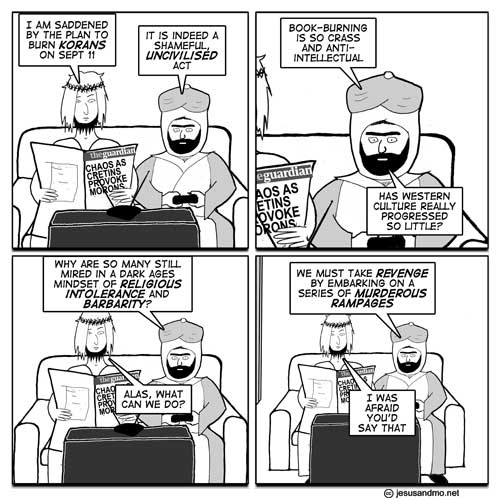
Chaos as cretins provoke morons


Re. the title, you did notice the cover article in the publication Jesus is reading, right? :)

Wednesday, September 8, 2010

Jobs outlook


Ed Stein's commentary:
I’m as perplexed as anyone by the lack of focus among Democrats running for office this election. It starts at the top, with a White House that has been unable to produce a coherent election message. It ought to be easy, especially for as gifted an orator as Obama, but he’s been bizarrely unable to connect with voters this time around. The message should be simple: we have enormous challenges as a nation, but when the going gets tough we Americans have always risen to the occasion, and here’s what we need to do. And then lay out an ambitious agenda and keep hammering it home and criticizing those who stand in the way as the obstructionists they are. But we haven’t heard anything of the sort. Somehow, this administration has never managed to figure out that it’s jobs, stupid; instead it has flitted from one subject to the next, hoping something works, and praying that the economy will respond before it’s too late. It’s too late. Republicans have done absolutely nothing to earn our trust, but given the inability of the Democrats to use their power effectively, the other party is the only alternative, and it looks as though they will gain significantly across the board.

I can't understand how we Americans could possibly consider putting the Republicans back in power - the same Republicans who brought us this mess, have dragged their feet in cleaning it up, and, worst of all, are pushing the same ideas that got us into this disastrous position in the first place. How can we be this dumb?

But I'm not happy with how Barack Obama has let this happen, either. What happened to his oratory? What happened to his leadership? We need a leader, dammit! Congress can't lead. It's a legislative body. We need the executive to lead. The President of the United States has the world's biggest bully pulpit, so why not use it?

Obama has been too busy trying to get along with his political opponents. Well, guess what? That's not working and it's not going to work. As usual, Democrats in general seem to be too timid. Arguing your own position, passionately and forcefully, isn't tyranny (although Fox "News" will always argue that it is, when Democrats do it). And incremental measures aren't going to work here.

For once, Democrats - and particularly Barack Obama - need to be bold. So what if it won't get past the continual Republican filibuster in the Senate? Nothing else will, either. We need Obama to propose bold policies - and then hammer away at them over and over and over again. Use the bully pulpit. Lead this country.

The biggest problem with the upcoming election is that progressives are discouraged and apathetic. We thought we were getting real change, and we got timid little half-measures, instead. OK, so you can't get bold policies through Congress. But you can propose them, and fight like a tiger every step of the way, instead of "compromising" and giving away everything unilaterally, without getting anything at all in return. We got politicians timidly sticking one toe in the water, to judge the political temperature first, instead of plunging in with a roar. Show them,... show us something worth fighting for and we'll vote. (I plan to vote anyway, of course, no matter what, since apathy is not an option.)

It's not just on the economy, either. Yes, jobs are number one. But Democrats need to fire up their base. So let's see real movement on "Don't Ask, Don't Tell." Not just behind the scenes, either. Let's see the President hammer at this, over and over again. Heck, let's see him boldly stand up for gay marriage. And, absolutely, let's see him boldly stand up for America's traditional separation of church and state. No half-measures! Also, one thing Joe Biden can do immediately is to challenge Senate rules in court, since the current filibuster takes away his constitutionally-mandated duty to break ties. Above all else, let's see some boldness!

I'm not the only one who can see this, so why can't the Democratic Party? We had a chance to turn this country around, but that chance has almost slipped through our feeble grasp. Heck, it might be too late already. But bold people won't let that worry stop them. And timidly cowering under our beds certainly won't help!

Pat Robertson's Regent University

Tuesday, September 7, 2010

We haven't learned anything


"Like another Bristol-Levi reunion!" Heh, heh. No kidding!

Tom Toles' commentary:
I guess this is the mood of the electorate this year, as far as I can tell.

-We are fine with the trend of an ever-greater share of the American economy going to the very richest people. We like a tax policy that encourages this trend. We don't feel that power follows wealth and so do not fear any negative consequences from this.

-We oppose any actually workable plans to rationalize the health care system in this country and feel that the long trends of ever-increasing costs for ever-shrinking coverage will fix themselves.

-We prefer more religion in government and schools and less science, and we feel this will lead to good outcomes.

-An opinion that climate science is wrong will make it be wrong.

-Deficits didn't matter before, but now they are all we can think about.

-We blame President Obama for the bad economy, but anything he does about it can only make things worse and make us blame him even more.

-We like Republicans even less than Democrats but plan to elect them in a landslide, and that this will improve things.

Did I miss anything?

Did he miss anything? Yes:

-We think that brown and black people are out to get us real Americans, so you can tell by looking at him that Barack Obama has some evil scheme in mind.

-We're confident that Jesus will return soon and put everything right, so why should we human beings bother about anything past next week?

-We dislike those egghead scientists who think they're so smart, just because they're educated and, you know, knowledgeable about stuff.

-If we really want something to be true, it must be true. I mean, haven't you ever seen Oprah.

The world's first experiment in terraforming


Here's a fascinating article at the BBC about the "world's first experiment in terraforming."

Two hundred years ago, Ascension Island was a barren volcanic edifice.

Today, its peaks are covered by lush tropical "cloud forest".

What happened in the interim is the amazing story of how the architect of evolution, Kew Gardens and the Royal Navy conspired to build a fully functioning, but totally artificial ecosystem.

In 1836, Charles Darwin stopped at Ascension Island, a volcanic "cinder" of an island in the south Atlantic, completely devoid of trees. A few years later, his friend, the botanist Joseph Hooker, also visited the island.

Ascension was a strategic base for the Royal Navy. Originally set up to keep a watchful eye on the exiled emperor Napoleon on nearby St Helena, it was a thriving waystation at the time of Hooker's visit.

However, the big problem that impeded further expansion of this imperial outpost was the supply of fresh water.

Ascension was an arid island, buffeted by dry trade winds from southern Africa. Devoid of trees at the time of Darwin and Hooker's visits, the little rain that did fall quickly evaporated away.

Egged on by Darwin, in 1847 Hooker advised the Royal Navy to set in motion an elaborate plan. With the help of Kew Gardens - where Hooker's father was director - shipments of trees were to be sent to Ascension.

The idea was breathtakingly simple. Trees would capture more rain, reduce evaporation and create rich, loamy soils. The "cinder" would become a garden.

So, beginning in 1850 and continuing year after year, ships started to come. Each deposited a motley assortment of plants from botanical gardens in Europe, South Africa and Argentina.

These weren't invasive species, because there wasn't anything there to invade. But the cloud forest that exists there now is entirely artificial. According to the article, no one is studying it. If that's true, it's really a shame. How does the ecology function when everything has been brought to the island from elsewhere?

How about animal life? How about insects? Is the ecology stable, or still in flux. This seems remarkable to me. Surely, there's a lot we could learn from it. In fact, the article suggests that what we could learn there might be useful in terraforming Mars:

"What it tells us is that we can build a fully functioning ecosystem through a series of chance accidents or trial and error."

In effect, what Darwin, Hooker and the Royal Navy achieved was the world's first experiment in "terra-forming". They created a self-sustaining and self-reproducing ecosystem in order to make Ascension Island more habitable.

[Dr. Dave] Wilkinson thinks that the principles that emerge from that experiment could be used to transform future colonies on Mars. In other words, rather than trying to improve an environment by force, the best approach might be to work with life to help it "find its own way".

Naturally, terraforming Mars would be a lot bigger trick than this, but Ascension Island is worth studying, I'd think. Meanwhile, check out these pictures of Mars (I've copied one of them below). Neat as they are, just imagine them with green vegetation. That would be an enormous project, of course, but we'd have a whole world to gain.

Sunday, September 5, 2010

How do we do it?

Here's an interesting thread at Pharyngula (yeah, me linking to Pharyngula - that will sure bump up their numbers, huh?) where a poster, finding his increased knowledge of evolution threatening his religious faith, asks a couple of apparently serious questions:

  1. I truly don't mean this to be insulting, so please don't take it that way, but what is your motivation to live a moral, upstanding life without the guidance of the rules of God and the Bible? I know you guys do this, but I'm not sure I understand how it works without concrete guidance.
  2. For those of you who were once Christians (I'm guessing there are some), how did you reconcile your atheism/agnosticism with your relationship with your Christian family/friends? How do you tell them? Do you still go to church for the fellowship but just don't pray/participate? Did you lose friends/family in your process of change?

There are hundreds of great replies to this, including one by PZ Myers himself. Here are just a few samples:

1) I would ask why you need god to be a "moral person". The god of the Judeo-Christian bible isn't upstanding and moral at all and neither are his rules. Do you pick and choose which rules you follow? Stoned any adulterers lately? No? Well then, my friend, you're a half-assed Christian.
As far as I can tell, you aren't supposed to pick and choose what rules are the rules that you follow. Why bother practicing a faith if you don't agree with what is taught?
The idea of getting something (eternal paradise) for being good is incredibly immature. Really, it's no different from being good so you get presents from Santa on Xmas.
My morality is based on respect for people-- recognizing that we have a shared humanity and no one should suffer by my hand. Not because I'm going to get anything out of the deal, but because I know suffering and it sucks. Which probably explains why I'm a big ol' lefty, too.

The first question is easy. Why do you think it's okay to work on Sunday, eat shellfish, or wear clothing of mixed fabrics? Why haven't you given away all your wealth, as the new testament clearly says to?
The answer isn't "because that first list is from the old testament, and Jesus didn't *really* mean to give away all your wealth if you want to go to heaven." The answer is that you have your own morality and you simply pick the pieces of the bible that agree with it and ignore those that don't. Or you let your local priest do that. As an atheist I just skip the bit about finding biblical justification for my pre-existing beliefs.
As for the second question, I mostly just didn't. My family wasn't especially religious, but I just avoid discussing religion with those who do attend church. Some of my friends enjoy a good philosophical debate, and I'll discuss religion with them even if they're theists. Others I just don't discuss religion with.
There seems to be this idea that "new atheists" are terribly confrontational, but there's a big difference between being willing to discuss atheism (and making sure that religion doesn't get a strong hold on our schools or government) and preaching atheism at street corners. Atheism doesn't command people to "spread the lack-of-word" or anything like that.

2) I work with a student atheist group, and this is the big issue. Letting go of faith is not a free-fall for many. For many students, the rejection of their belief in god entails a rejection of their entire support system....with very real implications regarding getting help with student loans, means of transportation, etc. It can be a bold move, and in this regard being part of a community of people who have recently made the break seems to provide some comfort and alternative access to "family". Fortunately, this wasn't a problem for me. I was raised in a strongly Catholic household, but have never been a believer. However, my family is even more clannish than it is Catholic, and there is NO EXCOMMUNICATION. When my uncle came out of the closet, most members of my family found it easier to abandon the idea that homosexuality was a sin than to abandon my uncle. My atheism was greeted similary. I mean, they are all praying for me, but I feel no less a part of the fam.

I was raised a Jehovah's Witness, which means that my move away from religion was more traumatic than it is for most people. I don't tell this story to scare anyone--rather, I tell it to show that it can be done successfully, and that even though the cost may be high, it's still worth it. My parents haven't spoken to me much in the last 15 years, and not at all in the last 5. The same goes for one aunt and one uncle. But my sister and I are still tight, and I've become close with much of the rest of my extended family, cousins and aunts and uncles I'd largely lost touch with, and I'd lost touch with them in part because they weren't Witnesses and so my parents didn't have much to do with them.
The first steps out of a fundamentalist world are the most terrifying, because you're leaving a place where you feel completely connected, where you feel harmonious and protected and safe, and you're entering a world that doesn't offer that feeling. The problem is that the feeling of harmoniousness is a lie--you're only in harmony as long as you agree with every dicta, with every interpretation of the group. Step outside that realm, ask questions, and you'll be cut out of it. Fear of being cast out keeps people in line.
The world outside that community is frightening, or it can be, but it's also rewarding in ways that beggar description. Not to get all motivational speaker on you, but you don't grow without challenge, and you won't be challenged in that other environment. You will be challenged in a world which forces you to actually think out why you act in particular ways, that forces you to defend your beliefs rather than simply falling back on truisms. I've been out for 15 years and I'm still sweeping out the cobwebs, and it's gotten to be fun. Take the step. It's worth the cost.

You know that slavery is wrong. That rape is wrong. The bible doesn't say that. Morality comes from empathy as Myers says. Live in accordance with what you value and you will be fine. You know what you value, you don't need religion to know what is right or wrong. And the close questions are never answered by religion anyway.
I am an undercover atheist. My husband is Hindu and is very religious. He thinks it is shameful to not believe in God/the Absolute and thinks that it is a personal failing to not have faith. I keep my mouth shut. He thinks any questioning on my part is intellectualizing and disrepectful. I'd get a divorce but I can't afford it. We are retired and live on a limited income.
I am living inconsistent with my values. It probably will shorten my life. It certainly doesn't help me sleep at night. 

Why be good? It's very simple; I love my children, and I want the best possible world for them. I also love my friends and neighbors, and their children, and (thanks to the infrastructure of the modern world) people across the globe. I want the best possible world for them. No gods required; indeed, the divisiveness of religions is antithetical to my goal of a best possible world.
I do not hide my atheism from my family or friends, but it rarely causes conflict. It has, on occasion, but I am only confrontational about it when someone else makes an indefensible comment first. I have lost the friendship of one couple--oddly enough, not because I became an atheist, but rather because they became born-agains and stopped coming by.

Morality comes from the same place: our desire to participate in society. I wish to benefit from having people around me, helping me out. That means I help them out. Mutual aid will only come from those that trust me, and so I remain as true to them as I can. I do not betray them, so they can trust me, and help me. They do not betray me, so I can trust them, and help them.
That is the foundation of morality.
I would argue that anything that does not come from that foundation is not morality, but law. For instance, we don't kill other people not because there is a law against it, but because it would harm our standing in society. However, the prohibition of same-sex marriage is about law, not morality. Same-sex marriage would not be a betrayal of trust of other members of society. It causes no harm to members of society. Therefore, there's nothing immoral about it.
You can further say, like several here have, that we don't want people to harm us, and so we don't harm them, or that we have empathy, but really all that is just an emotional way to say the same thing: we don't want to betray others, because we like society. We like the things society gives us: stability, comfort, safety, and all the good things we enjoy today.
This is how you can derive morality. It's really quite easy. You can judge an action based on whether or not it betrays trust. (Or, you can just trust your emotions -- they'll usually steer you right.)
Now, when you start assuming morality can only be given, you have to accept that you have no method of judging morality at all. You have to accept the guidelines really are moral. Or, you accept they are moral by fiat, not by any intrinsic rightness. Hell, only three of the Ten Commandments really have any relevance to . . . well, anything. The rest are either orders to love God in one way or another, or the generally good advice of not desiring things you can't have.

This is only a small fraction of the many good answers there. It really is an interesting thread, especially if you're facing a similar situation yourself. I highly recommend it.

One last comment, which I'll post below the fold:

Dr Kendall's Homeopathic Contraception


Check out Dr. Kendall's Homeopathic Contraception, made from 100% pure organic Brazilian rainforest babies:
For the uninitiated, homeopathy works on the principal of like curing like or of like preventing like, as eminent homeologist Crispian Jago explains. A remedy containing babies therefore prevents pregnancy.

Conventional contraceptive pills are full of harmful, unnatural chemicals with side-effects and have a failure rate of up to 8%, which means that for every 100 times you have sex, you will get pregnant eight times. The numbers do not lie. Do you want to take that risk? Dr Kendall's Homeopathic Contraceptive pills are for every woman who cares about her body.

After harvesting, the babies are washed inside and out in spring water to guarantee the purity of the remedy. They are then processed at Kendall Laboratories in our Kendall's Baby Masher (patent pending). The concentrated extracted essence is prepared for you in pills of the finest Saccharum officinarum for your health and well-being.

Note that these contain only the essence of babies. This contraceptive has been diluted enough times that there are no real baby molecules left, only the memory of babies. This, of course, saves on the number of babies needed for processing. Waste not, want not.

Stephen Hawking and the existence of God


This is a followup to yesterday's post. It's a three-minute video by Sean Carroll from the California Institute of Technology that explains, very clearly to a layman audience, what the latest news about Stephen Hawking and the existence of God is all about. It's definitely worth watching.

Saturday, September 4, 2010

Has Stephen Hawking ended the God debate?


Articles like this one by Graham Farmello in the Telegraph (UK) tend to irritate me. (Yeah, I know. What doesn't?) It's not that it's completely wrong, I suppose, but it's just... irritating.

First of all, it's deliberately sensationalist - for good business reasons, no doubt - while also frowning on others doing the exact same thing:

The science-religion relationship, in so far as there is one, continues to be a crowd-pleaser. It seems to be a fundamental law of PR that the God-science debate is a sure-fire source of publicity. Always welcome when one has a book to sell.

Yeah, do tell. And this just happens to be in an article with the title, "Has Stephen Hawking ended the God debate?" Heh, heh.

Here are some other excerpts that really irritated me:

The point is, he says, that our universe followed inevitably from the laws of nature. But, we might ask, where did they come from?

And if we were smart, we might answer, "I don't know." The fact is no one knows. Inventing a god or gods to explain that, without any evidence whatsoever, is just as wrong as making up any other kind of lie. "I don't know" is a perfectly valid answer. Indeed, it's the only valid answer when it's true, as it is in this case.

That's the thing with scientific research. There are always more questions to answer. But when we didn't know what the sun was, it was an error to assume that it must be a god flying a golden chariot across the sky. (But what else could it be, right?) In reality, back then, "I don't know" was the only valid answer. Inventing a supernatural explanation, just because you couldn't prove it false, was not valid then and it's not valid now.

Of course, Farmello just coyly asks the question, right? He doesn't actually say that "God done it." Yeah, that's kind of irritating, too. If he has a point, let's hear what it is.

He now suggests that the search for this particular Holy Grail is over, now that scientists have come up with a type of theory, known as M-theory, that may describe the behaviour of all the fundamental particles and force, and even account for the very birth of the universe. If this theory is backed up by experiment, it might perhaps replace all religious accounts of creation – in Hawking's capacious mind, it already has.

I did mention that this was sensationalist, didn't I? I haven't read Hawking's new book, and I wouldn't be able to judge the validity of his new theory if I had. This is an idea from a theoretical physicist, that's all. If, eventually, it's backed by experimental evidence, it might become mainstream science. But it's far, far from that right now.

And it's clear that Hawking is also being deliberately sensationalist, too. Well, he's trying to sell a book, isn't he? All of this is from "the flurry of publicity preceding his new book, The Grand Design, to be published next week." Gee, I wonder why anyone would want to be provocative at such a time?

But do the rest of us really have to take this seriously? No, not if we're smart.

The science-religion debate has been going on since science was born, centuries ago. Until relatively recently, it seemed to have quietened down, but now Hawking and others have brought it back into the limelight.

Maybe it "quietened down" in Great Britain, but certainly not here in America, not since I was a kid, at least. (This isn't an irritating excerpt, just a bit surprising.)

Science and religion are about fundamentally different things. No religion has ever been rendered obsolete by facts or observations, but this happens to most scientific theories, at least in the long run.

No religion has ever been rendered obsolete by facts or observations? Well, there are plenty of obsolete religions, though I suspect that most of them were "rendered obsolete" by true believers of some other religion killing off their rivals. But it's true that religious believers often seem immune to facts or observations.

However, there are plenty of religious beliefs which have been rendered obsolete by science. Remember Galileo, anyone? In fact, the history of science is one long parade of supernatural explanations being rendered obsolete by science. And you know, not one natural explanation has ever been found to be supernatural, instead. Funny how that's worked out, isn't it?

Furthermore, the fact that scientific theories change as new evidence is discovered is a great strength of science. Yes, Newton's ideas were superseded in some circumstances. That doesn't mean that Newton was wrong, but only that he wasn't completely right in every detail in every circumstance. At the very least, he was far more correct than the thinking - religious or otherwise - before him.

Admittedly, the article makes up for the above sentence by continuing the paragraph in this way:

Science advances over the wreckage of its theories by continually putting theoretical ideas to experimental test; no matter how beautiful a theoretical idea might be, it must be discarded if it is at odds with experiment. Like any other human activity, science has flaws and does not always flow smoothly, but no one can seriously doubt the progress it has made in helping us understand the world and in helping to underpin technology.

Yes, science is a process, a process that gets us closer and closer to the complete truth. Unlike dogma, it changes when it's been shown to be wrong (or, more commonly, just incomplete). That's a strength, not a liability. In science, nothing is ever an absolute truth, such that it can't, potentially, be overturned by subsequent evidence. Maybe the Earth really is flat. I truly doubt it, but I can think of explanations where that would be true. Right now, I disregard them, because there's no evidence backing them up, but it's always possible - if not at all probable - that that could change.

No religion has ever been set out in terms of scientific statements. This is why scientists are able to mock the claims of religions but have never been able to deal a knock-out blow: in the end, a religious believer can always fall back on a faith that does not depend on verification.

But why is this? If religion really was true, why fear verification? The whole point of the scientific method is to determine the truth, no matter what the current consensus might be. No matter who believes what, no matter what scientific authority backs an earlier theory, no matter how long it's been believed, it is always subject to verification. That never ends. Furthermore, science reserves its highest honors and accolades to those "heretics" who successfully overthrow established thought.

Religion is just the reverse. Religion fears verification. Religion depends on dogma that can't be questioned by the faithful. Even when religion tries to adopt science, it's always just pseudoscience. There are certain things that no believer can question, not and remain in the good graces of his church. You see, religion always thinks that it already knows the truth. Therefore, the only "research" allowed is that which will explicitly back up their claims.

Religion isn't "set out in terms of scientific statements" because it doesn't dare to do so. It fears finding out the truth. It's ironic that people who so fervently believe they already know the truth are so terrified of really looking into the subject, isn't it? Shouldn't they be supremely confident that verification would uphold their claims? But in fact, it's just the reverse. They don't dare open their eyes.

Powerful and eloquent though it [The God Delusion] was, religion continues to flourish, and scientists (albeit a minority) continue to go to church, just as Galileo, Newton, Faraday and others have done in the past. I suspect that none of them would have abandoned their respective faiths after reading Dawkins (admittedly, not a scientific statement).

Yes, some scientists are religious believers. Well, scientists are human, too, and they were raised in the same religion-saturated environments as the rest of us. But in fact, far fewer scientists are religious believers than in the population as a whole. In fact, education itself is associated with the loss of religious belief. The more you know, the less you believe in the fairy tales of your youth. And the top levels of science, the Nobel Prize winners, those scientists at the cutting edge of scientific discovery, are even less religious in general than those "scientists" further down the ladder.

And who knows what Galileo, Newton, and Faraday would think today, with modern knowledge. As a matter of fact, many religious believers have abandoned their faith after reading Dawkins and other authors. People willing to look at the evidence, willing to consider logic and reason, do lose their religious faith sometimes. In fact, sometimes priests do the same. It does happen. So I'm not quite willing to just assume that those famous scientists would cling to dogma in today's world.

Religions will survive so long as they steer clear of making statements that can be shown to be factually wrong.

Heh, heh. Now isn't that the truth! In order to survive, religions need to avoid saying anything that can be, you know, checked out. If you're a believer, how does that make you feel? Still think you know the absolute truth? Of course, you don't dare actually research the question. You can believe anything you want, but you don't dare look at it skeptically. You don't dare make any claims at all that can be investigated impartially. Yeah, that really sounds like you know the "truth," alright.

The kind of science done by Stephen Hawking, one of the leading theoretical physicists of modern times, has an almost religious ring to it. He and his colleagues are trying to find the patterns in the basic fabric of reality – the mathematical laws that govern the workings of nature at its finest level. There is plenty of evidence that these laws hold good all the way back to the beginning of time, which is how scientists have put together an extremely detailed and well-tested theory of the Big Bang, the first few minutes of the universe.

This is nothing like religion. It's like Farmello didn't even read what he wrote previously. (You see now why I get irritated by this?) Scientists have used evidence to put together a well-tested theory. How does that have any kind of "religious ring" to it? Religion shies away from evidence and tests as if they were the devil himself.

This has led writers to invest these experiments with a theological significance. The distinguished experimenter Leon Lederman labelled the Higgs particle, being sought at the Collider, as the God Particle, with no good reason except as a hook to promote his book, which he named after it. Yet these experiments will tell us nothing about God.

This whole article uses "God" as a hook to get readers. And it's ostensibly about a book that's also using the same hook. So how is the so-called God Particle, "with no good reason except as a hook to promote his book," surprising in any way?

And no, these experiments will tell us nothing about God, because God doesn't actually exist outside our own imaginations. These experiments will also tell us nothing about Narnia or Hogwarts. Is that at all notable? Despite Lederman's book-selling hook, has any scientist working at the Large Hadron Collider stated - or implied in any way - that their experiments would tell us something about God? I really doubt it.

Einstein, to the frustration of many of his colleagues, was fond of referring to God when he was talking about the laws expressing the fundamental harmonies of the universe. As Dawkins rightly stresses, it is quite clear that Einstein did not think of God as a white-bearded benefactor capable of interfering with the functioning of the universe. Rather, Einstein followed closely the views of the philosopher Spinoza, for whom the concept of God is an expression of the underlying unity of the universe, something so wondrous that it can command a spiritual awe.

OK, you can define "God" as meaning "the underlying unity of the universe," but how many believers will go along with that definition? I can define a cat as a "dog" if I want, but it's not going to be very useful in real life if no one agrees with me.

What the author is describing is atheists, or at best deists, who are trying to avoid offending the overwhelming number of religious believers. So Dirac said that mathematical beauty is "is almost a religion to me." Well, I know people who say that golfing is their religion. Do you think they really mean that? Honestly, this is just ridiculous!

Even religious scientists – and there are still a few – never use the God concept in their scientific work. Perhaps it is time for a moratorium on the use of the concept in popularisations, too? This would avoid mixing up scientific and non-scientific statements and put an end to the consequent confusions.

Confusions? Who's actually confused by this (except for the author of this article)? If you're confused by this sort of thing, you want to be confused. In fact, you're probably desperate to be confused. There's really no other way.

I think it wise for scientists and religious believers to keep out of each other's territory – no good has come out of their engagement and I suspect it never will.

OK, that sounds good to me. Scientists will say nothing about the supernatural realm if religious believers say nothing about this universe, nothing that applies to the real world at all. How do you think that will work?

Because I'll tell you this: if religions make any claims about the real world - any claims about biology, physics, geology, history, sociology, ethics, morality, government or anything else affecting this universe we live in - then those claims can and should be investigated using logic, reason, and, above all, evidence.

You can see why this whole article was irritating, I hope. But I suppose it did what it was supposed to do, get attention (mine, at least).

Evolution in action

(photo by Rebecca A. Pyles)

Of course, evolution is always "in action." But to borrow a phrase, it's normally like a snapshot in time. Still, there are snapshots and there are snapshots. So I thought it was interesting to read two separate articles this morning where evolution is not just ongoing, but obvious.

The first is this fascinating story in the National Geographic about a species of Australian lizard where the evolution of live births, from egg-laying, has been "caught in the act." (Incidentally, the photo above shows pretty clearly the family relationship between lizards and snakes, wouldn't you say?)

Evolution has been caught in the act, according to scientists who are decoding how a species of Australian lizard is abandoning egg-laying in favor of live birth.

Along the warm coastal lowlands of New South Wales, the yellow-bellied three-toed skink lays eggs to reproduce. But individuals of the same species living in the state's higher, colder mountains are almost all giving birth to live young.

This would seem to be a pretty major difference, wouldn't you think?

One of the mysteries of how reptiles switch from eggs to live babies is how the young get their nourishment before birth.

In mammals a highly specialized placenta connects the fetus to the ovary wall, allowing the baby to take up oxygen and nutrients from the mother's blood and pass back waste. (See related pictures of "extreme" animals in the womb.)

In egg-laying species, the embryo gets nourishment from the yolk, but calcium absorbed from the porous shell is also an important nutrient source.

I'll let you read the article if you want to know how this problem is resolved. (Incidentally, you might want to click on that link to see four "extreme" animals in the womb. Neat stuff!)

But the other obvious question is... why?

Both birthing styles come with evolutionary tradeoffs: Eggs are more vulnerable to external threats, such as extreme weather and predators, but internal fetuses can be more taxing for the mother.

For the skinks, moms in balmier climates may opt to conserve their own bodies' resources by depositing eggs on the ground for the final week or so of development. Moms in harsh mountain climates, by contrast, might find that it's more efficient to protect their young by keeping them longer inside their bodies.

Keep in mind that these reptiles aren't making a conscious - or even an unconscious - decision about any of this. There's no planning involved. It's just that skinks in the warm coastal lowlands do better - leave more descendants - when they lay eggs, while those in harsher climates do better giving birth to live young.

This sort of change requires a mutation first, perhaps more than one. (But this change, in reptiles at least, is not as drastic as it might seem at first. Although most reptiles lay eggs, live birth is also pretty common. According to this article, about 20% of reptile species give birth to live young only. And if more than one mutation is required, they don't have to occur at the same time. A prior mutation can already be present in the population, for some other benefit, or perhaps at low level from mere chance.)

But if there's an advantage in live birth, those individuals with the mutation will tend to leave more offspring. In effect, they will out-compete egg-laying skinks, at least in particular environments. These two populations of yellow-bellied three-toed skinks might well be in the process of splitting into separate species.

Another article, at the BBC, describes how orcas - killer whales - are also evolving into two separate populations.

Researchers have discovered that two distinct types of orca, a large and a pygmy form, are rapidly diverging, evolving away from each other.

The scientists' study reveals each type of orca carries a unique gene mutation that benefits its particular lifestyle.

There's a size difference between these two populations, and there's also a difference in food preferences, with the larger orcas feeding mostly on seals and the dwarf orcas feeding mostly on fish. But most notably, each has a specific genetic mutation that appears to govern energy production and metabolism.

Each population has the gene complex that's most suited for its lifestyle. I don't know if there's still interbreeding between them, but given this difference, crosses between the two types would have a poorer success rate (at survival or leaving descendants), which would encourage further separation. Eventually, assuming no other changes, we'd expect to see two entirely separate species (which would continue to follow their own evolutionary paths and might well become quite different indeed).

Neat stuff, isn't it? Of course, if you're a birder, you'll know that spotting evolution in action isn't at all uncommon. Every time a new field guide to the birds is published, it seems like there are a different number of species - sometimes more, sometimes fewer. No, biologists aren't discovering new species this quickly, nor are that many going extinct (not quite this quickly, at least).

What's happening is that it's not always easy to tell when birds are a single species or two. It's not a clear dividing line, and there are many populations which are right on the edge. Well, "species" is a human concept. We like to categorize things. But it's not always so clear in nature.

Many species - of birds, at least (I'm no biologist) - seem to be right on the verge of splitting into two species. Some taxonomists might consider a population one species, maybe just different subspecies, while others argue that they are two separate species. And the consensus tends to change, depending on the current evidence.

Sometimes, birds that are nearly impossible to distinguish in the field (by sight, at least) are fully accepted as being of two separate species. Others, which are quite different in appearance, may be considered just different forms of the same species. It's very, very clear that species do split and evolve separately. Any birdwatcher should be fully aware of that.

Actually, any educated adult should be aware of that. Even if you didn't graduate from high school, this is just very, very basic stuff. Evolution is the foundation of modern biology. You should have learned that in elementary school, in fact, because it really is... elementary. Yet only a minority of Americans apparently "believe in" evolution. Heh, heh. Insane, isn't it? In biology, at least we are easily the most ignorant of all developed countries.

Here's a chart that should make you embarrassed to be an American. The question was whether "human beings, as we know them, developed from earlier species of animals."


Incredible, isn't it? Especially in the 21st Century, more than 150 years since Darwin first published On the Origin of Species? We rank down with Turkey on this issue. Look at the countries at the top of the list. What does that tell you?

This degree of ignorance is just astonishing. Frankly, it would be astonishing in any nation on Earth, let alone in the world's last remaining superpower. What has happened to America? What has happened to us?

Friday, September 3, 2010

Dwarf Fortress: Toraliden

I've been playing Dwarf Fortress lately. No, I don't really have time to be playing computer games right now, but I just couldn't resist any longer. I've been wanting to try the new version since it was first released, just waiting until the major bugs had been worked out. (This is a free game, still in alpha, so the developer relies on his players to find the bugs - and on contributions from his fans to keep the project going.)

I started the game a couple of months ago, but it kept crashing (a problem I'd never had with DF before). So I put it aside for awhile. With the latest version, 0.31.12, that's been fixed. And a couple of rainy days gave me all the excuse I needed to pick it up again. It's been great fun!

If you're not familiar with Dwarf Fortress, it's really kind of hard to describe the appeal of the game. Frankly, the interface stinks, the learning curve is a killer, and the unmodded game uses ASCII graphics! Even with the May Green graphics bundle I'm using, it's an understatement to describe them as "minimal." (I've posted some screenshots below the fold.)

But the gameplay is wonderful! My description won't do it justice, but basically you take a party of dwarves into the wilderness to carve out a home. It's a fortress, because it's a dangerous world. But it's also a trading post, a farmstead, and a center for all sorts of crafts. If you're successful, you'll attract immigrants until you have a thriving community.

And every one of your dwarves is an individual, with an individual appearance, personality, likes and dislikes, mannerisms, and skills (which improve with use). You can give them a task list and assign them responsibilities, but they themselves choose when to do what. They eat when hungry, drink when thirsty, rest when tired, sleep when sleepy, and even socialize when they need a party. They make friends (and grieve when those friends are killed), adopt pets, get married, and raise children.

For the most part, the game is perfectly logical. If you can think of a logical way to do something, you can probably do it. It's wide open. This game doesn't tell you what to do, it lets you make the decisions. And although there are many, many ways to lose, there's no way to win. "Winning" just means that your fortress is still going strong. Dwarves die, they're buried in plain coffins or elaborate tombs, and life goes on. Until it doesn't.

My latest fortress, Toraliden ("Lawpaddles"), has been under construction for just over two game-years now, which isn't long at all. Still, we're up to 60 dwarves (including three babies and two children), having lost two in violent incidents. I didn't originally intend to document our experiences, so I don't have any screenshots of the beginning. But if you're interested, I'll describe what's happened so far below the fold.

Scary news

See the whole cartoon here.

Thursday, September 2, 2010

The enchanted financial forest


It's incredible that we've become so gullible as to believe in fairy tales, isn't it? But that certainly seems to be the case. All too many of us ignore the abundant evidence from recent years and still buy in to right-wing fantasies.

Somehow, it's supposed to be "conservative" to benefit the wealthy, even at the expense of horrendous government debt. Explain that to me, if you can. I really don't get it.

And why, in a democracy, do so many ordinary, non-wealthy people go along with something this insane? (It's easy to see why the wealthy go for it. After all it's always easy to believe what you want to believe.)

I think it might be a yearning for an aristocracy. We Americans love our celebrities, and we seem to yearn for our own royalty. Maybe it's comforting to be the loyal servant of the high and mighty. I've never understood that feeling, but I know it exists, especially in times of stress.

I mean, you can't really believe that cutting taxes on the rich will cause all that wealth to trickle down to the rest of us, can you? Not after the last decade, surely. And it's not as though the super-rich were hurting during the Clinton years - or during the Reagan years, for that matter. Our economy did far better when there was less of an extreme between top and bottom.

I just don't understand it. It all seems so... dumb. I suppose it could be ignorance, rather than stupidity, though. And extreme gullibility. Well, that's why I'm a skeptic. I want evidence for my beliefs. You'd be surprised at how many people don't (or, perhaps, just don't understand what "evidence" really means).

Sufi

Wednesday, September 1, 2010

Penn and Teller on vaccinations

Juggling

The end of combat operations in Iraq

No, the Iraq War isn't completely over. We still have 50,000 troops in the country, for training and support purposes. And they'll still be fighting (and dying). But this is a milestone, nonetheless. And it's a good time to look back, don't you think?

Seven years, billions of dollars (trillions in indirect and delayed costs), and tens of thousands, if not hundreds of thousands, of lives,... all because of right-wing fantasies. Remember, the Iraq War had nothing to do with 9/1l.

Does it make you feel good as an American to know that we invaded a completely innocent country, a nation that had not attacked us and was no threat to us at all? Indeed, Saddam Hussein was the sworn enemy of the religious fanatics who did attack us (and the enemy of Iran, too, I might add).

But I guess if you can't catch the person responsible, you just attack whomever you can catch, huh? Even when it actually benefits our foes?

There were no "weapons of mass destruction." None. And there was no risk of them, because the United Nations was continuing to carry out weapons inspections in Iraq. We could have finished the war in Afghanistan, instead of starting a new war for no reason. Maybe we could have even won it, if we hadn't taken our eye off the ball and given the Taliban time to regroup. But Afghanistan was boring, right? And Iraq had all that lovely, lovely oil...

Of course, you weren't at risk, not at all. It would be someone else dying, not you, someone else's kid, not yours. After all, there's no draft these days, so why worry? Why even care? It would be like... reality TV, entertainment staged for your enjoyment.

And Iraq had lots and lots of oil, so the war was going to pay for itself. (A free war! How could it get better than that?) Yeah, right. Sort of like the promise that cutting taxes for the rich would pay for itself,... in right-wing fantasy land.

The right-wing turned us into our enemies. It was now America that invaded innocent countries. It was now America that tortured prisoners. It was now America that became the world bully, instead of the shining light on the hill. You must be so proud.

Yeah, we were attacked on 9/11, and then we used that tragic incident by a handful of religious extremists as an excuse to do anything the right-wing wanted. Instead of considering it a criminal act - as it was - and getting the world police forces behind us to catch the criminals responsible, we used it as an excuse to start two wars, to give tax cuts to the rich, and to destroy our own economy.

Oops! Destroying our own economy (and nearly destroying our own military) probably wasn't intended, was it? No, it's just that right-wing ideologues tend to be incompetent at real-world decisions. You see, they live in their own fantasy land, where what they really want to be true must be true. They live by faith, not evidence. The war was going to pay for itself. We'd be greeted as liberators. And tax cuts to the rich would trickle down to everyone else.

Seven years later, how does that decision look to you now? And you're going to put the Republicans back in power? Ha! What has happened to us? Have we Americans completely lost our minds?