Friday, April 16, 2010

Why have fire departments?

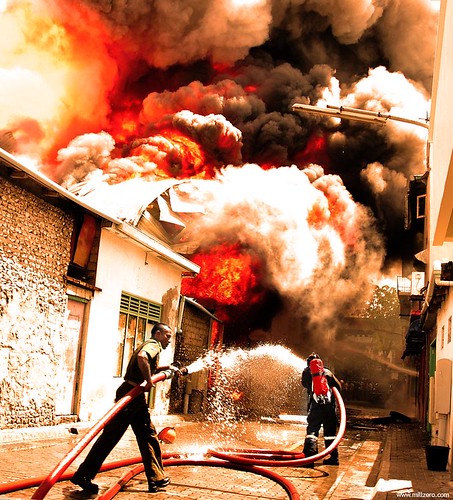
(photo by millzero)

Let's start with this article by Nobel Prize-winning economist Paul Krugman. Shocking, isn't it?

On Tuesday, Mitch McConnell, the Senate minority leader, called for the abolition of municipal fire departments.

Firefighters, he declared, “won’t solve the problems that led to recent fires. They will make them worse.” The existence of fire departments, he went on, “not only allows for taxpayer-funded bailouts of burning buildings; it institutionalizes them.” He concluded, “The way to solve this problem is to let the people who make the mistakes that lead to fires pay for them. We won’t solve this problem until the biggest buildings are allowed to burn.”

Well, why not? Public fire departments are just "socialism," after all. Why should the government get involved? If I own a firetrap, I should just accept the risk that my property might burn to the ground, right?

Of course, that's completely ridiculous. Fire tends to spread. If my house catches fire, my neighbor's house might be the next to go. Even in rural areas that's the case, certainly here in Nebraska, where fires spread literally on the wind. After many devastating fires in large cities, we eventually learned the value of public fire departments, "socialism" or not.

O.K., I fibbed a bit. Mr. McConnell said almost everything I attributed to him, but he was talking about financial reform, not fire reform. In particular, he was objecting not to the existence of fire departments, but to legislation that would give the government the power to seize and restructure failing financial institutions.

But it amounts to the same thing.

Another thing we learned long ago was that bank failures also tend to spread. When one bank collapses, there's a good chance that other banks will also collapse, with bankruptcies spreading from one to another. I was going to say that we learned this in the 1930's, but in fact, we learned that long before then. But it was only in the 1930's that we came up with a solution: the federal regulation of banks, which was combined with a guarantee of deposits.

And it worked great! It completely stopped the periodic cascades of bank failures that had plagued America since our founding. Unfortunately, as the Great Depression faded from our collective consciousness, right-wing ideologues started dismantling those protections that had served us so well. At the same time, financial innovation created new ways to get around the old rules on regulation. Well, we all know what happened then, don't we?

In his speech, Mr. McConnell seemed to be saying that in the future, the U.S. government should just let banks fail. We “must put an end to taxpayer funded bailouts for Wall Street banks.” What’s wrong with that?

The answer is that letting banks fail — as opposed to seizing and restructuring them — is a bad idea for the same reason that it’s a bad idea to stand aside while an urban office building burns. In both cases, the damage has a tendency to spread. In 1930, U.S. officials stood aside as banks failed; the result was the Great Depression. In 2008, they stood aside as Lehman Brothers imploded; within days, credit markets had frozen and we were staring into the economic abyss.

So it’s crucial to avoid disorderly bank collapses, just as it’s crucial to avoid out-of-control urban fires.

Since the 1930s, we’ve had a standard procedure for dealing with failing banks: the Federal Deposit Insurance Corporation has the right to seize a bank that’s on the brink, protecting its depositors while cleaning out the stockholders. In the crisis of 2008, however, it became clear that this procedure wasn’t up to dealing with complex modern financial institutions like Lehman or Citigroup.

So proposed reform legislation gives regulators “resolution authority,” which basically means giving them the ability to deal with the likes of Lehman in much the same way that the F.D.I.C. deals with conventional banks. Who could object to that?

Well, we all know the answer to that, don't we? Since this was proposed by a Democratic president and Democrats in Congress, the "Party of No" must oppose it. It's as simple as that. The good of the country is nothing to them, compared to political advantage.

But how in the world could this tactic work for them? We've just seen the results of the GOP mania for financial deregulation, and bankers are nearly as unpopular as terrorists (more unpopular than Christian terrorists, I suspect). Republicans had always claimed than bank CEO's didn't need regulation, which would just hold them back, because they'd just naturally do the right thing.

Unfortunately, it turned out that the right thing for bank executives - increasing risk in order to maximize their multi-million dollar annual bonuses - was not the right think for the banks, and certainly not for America. When banks collapse, the executives keep all that money they got in previous years. Shareholders lose big, but not bank CEO's. That's one reason why deregulation didn't work. We all saw it, and just recently. So how could anyone argue otherwise?

Now, Mr. McConnell surely isn’t sincere; while pretending to oppose bank bailouts, he’s actually doing the bankers’ bidding. ...

His talking points come straight out of a memo Frank Luntz, the Republican political consultant, circulated in January on how to oppose financial reform. “Frankly,” wrote Mr. Luntz, “the single best way to kill any legislation is to link it to the Big Bank Bailout.” And Mr. McConnell is following those stage directions.

Ah, yes. The "bailout" isn't popular, to say the least. It just didn't seem fair - and it wasn't, not really. It was just necessary. Would you really cut off your nose in order to spite your face? Doubtful. So why would you accept a complete meltdown of our global economy just because a rescue attempt wouldn't be "fair"?

Of course, most people are also very confused about the "bailout." For one thing, this was something undertaken by the Bush administration, not Barack Obama. The TARP program happened before Obama took office. I've got to give them at least some credit for that. They may have wrecked our economy, but they did the right thing in this case,... basically. Yes, it was far from perfect. But it didn't "bail out" the owners of these banks. They lost almost everything. It just kept the business itself as a going concern.

So yes, it benefited some of the bank employees who caused these problems in the first place. And it benefited bond-holders, since they didn't lose on supposedly "safe" investments. But mostly, it benefited us. It benefited all of us, by keeping our economy from crashing further. This is why we're not currently in another Great Depression. Bad as this economy is, it could have been far, far worse.

It’s a truly shameless performance: Mr. McConnell is pretending to stand up for taxpayers against Wall Street while in fact doing just the opposite. In recent weeks, he and other Republican leaders have held meetings with Wall Street executives and lobbyists, in which the G.O.P. and the financial industry have sought to coordinate their political strategy.

And let me assure you, Wall Street isn’t lobbying to prevent future bank bailouts. If anything, it’s trying to ensure that there will be more bailouts. By depriving regulators of the tools they need to seize failing financial firms, financial lobbyists increase the chances that when the next crisis strikes, taxpayers will end up paying a ransom to stockholders and executives as the price of avoiding collapse.

Even more important, however, the financial industry wants to avoid serious regulation; it wants to be left free to engage in the same behavior that created this crisis. It’s worth remembering that between the 1930s and the 1980s, there weren’t any really big financial bailouts, because strong regulation kept most banks out of trouble. It was only with Reagan-era deregulation that big bank disasters re-emerged. In fact, relative to the size of the economy, the taxpayer costs of the savings and loan disaster, which unfolded in the Reagan years, were much higher than anything likely to happen under President Obama.

Wall Street executives have made out like bandits in recent years, and it's not just Bush's (and Reagan's) tax cuts for the rich. Risky behavior pays off for CEO's and other executives who get multi-million dollar bonuses based on short-term profits. They pocket that money when times are good, and they keep it even when they run their corporation into the ground. When the music stops, the rest of us are left in the lurch, while Wall Street executives risk little or nothing.

None of this should be surprising. We don't even have to go all the way back to the 1930's, because we also went through it in the savings and loan disaster, during the Reagan administration (but not between the two eras, when financial regulation was kept intact). The facts aren't even in dispute. It's just that Wall Streeters want to keep this pattern of "I win, you lose" since it's very lucrative for them personally. And Republicans are their guys in the government.

Of course, these days that might not even matter, much. If Democrats propose anything, the Republicans will automatically oppose it. And they'll not just vote against it, in one solid block, but try to prevent a vote from even taking place, using the filibuster for virtually everything these days. Why do we let them get away with this? Well, they're good at confusing ignorant, gullible people - and they've got Fox "News" pushing their lies all the way.

Should we get rid of public fire departments? Of course not! And we shouldn't get rid of government oversight of the financial industry, either - for basically the same reason. When a fire starts, there's a good chance that it will spread. So it's in our interest - all of us - to see that the initial fires are contained, as quickly, as easily, and as cheaply as possible.

Thursday, April 15, 2010

Classic - Classic! - Fox News Takedown

The Danger of Science Denial

More Hilarity from the Jon & Fox Show

The Daily Show With Jon StewartMon - Thurs 11p / 10c
A Farewell to Arms
www.thedailyshow.com
Daily Show Full EpisodesPolitical HumorTea Party

Dumb, gullible, and selfish

(photo* from reddit)

This poll of Tea Party supporters tends to confirm my poor opinion of them. They're angry, yes, but they don't seem to know why they're angry (and when they think they know, their facts are wrong). They claim to want spending cuts, but they don't want anything cut that benefits them. They want tax cuts, but they also want to lower deficits. Basically, they don't want to sacrifice anything, themselves. They just want a magic wand.

Well, these are basically the same people who got us into this mess in the first place. They're the same people who bought into "voodoo economics" - that never-ending tax cuts (mostly for the rich) would just magically balance the budget, that wealthy CEOs would just naturally do the right thing, that even two wars would "pay for themselves,"... somehow. The evidence of the past decade hasn't fazed them a bit, because they don't care about evidence. They just "know."

And there's plenty of racism there, too. It's not always overt, but having a black president has certainly raised the hysteria level among them. There's this suspicion of minorities, that they'll get something for nothing, and especially that a black president will favor "his people" over "real" Americans. It's ugly, it really is.

Tea Party supporters’ fierce animosity toward Washington, and the president in particular, is rooted in deep pessimism about the direction of the country and the conviction that the policies of the Obama administration are disproportionately directed at helping the poor rather than the middle class or the rich.

The overwhelming majority of supporters say Mr. Obama does not share the values most Americans live by and that he does not understand the problems of people like themselves. More than half say the policies of the administration favor the poor, and 25 percent think that the administration favors blacks over whites — compared with 11 percent of the general public.

They are more likely than the general public, and Republicans, to say that too much has been made of the problems facing black people. 

Get that? They're even more racist than Republicans in general! And it seems odd to me that people would want the government to benefit the rich, but not the poor. Why would the rich need our help? Indeed, for eight years we've suffered under an Administration that did favor the rich. And they've made out like bandits. So why are we so concerned with the rich?

The middle class, sure, because most of these people are middle class. It easy to think that you yourself deserve every benefit, isn't it? But under Obama's leadership, the Democrats have focused far more on the middle class than the Republicans ever did. So what gives? I've got to think that this is mostly just bigotry. In Nebraska, "poor" is a code-word among conservatives for "minority" (black and Hispanic, generally).

Most poor people in Nebraska are white, of course, but this is a matter of belief, not evidence. And Republicans from Fox News on down have been very good at pushing these racist myths. When Ronald Reagan talked about welfare queens picking up their checks in Cadillacs, he knew his audience would understand that these were black people, not the widow down the street. And so, too, they push the idea that Obama - that scary black man with a foreign-sounding name - is a socialist, which is laughable on the face of it.

“I just feel he’s getting away from what America is,” said Kathy Mayhugh, 67, a retired medical transcriber in Jacksonville. “He’s a socialist. And to tell you the truth, I think he’s a Muslim and trying to head us in that direction, I don’t care what he says. He’s been in office over a year and can’t find a church to go to. That doesn’t say much for him.” 

Barack Obama is black, so he isn't "one of us." It's easy to get these bigots - especially these elderly bigots - to believe the worst of him, even really laughable claims like this. (And Republicans who know better are, as usual, unethical enough to take advantage of this bigotry.)

But while most Americans blame the Bush administration or Wall Street for the current state of the American economy, the greatest number of Tea Party supporters blame Congress.

They do not want a third party and say they usually or almost always vote Republican. The percentage holding a favorable opinion of former President George W. Bush, at 57 percent, almost exactly matches the percentage in the general public that holds an unfavorable view of him. 

Amazing, isn't it? How could anyone hold a favorable view of George W. Bush these days, after the complete and unmitigated disaster of his two terms in office? Of course, blaming Congress is easy, but they blame Barack Obama (when he didn't take office until our economy had collapsed), so why not Bush? For that matter, the Republicans controlled Congress for 12 years - and through at least half of that time, the GOP controlled all three branches of the federal government. Are our memories really that short?

But note that they "usually or almost always" vote Republican. You see? They are the people who got us into this mess - all of these messes - but they just don't want to blame themselves. Well, that's human nature, isn't it? But if you can't learn from your mistakes, you'll continue to make them. And these Tea Party people are continuing to make the same mistakes that have brought our country to the brink of disaster.

When talking about the Tea Party movement, the largest number of respondents said that the movement’s goal should be reducing the size of government, more than cutting the budget deficit or lowering taxes.

And nearly three-quarters of those who favor smaller government said they would prefer it even if it meant spending on domestic programs would be cut.

But in follow-up interviews, Tea Party supporters said they did not want to cut Medicare or Social Security — the biggest domestic programs, suggesting instead a focus on “waste.” 

Heh, heh. OK, this is funny, but it would be funnier if it weren't so dumb. Every politician since George Washington has focused on cutting waste, because "waste" doesn't have any constituents. Who could be against cutting waste? It's an easy promise to make, because no one will get upset over it. Of course, it's a useless promise, too.

Oh, sure, there's waste in government. There's waste in every large organization - and small ones, too. There's a certain amount of waste in your own household, no matter how hard you work to minimize it. Waste is a fact of life. You can't eliminate all waste, and even if you could, you wouldn't make a dent in the U.S. budget deficit.

No, they want to cut "spending," but then ask about the details. These Tea Party supporters - who tend to be elderly, anyway - don't want to cut Social Security or Medicare, because that benefits them. And you can bet they don't want to cut military spending, either (and really, that's hard to do when they got us into two wars, without an exit strategy and without any means of paying for them).

They want to "cut spending" but only on things that benefit other people. No, even that's probably too rational for them. For the most part, they want to cut imaginary spending. The vast majority of actual spending is sacrosanct. No, just cut "waste." Heh, heh. Oh, and cut taxes and balance the budget, too, while you're at it.

I recently saw a TV interview of this elderly Tea Party activist who was convinced that the Democrats were going to take away her precious Social Security and Medicare. And yes, they were going to ration health care to the elderly, a la those notorious "death panels." She knew this, because... "it's all over talk radio." (Talk radio wouldn't lie to her, would it?) She was adamant that Social Security and Medicare be protected (military spending, too, I'll bet, but they didn't ask her about that).

But she was also determined that government spending (other, unspecified government spending), taxes, and the deficit all be cut. Funny, huh? Well, no, I guess it's just sad. How can people be this dumb? How can they be this gullible (especially when it's the Democrats who brought her Social Security and Medicare and have defended it from Republicans ever since)? And how can they be this selfish, that they push for solutions, but they're not willing to make any sacrifices themselves?

At least this woman was honest:

“That’s a conundrum, isn’t it?” asked Jodine White, 62, of Rocklin, Calif. “I don’t know what to say. Maybe I don’t want smaller government. I guess I want smaller government and my Social Security.” She added, “I didn’t look at it from the perspective of losing things I need. I think I’ve changed my mind.”

* Note that the title of this post doesn't necessarily refer the woman in the photo, since I don't know who she is. I just thought it was an appropriate illustration.

(Edit: I see now that 59% of Tea Partiers have a favorable impression of Glenn Beck! 'Nuff said.)

Wednesday, April 14, 2010

Who to tax? The poor!

The Daily Show With Jon StewartMon - Thurs 11p / 10c
That's Tariffic
www.thedailyshow.com
Daily Show Full EpisodesPolitical HumorTea Party

The really funny thing about this claim that 47% of households pay no taxes is that it's false. They may have paid no federal income taxes last year, in the middle of the worst economic collapse since the Great Depression (and after the Bush administration lowered the lowest tax rate for dividends and capital gains to 0% - yes, that's ZERO - the last few years*).

But taxes? Everyone pays taxes. And even if you restrict it to federal taxes, things actually look a lot differently than what you're hearing on Fox "News." From David Leonhardt:

Income taxes aren’t the only kind of federal taxes that people pay. There are also payroll taxes and capital gains taxes, among others. And, of course, people pay state and local taxes, too.

Even if the discussion is restricted to federal taxes (for which the statistics are better), a vast majority of households end up paying federal taxes. Congressional Budget Office data suggests that, at most, about 10 percent of all households pay no net federal taxes. The number 10 is obviously a lot smaller than 47.

The reason is that poor families generally pay more in payroll taxes than they receive through benefits like the Earned Income Tax Credit. It’s not just poor families for whom the payroll tax is a big deal, either. About three-quarters of all American households pay more in payroll taxes, which go toward Medicare and Social Security, than in income taxes. 

But why are people talking of raising taxes on the rich?

The answer is that tax rates almost certainly have to rise more on the affluent than on other groups. Over the last 30 years, rates have fallen more for the wealthy, and especially the very wealthy, than for any other group. At the same time, their incomes have soared, and the incomes of most workers have grown only moderately faster than inflation.

So a much greater share of income is now concentrated at the top of distribution, while each dollar there is taxed less than it once was.

Thanks to our misguided economic policies, at least since Ronald Reagan, the wealthy have made out like bandits, while the rest of us have been treading water. The wealthy simply have a bigger share of the wealth than they did decades ago. And thanks to tax cuts that overwhelmingly benefited the wealthy, they pay less in taxes now, too.

But this can't be right. Why would Fox "News" and right-wing talk radio personalities constantly harp on this tax issue? It couldn't have anything to do with their own tax brackets, could it? Glenn Beck** made $32 million in the past year. Sarah Palin has made $12 million just since last July, one hundred times what she was making as governor of Alaska. (Is it any wonder that she quit halfway through her first term?) Rush Limbaugh, of course, beat them both with an income of at least $54 million annually.

So why are those radio and television talk show hosts spending so much time arguing that today’s wealthy are unfairly burdened? Well, it’s hard not to notice that the talk show hosts themselves tend to be among the very wealthy.

No doubt, like the rest of us, they don’t particularly enjoy paying taxes. They are happy with the tax cuts they have received lately. They would prefer if other people had to pick up the bill for Medicare, Social Security and the military — people like, say, firefighters, preschool teachers, computer support specialists, farmers, members of the clergy, mail carriers, secretaries and truck drivers. 

It's not too surprising that it's these same wealthy blowhards who are scaring people about estate taxes - archly renamed "death taxes" - either, is it? Very few of the people they're scaring have estates large enough to worry about federal taxes, but people are just too ignorant or too dumb to understand the truth.

* Don't you wish you lived on investment income? Unlike wages, which are always taxed at the full rate, the maximum rate for qualified dividends and long-term capital gains is 15%, and they're currently tax-free for anyone in the 10% and 15% tax brackets. Basically, if you work for a living, you get shafted.

** Of course, Glenn Beck of Fox "News" told Forbes magazine, "I could give a flying crap about the political process,... We're an entertainment company." So he apparently feels that his viewers are entertained when he lies to them. Caveat emptor.

Environmental Economics

Here's something of a primer on environmental economics from Nobel Prize-winning economist Paul Krugman (registration with the New York Times is required, though it's free).

Note that, if you're not rational enough to accept, provisionally (as all science is provisional), the scientific consensus on global warming, you won't get a detailed argument about that here. Krugman generally assumes that his readers are intelligent and rational. If you are, it's a very interesting read. If you're not, don't bother.

It's really too long - and too good - to summarize here, since he so clearly explains what he means, and why. I simply couldn't do it justice. So I'll just point out a couple of things that struck me, for one reason or another. But I urge you to read the original article. It's worth it!

Krugman starts off explaining why intervention in the free market is necessary in the first place, and what we've tried in the past (if we don't learn from history, what's the point?). He looks at Pigovian taxes, cap-and-trade, and direct restrictions on pollution. And he uses acid rain as an example:

In any case, experience suggests that market-based emission controls work. Our recent history with acid rain shows as much. The Clean Air Act of 1990 introduced a cap-and-trade system in which power plants could buy and sell the right to emit sulfur dioxide, leaving it up to individual companies to manage their own business within the new limits. Sure enough, over time sulfur-dioxide emissions from power plants were cut almost in half, at a much lower cost than even optimists expected; electricity prices fell instead of rising. Acid rain did not disappear as a problem, but it was significantly mitigated.

I remember that, maybe because I was in the electrical utility business at the time. I remember hearing the terrible predictions from right-wing politicians and industry at how expensive this would be. But in fact, it was cheaper than even proponents had predicted. The horror stories were just scare tactics, and the cost of pollution permits dropped like a rock.

That's a good lesson for today. Political opponents will always exaggerate the effects of regulations like this, and so will the affected industry. It's pretty much a natural law. And when you create incentives for developing clever technological solutions to problems, that's what you'll get - and generally at a lot cheaper cost than you expected.

What you hear from conservative opponents of a climate-change policy, however, is that any attempt to limit emissions would be economically devastating. The Heritage Foundation, for one, responded to Budget Office estimates on Waxman-Markey with a broadside titled, “C.B.O. Grossly Underestimates Costs of Cap and Trade.” The real effects, the foundation said, would be ruinous for families and job creation.

This reaction — this extreme pessimism about the economy’s ability to live with cap and trade — is very much at odds with typical conservative rhetoric. After all, modern conservatives express a deep, almost mystical confidence in the effectiveness of market incentives — Ronald Reagan liked to talk about the “magic of the marketplace.” They believe that the capitalist system can deal with all kinds of limitations, that technology, say, can easily overcome any constraints on growth posed by limited reserves of oil or other natural resources. And yet now they submit that this same private sector is utterly incapable of coping with a limit on overall emissions,..

Clearly, conservatives abandon all faith in the ability of markets to cope with climate-change policy because they don’t want government intervention. Their stated pessimism about the cost of climate policy is essentially a political ploy rather than a reasoned economic judgment. The giveaway is the strong tendency of conservative opponents of cap and trade to argue in bad faith.

This is the equivalent of "death panels" and "government takeover" in the debate over health care reform. Opponents were claiming what they themselves knew was false. They were lying just to "win," politically. It's the same thing with climate change policy.

Here's another point that's long struck me as significant in this discussion:

Finally and most important is the matter of uncertainty. We’re uncertain about the magnitude of climate change, which is inevitable, because we’re talking about reaching levels of carbon dioxide in the atmosphere not seen in millions of years. The recent doubling of many modelers’ predictions for 2100 is itself an illustration of the scope of that uncertainty; who knows what revisions may occur in the years ahead. Beyond that, nobody really knows how much damage would result from temperature rises of the kind now considered likely.

You might think that this uncertainty weakens the case for action, but it actually strengthens it. As Harvard’s Martin Weitzman has argued in several influential papers, if there is a significant chance of utter catastrophe, that chance — rather than what is most likely to happen — should dominate cost-benefit calculations. And utter catastrophe does look like a realistic possibility, even if it is not the most likely outcome.

I hear conservatives claim that we shouldn't do anything because we don't know for certain, beyond a shadow of a doubt, that man-made climate change will be a disaster, or is even happening at all. But tell me something: In what universe is that "conservative"?

To my mind, the real conservative position is that we shouldn't be pumping carbon dioxide and other greenhouse gasses into the air - actually changing the composition of our only planet's atmosphere - unless we know for certain that it won't be a problem. How isn't that conservative? And how could that possibly not make sense?

I've hardly even mentioned the real meat of this article, the clear explanation of environmental economics, and the carefully reasoned and argued discussion of our options. It really is worth a read - and thoughtful consideration, too.

Tuesday, April 13, 2010

The 1954 GOP


Joe McCarthy was a Republican, but so was Joseph N. Welch. Where are the Republicans these days who'll stand up to the lunatics in their party? Of course, there have always been far-right extremists in the GOP, but they've generally been on the fringe. These days, they are the GOP.

And these days, Joe McCarthy would have a lucrative career on Fox "News." And Joseph N. Welch would probably pay for his decency and his bravery.

Incidentally, if you're wondering about the National Lawyers Guild, that McCarthy claimed was a Communist front organization, it still exists. According to Wikipedia, it was founded in 1937 in protest of the American Bar Association's refusal to allow blacks and Jews to join. Very un-American, huh?

Monday, April 12, 2010

The Conservative Misinformation Feedback Loop

This is an interesting post by Jonathan Chait in The New Republic. It's actually a follow-up to his previous post on a "perfect case study of the broader phenomena of right-wing media creating a closed information circuit, in which even claims that are demonstrably false questions of fact can circulate unchallenged."

The false claim, in this case, is that the financing is phony in the health care reform bill because it doesn't take into account physician pay increases (the so-called "doc fix").

Let me first explain the underlying issue. It's not very complicated. In 1997, Congress tinkered with the formula for reimbursing doctors who treat Medicare patients. Congress bungled the formula, accidentally creating a massive cut. Congress takes back the cut on a year-by-year basis, a ritual known as the "doc fix." But technically, the cut remains on the books for future years. In other words, there are hidden costs in the budget.

Numerous conservatives, led by [Paul] Ryan, have tried to claim that the cost of the doc fix is a hidden cost of the Affordable Care Act. Obama's numbers aren't real, they say, because they don't account for the money needed for future doc fixes. Of course, fixing this problem isn't part of the Affordable Care Act at all. It's a cost that would have occurred whether or not the Affordable Care Act was passed. Indeed, Ryan's own health care plan, as well as the main House Republican plan, did nothing to address the doc fix. The Affordable Care Act simply did not use imaginary physician reimbursement cuts to pay for coverage expansions. I've pointed this out numerous times, most recently in the item mentioned above.

So what kind of reply does Chait get to his first post? The answer from the right is a deliberate falsehood, removing four words from a report by the Congressional Budget Office that prove Chait's point!

Did you catch that? [Jeffrey H.] Anderson used ellipses to remove the part of the quote that disproves his entire claim. He removed the part that says "other than physicians' services," and then wrote, "That's the physician pay cut." But it's not the physician pay cut. The physician pay cut is simply not part of the financing of this law. By the way, I'm not merely going off my own interpretation on this. I checked this with Paul Van de Water, a budget expert with years of analytical experience at the Congressional Budget Office and other places. He's the one who tracked down the Reid letter for me.

Van de Water was astonished at the brazenness of the tactic used by Anderson, or whoever is feeding misinformation to Anderson. I wasn't. Real budget wonks who circulate among genuine experts often fail to understand the degree to which the public debate is driven by pure hacks. I'm not picking on some marginal figure here. Anderson has been writing about health care for nearly all the major conservative publications. Very few conservatives follow health care reform in any detail. They have a general hostility to government and proposals formulated by Democrats, and since they reject the overwhelming majority of actual health care experts on ideological grounds, they have relied on a tiny handful of self-styled conservative pseudo-wonks to fill in the details for them.

But figures like Anderson are simply not up to the job. And once some factual misapprehension has made its way into the right-wing echo chamber, it's nearly impossible to dislodge. The same basic phenomenon can be seen is debates over climate change, supply-side economics, and other issues. You have a whole ideological movement that, to a substantial degree, relies upon the pseudo-expertise of cranks and hacks.

Unfortunately, that whole ideological movement is operated by people who don't care that they're lying. In their eyes, the question is not "Is this true?" but "Will this claim work politically?" Let's face it, no one ever thought that "death panels" were in the bill, either. So what? The right-wing is perfectly willing to lie. In fact, it almost seems to me that they prefer lying.

Treason?

I was reading a comment at FiveThirtyEight.com and it struck me as being worth a separate post. Unfortunately, I don't know the real name of filistro (and a search didn't help), but this is what he said:

Just saw a clip from Michael Steele at the SRLC, saying nobody should be focused on him... they should all concentrate on stopping the Democrats and their un-American agenda.

Un-American agenda.

Why do they keep saying stuff like that? It fills me with cold, bitter rage... and I'm a nice person.

Policy differences, scandals, arguments about taxation and war, unfunded mandates and hypocrisy... all completely valid in the national debate. Necessary, even. But why must Republicans constantly accuse their opponents of TREASON?

The more these people appear in the media and spout their hateful garbage, the more they seal their doom as a viable political party.

This sort of thing fills me with rage, too, and I'm not so convinced it won't work for them. After all, this has been standard policy in the GOP, at least since Barack Obama started campaigning for the presidency. It's not enough that you simply disagree with Democrats? They actually have to be traitors?  Like Joseph Welch, I want to ask, "Have you no sense of decency, sir? At long last, have you left no sense  of decency?"

Un-American, anti-American, Nazi, socialist, fascist, Communist, terrorist, appeaser, traitor,... and remember the old lady during the campaign who was terrified that Obama was an Arab? It's really not funny. According to Glenn Beck, President Obama - whose mother was white - "hates white people." According to Sarah Palin, he wants to kill grandma. This is only a small sample of the invective regularly tossed around by Republicans. And have you heard the tea-baggers?

Democrats don't do this, not to this extent - and certainly not Democratic leaders. Many of us thought that George W. Bush was as dumb as a post and the worst president in U.S. history, but we never claimed that he meant to destroy America. He was just wrong. A lot of people came to hate the Bush administration, but we all gave him a chance when he was first elected. (There was an Impeach Obama group on Facebook months before he even took office.) And Democratic leaders were respectful of the office, at least. You didn't hear "You lie!" and "baby-killer" shouted in Congress.

But the really crazy thing about all this is that Republicans completely ignore secessionist statements, and threats of armed conflict, on the right. The Palins were involved with a secessionist group in Alaska, but that hasn't mattered to Sarah Palin's fans at all. Texas Governor Rick Perry has spoken favorably of seceding from the Union, too, and I've seen it on signs at Tea Party rallies. How is seceding from America supposed to be patriotic?

This sort of thing angered me in the Bush years, when the president opined that atheists might not be citizens and certainly weren't patriotic. I'm both, at least as much as any Republican, and at least as much as any Christian. And although it's hard to believe sometimes, I understand that the far-right is also trying to do what they think is right. They're wrong - horribly, dangerously, embarrassingly wrong - but they're not traitors.

Unless, of course, they support secession. That really is un-American.

Life After Death


PZ Myers on life after death:

When we die, there is no paradise, no hell, not even a grim gray afterlife of darkness and regret…we are just gone. Everyone who has ever lived has or will simply end, and become nonexistent.

Well, not entirely, as I'm sure Myers would agree. Some of us live on, biologically, in our children. And all of us live on in the memories of our friends and relatives and in the effect we had on the world, and everyone else in it, for good or ill (and we all have both kinds of effects, to some extent).

But here is his reply to the inevitable question from believers:

One answer is that a lie is not reassuring at all — telling me that I'll get to go to heaven when I die is about as believable as telling me that I'll be rewarded with beer volcanoes and strippers for my irreverence. I'd rather be honest and aware then deluded and oblivious.

Another answer is that we are alive right now — I simply do not worry about what will happen after I'm dead. Life is for the living of it, it's wasteful to spend it fretting over what you'll do when it's gone. One reasonable response to mortality is to enjoy life now.

We do have hope for the future, too. Think for a moment about your community a century from now. Does it make you feel good to think that there will still be people living there then? That they will be talking about things that you find interesting, that they will be doing activities you also enjoy? Do you hope that life will be better for them? Even though we will be gone, we can still aspire to perpetuate our culture, and find satisfaction while we are alive in advancing that cause.

The hardest explanation for theists to grasp, though, is the understanding that none of us have ever had this unlikely clot of vapor called a soul. If the soul is an imaginary fantasy, then Mozart's music, Michaelangelo's sculptures, Picasso's paintings, the Wright brothers' plane, every work of art and technology produced by people whose names have been lost to us, every child, every dream, has been created by us, mere mortal flesh unled by a magic puppeteer in the sky, unaided by angels or spirits. I find that wonderful.

That's similar to my own short post two days ago, isn't it?

Were you sad to discover that Santa Claus and the Easter Bunny don't really exist? Perhaps. But would you rather still believe in them, just for comfort's sake? Or do you think that adults should face the world as it really is, taking comfort from the truth instead of from pleasant lies?

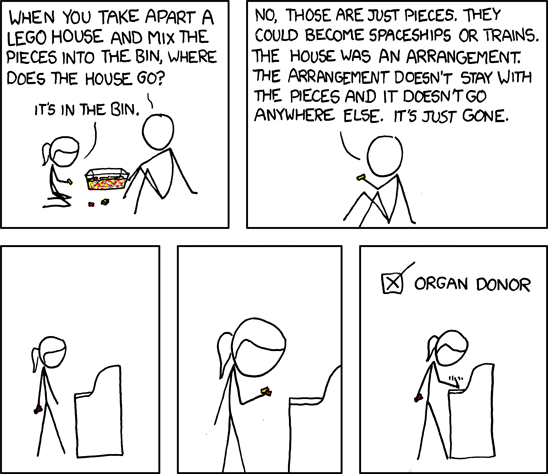
And regarding the comic, yes, I've signed up to be an organ donor. More than that, I donate blood every two months. So far, I've donated more than 17 gallons. It feels good to know that I've helped people live longer or have better lives now, and I don't need any supernatural threats or rewards to make me do the right thing.

Tina Fey does it again

Tea-Party Tree

(Photo by Glyn Baker; licensed for reuse under this Creative Commons License.)

Yes, it's the Caucasian Wingnut (really). I just assume it must be the official tree of the Tea-Party movement.

Sunday, April 11, 2010

Content-Aware Photoshop


A sneak peak at the new Photoshop. Amazing, isn't it? Actually, there are a lot of YouTube videos about using Photoshop. We've long since passed the point where we could trust photos as evidence, haven't we?

The FarmVille Diaries


 FarmVille, the Facebook game, is getting a lot of notice lately (see my previous posts here and here). Well, 85 million players do attract considerable attention. I'm not on Facebook, and I haven't played the game, but here's an interesting article about it: The FarmVille Diaries, "a bleak and chilling record of one woman's spiralling descent into FarmVille addiction." (As you'll see, that's very tongue-in-cheek. It's actually a funny, and rather clever, article.)

FarmVille really doesn't seem like much of a game, and Ellie Gibson agrees, at least at first. But the key is that it's a Facebook game.


So far I haven't been too impressed by FarmVille. It just seems like a Facebook version of a lot of games I've played before. But today I realised I've been missing the point - the key word there is "Facebook".

Sounds stupid I know, but until now I didn't bother checking how many of my Facebook friends might be playing the game. Turns out there are around a dozen. Now I understand that interacting with them and their farms is key to the success of your own. For example, fertilising someone's crops earns you extra XP. Feeding their chickens might get you an egg containing your very own birdie. 

And I suspect that the simplicity of the game helps attract people who have never played a computer game before.

Having Neighbours is like having a Friends list within FarmVille. You need a certain number of them to get access to certain items. Even after I'd sent Neighbour requests to all the FarmVille players, I still didn't have enough to qualify for a Dairy Farm.

I asked my friend Kim, who doesn't currently play, to join the game. She was reluctant but agreed after I explained it'll only take a few minutes to sign up, and she doesn't have to keep playing the game once she's accepted my Neighbour invitation. ...

I have become a drug pusher. 

Like Facebook itself, this is all about social networking.

With games like Harvest Moon, no one cares how your farm's doing except you. You might tell everyone in the pub you've got all the gold medals in Farm Frenzy, but they won't care. I know from experience that most people in the pub won't care how many yellow ribbons you've got in FarmVille either, but one or two might, and then you can talk to them about it until everyone else threatens to switch tables.

The social networking aspect takes the reward mechanic which makes farming games so satisfying and throws in the ability to show off. You get the same feeling of power and control as with a real-time strategy game, but everyone can see how you wield that power, and instead of launching air strikes you get to breed pink cows. ...

Then there are the clever tricks Zynga has built into the game. The brilliantly designed mechanics which don't just keep you playing, but get you to get other people to keep playing. I've got Kim, Miriam and Johnny to either start playing FarmVille or go back to playing on a regular basis. If each of those people got three people to play, and each of those people got three people to play, and each of those people... Well, you'd be at 85 million in no time.

Gamers like to talk about computer games, but few people want to listen, except for other gamers. And if your friends are playing a game, you're more likely to play it, too. FarmVille really doesn't sound like much of a game, not compared to the games I enjoy. But it takes advantage of clever psychological tricks on a social networking site, and now it's the new model for commercial success.

Defense Spending

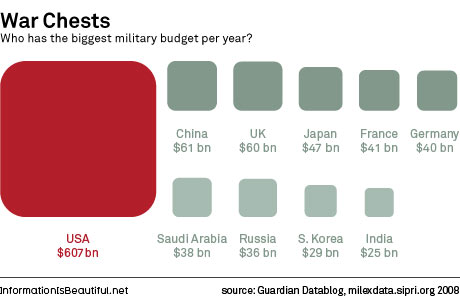
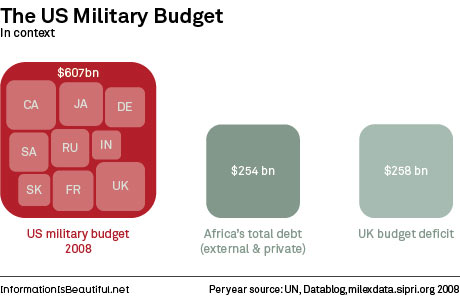
This page at The Guardian (London) has some interesting graphics about defense spending. Of course we all know that America spends more on defense than any other country in the world, but how does that appear graphically? (Note: all these graphics are by David McCandless.)


To put this in perspective, the U.S. spends more on defense than the next nine biggest defense spending countries:


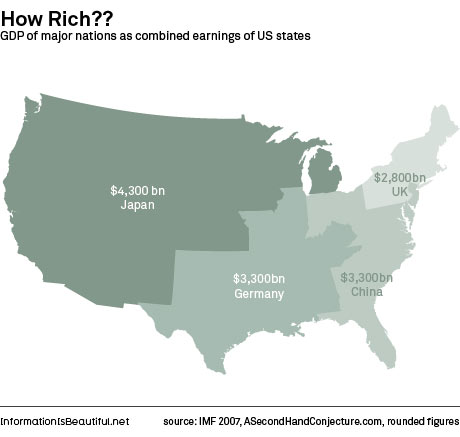
But we're a very rich country. How rich? Well, our gross domestic product in 2007 was roughly equal to the GDP of Japan, China, Germany, and Great Britain combined.


Using 2008 figures (the latest I can find), that's no longer quite true, apparently, since China has continued to grow so very strongly. But our GDP is still equal to that of the next three biggest economies, plus more than half of the United Kingdom's.

There are a few more defense spending graphics at that Guardian datablog, too. I don't know about you, but I find this easier to grasp than looking at the raw numbers.

Saturday, April 10, 2010

Calamities of Nature

Second half below the fold:

Think about it

If we human beings have really been designed and guided by an omniscient, omnipotent, and benevolent god, who created the whole universe specifically for our benefit - and then, when we screwed up, who zapped his son/himself down to Earth to teach us the right direction again - then we've done pretty darn poorly, I'd say. All that help and this is the best we can do? How embarrassing!

But if we evolved naturally, just one of the species of primates on a nondescript planet in an uncaring universe, who's had to struggle for every tiny advance in knowledge, all by ourselves, learning everything the hard way,... well, we're not doing all that badly then, are we? Some of us are even admirable.


It's a slow, hard climb, but it's all our doing. We should be proud of what we've accomplished, so far.


(Edit: And it's actually rather empowering.)

Fruit

After the long, cold winter, it's really warmed up. And I've been swamped lately with getting my fruit trees pruned and the branches trained. I've really had a lot to discuss in this blog, but I simply haven't had much time.

For the record, I'm growing apples, pears (Asian and European), peaches, nectarines, apricots, pluots, plums, cherries, strawberries, black raspberries, mulberries, grapes, gooseberries, currants (white, red, pink, and clove currants), and... rhubarb (not a fruit of course, but it makes great pie) - all in my backyard. Heh, heh. I try to keep everything small, but it's still really crowded - one reason why it's so much work.

Right now, my apricot trees are in full bloom. They really look great, and maybe I'll actually get some apricots this year, for a change. Apricots bloom as soon as it warms up, and in Nebraska they're almost always hit by a hard freeze afterward. The flowers aren't too hardy, either. Last year, the temperature dropped to 23 degrees (officially, at the airport) just one night in April, but that killed every apricot flower. I had plums and pluots blooming at the same time, but it didn't seem to faze them.

If you're wondering, pluots are a cross between apricots and plums developed in California. I wasn't sure they'd grow here, but they really seem to like Nebraska. My biggest problem is trying to keep the trees small. I've got three different varieties and just got fruit for the first time last year. Well, all of this is pretty new to me. I've had raspberries for some years (believe it or not, the birds planted them - my two long rows spread from just a single plant), and some of the grapes for about five, but everything else is younger than that.

I've struggled to keep some room for a garden, too - reluctantly, since there are other kinds of fruit I'd like to plant. I really love blueberries, for example, but they'd be a lot of work here in Nebraska (they need acid soil and regular watering). I'm always tempted, but so far I've resisted. I'd like to try a fig, too (I ate fresh figs many years ago in Greece - a fond memory), but that would be even more work.

Ah, probably not. I've got more than enough here to keep me busy (frankly, I had more than enough to keep me busy even without this blog). And I've got to keep some room for tomatoes (hmm,... technically, that's another fruit, isn't it?)

Friday, April 9, 2010

Jon Stewart Nukes Fox

The Daily Show With Jon StewartMon - Thurs 11p / 10c
The Big Bang Treaty
www.thedailyshow.com
Daily Show Full EpisodesPolitical HumorTea Party

Jon Stewart just gets better and better. Note about halfway through this seven minute clip when he demonstrates the "purposeful idiocy" of Newt Gingrich and Sean Hannity on Fox News.

Oh, and note the mushroom cloud graphic on Fox, too. That's a nice touch, isn't it? I don't think we've seen that since they pushed us into attacking Iraq, an innocent - but oil-rich - country that 1) had never attacked America, and 2) was no threat to us whatsoever.

(Time Life Pictures via National Geographic)