Monday, May 17, 2010

Hottest year on record

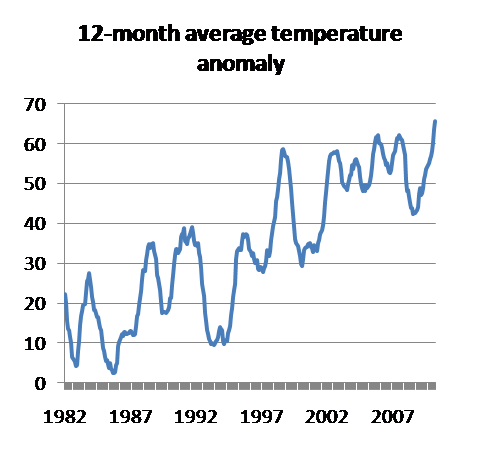
I got this graph from Paul Krugman's blog. I thought it was interesting for a couple of reasons. (The vertical scale is the difference, in hundredths of a degree centigrade, from the average global temperature from 1951-1980.)

Here's the raw data, which shows April, 2010, to be the hottest April on record, and the previous 12 months to be the hottest year on record. (Yes, we had a long, cold winter here in Nebraska, but this graph is showing global temperatures.) This previous decade was also the hottest on record.

And we're in the deepest solar minimum in nearly a century. You've heard global warming deniers claim that sunspots are the main reason for global warming? Well, if that's really true (it isn't - climatologists have already taken that into account), then we're really in for a world of hurt, because we're setting records even while sunspots have virtually disappeared.

So what about that canard, so popular with global warming deniers, that the Earth hasn't warmed at all in the past ten years? Take another look at that graph. Even global temperatures bounce around a lot. The recent trend is unmistakable, but if you cherry pick your positions - like starting from 1998, at that temporary high point on the graph - you could claim that temperatures have not gone up for a decade. Well, you could if you didn't mind lying through your teeth.

Yes, that's the kind of thing that global warming deniers do. Now tell yourself if that's really the side of the debate you want to be associated with, the side with people willing to use cheap tricks like that (since they don't have the evidence on their side). And if that doesn't bother you, how about the current witch hunt undertaken by right-wing politicians? They can't counter the science, so they simply try to persecute scientists. Shades of Galileo, huh? Does that make you proud?

As I've said before, I'm not a climatologist myself. So as a layman, the only rational move for me, in a scientific issue such as this, is to accept - tentatively, as all science is tentative - the consensus of the experts in this particular field. It is not rational to go with my gut, or some politician's or TV personality's gut, or someone's wishful thinking, or the latest conspiracy theory, always popular with lunatics, or even some minority view among scientists.

No, none of those things would be rational. They would not be smart. If I did that, if you did that, it would just be picking sides based on whatever you wanted to be true. That's not trying to determine the truth, it's just wishful thinking.

The consensus of scientists, those scientists who are specialists in this particular field, may be in error, but that's certainly not the way to bet. The consensus of climatologists is far more likely to be correct than the opinion of anyone else. There's no guarantee, of course. There's no such thing as "proof" in science, and no one is infallible. But if new evidence shows otherwise, the consensus will change quickly enough - far more quickly than any right-wing politician will ever change his mind, I assure you.

Total Earth Heat Content [anomaly] from 1950 (Murphy et al. 2009). Ocean data taken from Domingues et al 2008.

While I'm on the subject, here's another graph, from Climate Progress, showing where most of the heating is going, just as predicted. And so we're getting corals dying, due to higher ocean temperatures and more acidic ocean chemistry (because of increased carbon dioxide dissolved into the sea).

We are changing the composition of our atmosphere! We are changing the chemistry of our oceans! We are tinkering with critical parts of our only planet, without knowing for sure that it won't cause complete disaster. And Republican politicians call themselves "conservative"? I just don't get it.

Will any of this stop the global warming deniers? Of course not! After all, 150 years of evidence, every bit of it confirming evolution, hasn't stopped creationists. These people believe what they want to believe and that's that. But where are all the rational people? Are we really that outnumbered? Or are we just too apathetic to care?

Clarity

Sunday, May 16, 2010

We are turning into our enemies


I think Pogo was right. As far as I can tell, we are actually turning into our enemies - even those enemies we had thought vanquished long ago. Really.

I first noticed this during the Bush administration. Attacked by religious fanatics, we should have emphasized our proud heritage as a secular nation with a strict separation between church and state. It was impossible for us to be at war with Islam because our Constitution guarantees complete freedom of religion and mandates that America remain neutral in religious issues. As the Treaty of Tripoli confirmed, America was not, in any sense, founded on the Christian religion. On the contrary, we are a secular nation of people with all manner of religious beliefs - and non-belief, too. We should have fought religious fanaticism with traditional American principles.

But it turned out that our own government was actually controlled by religious fanatics (or by cynical politicians willing to use the religion card). It might have been ignorance when they used the word "crusade" (incompetence is always a very believable excuse for the GOP), but the deliberate pairing of Christianity and patriotism was no accident. After 9/11, George W. Bush seemed to think that he was president of the Christian States of America, not the United States of America. Before my eyes, we were turning into our enemies.

Then we started torturing prisoners of war. Hey, I grew up on World War II movies, so I was outraged. The Gestapo tortured prisoners, not us. The Kempeitai tortured prisoners; we did not. We had our American standards. Torture was beneath us. It was a coward's game, not ours. How could this happen? Why didn't all of America erupt in protest? After all, for at least a hundred years, we'd considered water-boarding to be a war crime.

Not anymore. We'd become our enemies. After all the sacrifices of World War II, the hundreds of thousands of our soldiers bravely dying to defend our way of life, we ended up surrendering after all - surrendering to the Nazis and to Imperial Japan in the first decade of the 21st Century. We abandoned our way of life and became just like them. We became timid little cowards, willing to give up everything America stands for, just because some demagogue told us it would help keep us safe (and not even from a terrible foe, but only from a ragtag band of petty terrorists, too weak to pose any real threat to our country).

That's not all. We were even willing to abandon the rule of law. No habeas corpus, no trials, no charges even, just the whim of our government was enough now. All because we'd become such timid little cowards. And although we'd always been proud of civilian rule in America - no caudillos for us - now we had a chickenhawk of a president prancing around in a flight suit. Everywhere, we kept hearing that he was the "Commander-in-Chief" - as if that was more important than being President.

Again, we'd become our enemies. How many authoritarian leaders - all dressed up in military garb - have we faced with our civilian presidents? America was founded with the military specifically subordinate to civilian powers. Commander-in-chief is only one of the president's duties, and besides, he is not the commander-in-chief of civilians. This militaristic posturing (by a president who used family connections to stay well away from danger when he actually could have served his country in wartime) is just not American.

And again, this change wasn't even during a period of real danger. It was nothing like World War II, which we met bravely and honestly. No, this was a handful of petty criminals who scared us enough that we were willing to invade an innocent country and kill tens of thousands of people for no real reason at all. We were that easily scared by loony right-wing ideologues. It was shameful!

But if John McCain has his way, it will get even worse. Take a look at S.3081, the Enemy Belligerent, Interrogation, Detention, and Prosecution Act of 2010:

Requires an individual who is suspected of engaging in hostilities against the United States or its coalition partners through an act of terrorism and who may be an unprivileged enemy belligerent to be placed in military custody for purposes of initial interrogation and determination of status. ... Authorizes the President to establish an interagency team composed of executive branch personnel with expertise in national security, terrorism, intelligence, interrogation, or law enforcement to interrogate an individual placed in military custody and to determine if such individual is an unprivileged enemy belligerent. ... Directs the high-value detainee interrogation group to conduct interrogations of such individuals... Prohibits the use of Department of Justice (DOJ) appropriated funds to prosecute an unprivileged enemy belligerent in an Article III court. Allows the detention of an unprivileged enemy belligerent without criminal charges or trial for the duration of hostilities against the United States or its coalition partners in which the individual has engaged or which the individual has purposely and materially supported. [My emphasis, throughout.]

That's just the summary. This bill would let the military arrest anyone - U.S. citizen or not - who is even suspected of terrorist associations and keep them indefinitely, without a trial. No habeas corpus. No Miranda rights (which are specifically waived in this bill). And who decides if you are one of these "unprivileged enemy belligerents"? The president's appointees (if they disagree, then just the president himself). Yup, McCain is trying to give away all of your rights as an American citizen.

Welcome to the Soviet Union! If this bill passes, don't upset the government, whatever you do, because then you could just disappear into some gulag... forever. After all, you can be held "for the duration of hostilities," and this is the so-called "War on Terror." There is no enemy government to surrender to us, so there's no way for the war to ever end, as long as our own government says that hostilities are still ongoing. And really,... terrorism? I doubt if there's ever been a time in the history of our species where we haven't had some terrorism. Think of it: a never-ending war authorizing never-ending emergency powers. Authoritarians must be peeing themselves in delight.

The Republicans have already turned us into the Taliban, Nazi Germany, Imperial Japan, Libya, and assorted South American dictatorships. Now John McCain wants to turn us into the Soviet Union. Or perhaps North Korea. Yes, we seem to be turning into our enemies. But are we really cowardly enough to let him? Have we actually become the kind of timid little people who will give up the rule of law in the face of... what, some guy who tries to light his underwear on fire? Some incompetent who can't get a car bomb to explode?

Maybe there's something in our water turning us not just dumb, but cowardly, too. Jebus, I'd hate to think of how we'd react if we had a real threat to face! Oh, yeah, come to think of it, there's global warming, isn't there? That's about as serious a threat as they get. And apparently, we want to deal with that by... sticking our heads in the sand. I guess we just don't have the guts to face anything at all. How pathetic. As an American, I'm horribly embarrassed. Aren't you?

***

OK, I did discover one right we can't take away from anyone, even terrorists: the right to buy guns. According to the Government Accountability Office, "Membership in a terrorist organization does not prohibit a person from possessing firearms or explosives under current federal law."

Why not? Well, you can thank the gun nuts for that. These right-wing lunatics are apparently fine with "disappearing" people into military prisons on mere suspicion, denying them a fair trial, keeping them indefinitely on the government's whim. But even for a terrorist, taking away their guns is just going too far!

What a country, huh? I think they're trying to turn us into Freedonia with this one.

Best Visual Illusion of the Year

Saturday, May 15, 2010

Great Games #2: X-Com: UFO Defense


In my first post in this series, I stated that Civilization II might be my favorite game of all time. I still think that's true, but I could probably say the same thing about this game, X-Com: UFO Defense (known in Europe as UFO: Enemy Unknown), too. For now, let's call it my second-favorite, but it really is a close call.

X-Com was a strategy game released by Microprose Software in 1994, and it's widely known and well-respected to this day. Note that Long Tail Gamer has the best video clip about the game (unfortunately, I can't figure out how to embed it here), as well as sources for purchase (very cheap these days) and links to instructions on getting it to run on today's computers. Yes, it's still very playable, if you don't mind the ancient graphics.

Let's Play X-Com has around 2,000 screenshots illustrating their play of the game (with their own storyline added). Take a look. It's pretty neat. (But beware spoilers if you follow the story too far.) And if you decide to play the game yourself, you might check out XComUtil, a utility which fixes the difficulty bug (if you want to play on anything but "easy") and adds a few very useful enhancements to the game.

Basically, X-Com takes UFO mythology - perfectly adopted, right down to the cattle mutilations - as its theme. This isn't War of the Worlds. Instead, aliens are just probing the Earth (and its people), flying their craft on mysterious errands, landing in isolated locations for nefarious purposes, building secret bases, and occasionally launching terror raids on our largest cities. Finally, the nations of Earth decide to fund the Extraterrestrial Combat Unit (X-COM) to fight back.

(screenshot from Rock, Paper, Shotgun)

You begin on January 1, 1999 by building your first base somewhere on Earth, probably either in Europe or North America (realistically, you especially need to keep the richest nations happy). Eventually, you'll need bases - if only containing radar facilities - scattered across the planet, but they're expensive to build and to maintain, and you must always watch your budget. From these bases, you'll detect UFOs, launch fighters to knock them out of the sky, manage your scientific research and engineering activities, and equip your ground troops who'll do the dirty work of cleaning up crashes and defending against terror raids.

This first part of the game is "real-time," more or less. The game does pause whenever you look inside a base or open up any other menu, and you can speed it up or slow it way down (from five second to one day increments). Certainly, you have all the time you need to think of what you want to do. And you really must plan ahead. Every purchase and every hire takes some minimal amount of time to get to your base, and construction takes weeks before it's completed. And everything has not only an initial cost, but a monthly upkeep cost, too.

(screenshot from Let's Play X-Com)

When a UFO is spotted by your radar, you can send a fighter after it (luckily, the first UFOs are small and weak, but this doesn't last). The goal is not to destroy the UFO completely, but to make it crash. After all, you need to research alien technology, which starts out far, far better than your own, to investigate everything possible, right down to alien corpses, and to understand what's going on by interrogating live aliens, eventually. So when a UFO crashes, or lands for some purpose of its own, you send a transport plane to the site with a heavily-armed away team.

At this point, the gameplay changes to turn-based. Your turn begins with your men and women inside their transport plane, near the crash site. Everything they do takes a certain amount of time, and each of them has only a limited amount of action points. They must start exploring their surroundings, without leaving them too exposed at the end of the turn. Furthermore, if they have enough unused action points remaining at the end of the turn, they'll be able to fire on aliens that they see during the alien's turn. Opportunity fire is very important in this game.

Of course, it works the other way around, too. All too often, your first people to leave the plane will immediately take fire from aliens nearby. And at first, you are woefully ill-prepared to fight. The aliens have far better weapons and other equipment. One shot from them will likely kill your guy, while you may hit them many times with your puny rifles without taking them down (assuming that you can hit them at all, since your people also tend to be very poor shots at first).

(screenshot from Cosmic Maher)

You can send a tank out to scout and draw fire, if you have one, since tanks can usually take a few hits from an alien before they're destroyed. But tanks are expensive and take up a lot of room on the transport. And unlike your troopers, tanks don't improve with experience. On the other hand, you'd usually rather lose a tank than one of your very promising soldiers. Well, that's just one of many decisions you must make. At first, UFOs are small and may only have two or three aliens still alive after a crash. But larger craft show up soon enough, deadly in the air and full of dangerous aliens on the ground. X-Com is nothing if not challenging.

But it's great fun. This kind of turn-based combat is tense and exciting. Every step may reveal an alien - or turn deadly, as a distant shot takes out your guy (aliens can see farther than your people, especially in the dark). You have to keep your people close enough to support each other. But if you keep them too close together, aliens will wipe them all out with an explosive rocket or a grenade. And when you've finally moved all of your soldiers - leaving them behind cover, as much as possible - you must click the "End Turn" button and see how the aliens respond. Did you make sure to have someone watching the rear? Remember, you can only see what's in your soldiers' lines of sight.

Eventually, with luck, you'll kill or capture all of the aliens, and the battle will end. You'll get a report grading the fight and listing what items you were able to recover (and how many men you lost), and your people can return to base. Then you can put your scientists to work researching whatever alien equipment or corpses you retrieved - or even live aliens, assuming you captured any and have a way to keep them alive long-term. Alien equipment also becomes a welcome new source of funding, though you don't want to sell all of it (much of it you'll want to use yourself).

(screenshot from Giant Bomb)

You can hire and fire scientists, engineers, and soldiers as you wish - provided you have enough money and enough room for them at the base (living quarters and working space). The soldiers all have individual names (which you can change as you like) and individual statistics, which will improve with use. This means that you can - and should - fire your worst soldiers and hire replacements. It also means that you'll really hate losing your best people,... but that's war. (There are two hidden stats which research will eventually uncover. Unfortunately, they might show you that a very good soldier is actually a liability - if you haven't discovered that in battle already.)

As time goes on, you'll start seeing larger, more dangerous UFOs and newer kinds of aliens. But if you've done well, you'll be improving your own equipment, too. (You'd certainly better be!) If you keep the nations of Earth happy, they'll increase their funding. If not, if you're not effective in keeping them protected, they'll decrease their funding or even stop supporting you altogether, cowardly making a separate pact with the aliens.

Most of your time will be spent in the turn-based battles, which take place in a number of different terrains. If I have any complaint about the game, it's that there aren't enough different battle terrains. The farm terrain - complete with buildings - is my favorite, while I didn't like the jungle, desert, or arctic terrains that much, but they all get old after awhile. Admittedly, there are a number of different UFOs, too, which generally must be entered to rout out all of the aliens. And various features of each terrain are randomized a bit. So there's quite a bit of variation.

(screenshot from Let's Play X-Com)

But without a doubt, defending against terror raids in Earth's cities is the most fun of all. Aliens will attack a city to try to intimidate the nation. Terror raids are an absolute priority for you, because if you don't stop them, you'll lose funding from that nation entirely. In addition to killing or capturing all of the aliens in several blocks of a city, you're also supposed to keep civilians from being killed. (That's almost impossible, unless you use a nonlethal attack against them yourself.) But what's really fun is that - like all of the other battle maps - everything is destructible. So you usually end up "saving" the city by leaving it a burning, smoking ruin behind you.

That destructible terrain is another reason why this game is so great. If you open a door, there might be an alien waiting in ambush on the other side. This is particularly the case when taking the battle into a UFO itself. So the smart move is often to blow a hole in a wall and enter that way, instead. This game is quite challenging, but the possibilities are endless. You aren't forced into a linear kind of play, but can make your own decisions about how to proceed. That's really great.

X-Com: Terror from the Deep was the first sequel, released in 1995. That could have been a great game, too, if they'd given it any thought at all. What could be more fun than aquatic and amphibian aliens attacking in and around Earth's oceans? The possibilities are endless. Unfortunately, they just stuck underwater scenes into X-Com without apparently giving it the slightest thought first. So, for example, you got a game where your soldiers still threw grenades... underwater!

OK, it was still X-Com, so it was playable,... just really, really disappointing. It could have been so much better! There were such wonderful possibilities that were just ignored.

X-Com: Apocalypse, released in 1997, was OK. Actually, I had a lot of fun with it. But it's set in a single futuristic city, so you lose the worldwide outlook of the earlier games. And especially disappointing for me, you were penalized when the city took damage. Damn! I really missed the destructible cities of the first game, where no one cared how much damage you did. That's just fun!

And that was the end of X-Com. Oh, there have been other games that used the name for marketing purposes, but none were really X-Com. Everything has to be a first-person shooter these days, don't you know?

OK, I should mention a few other games, I guess. UFO: Extraterrestrials was released in 2007 by Chaos Concept as a "spiritual sequel" to X-Com. It was playable, but had poor graphics and not nearly enough different kinds of aliens. (I've heard that it's been improved by mods, though. Maybe I should check it out again sometime.)

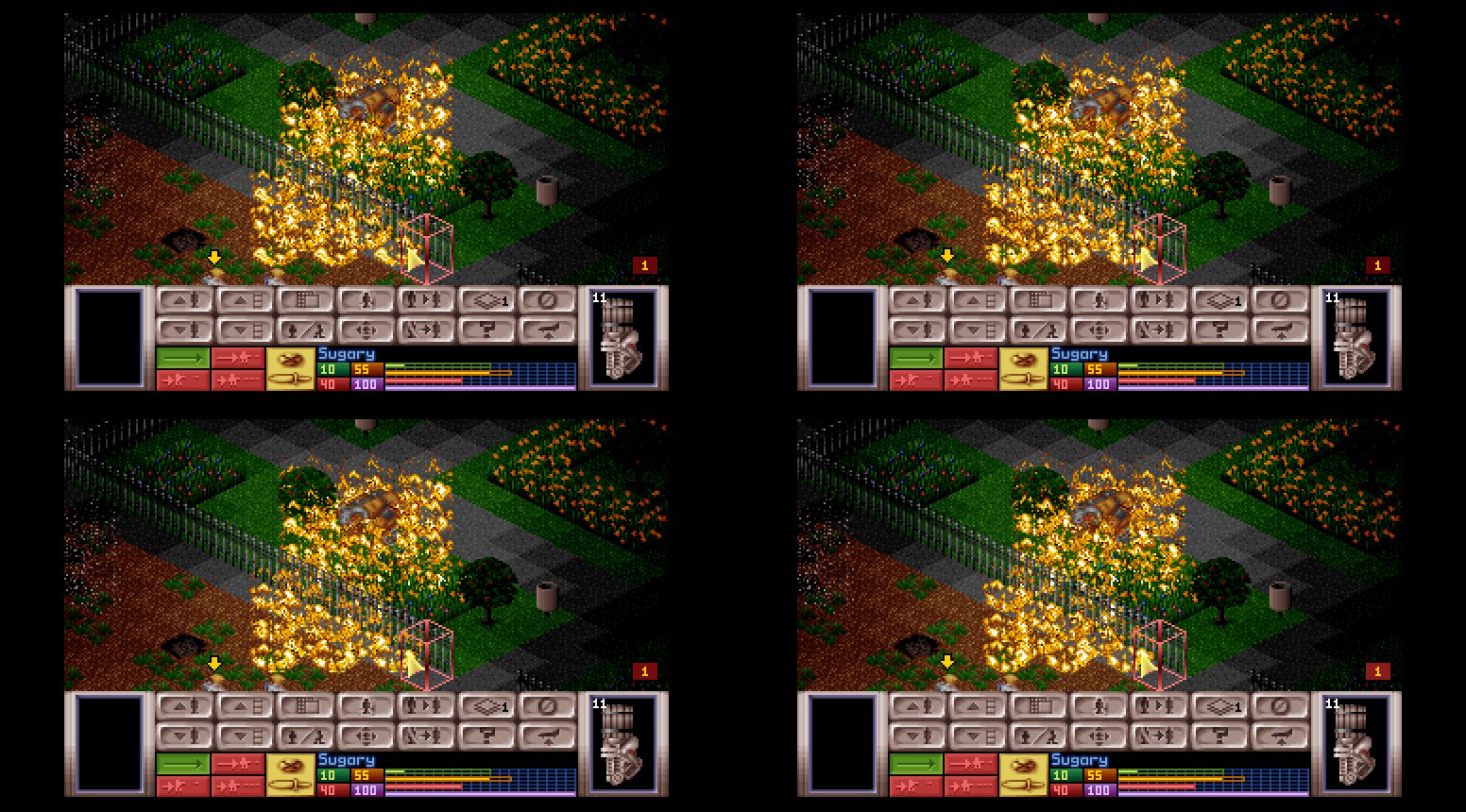
(screenshot from Let's Play X-Com)

And UFO: Alien Invasion is a fan-made open source clone of X-Com. I tried it about three years ago, and it seemed to have promise. But it was a long way from being finished. These volunteer fan projects are great, but they struggle to ever finish a game. And there's no destructible terrain, due to the game engine they're using, so that's disappointing (understandable, in a volunteer effort like this, but still disappointing). Finally, you can't save the game during a battle. That's absolutely ridiculous! I hate games that try to force me to play their way! And battles take a long time in X-Com. For some of us, the real world must sometimes take precedence over game-playing.

The Jagged Alliance games (1994 & 1999) had similar combat to X-Com, but nothing else was similar. They were reasonably fun, but not anywhere close to as good as X-Com: UFO Defense. The turn-based combat was critical to X-Com, true, but the game was more than just that. It was a package deal, and the whole package was absolutely incredible. Really, if you haven't played it, find some cheap source and give it a try.
After driving us into the ditch...

Life Imitates The Simpsons


I'd read elsewhere how anti-science Republicans succeeded in killing a House bill to increase funding for scientific research, and for math and science education, by forcing Democrats supporting the bill to vote in favor of letting federal employees watch pornography.

It really struck me as the worst kind of cynical obstructionism, especially considering the bill should not be controversial in the slightest. (Really, it should have been a slam-dunk, don't you think? If America doesn't keep its lead in science, what do you think will become of our country?)

But it was Jonathan Chait who pointed out how life imitates art, by posting this excerpt from The Simpsons:

The Simpsons, 1995:
Kent Brockman: With our utter annihilation imminent, our federal government has snapped into action. We go live now via satellite to the floor of the United States congress.
Speaker: Then it is unanimous, we are going to approve the bill to evacuate the town of Springfield in the great state of --
Congressman: Wait a minute, I want to tack on a rider to that bill: $30 million of taxpayer money to support the perverted arts.
Speaker: All in favor of the amended Springfield-slash-pervert bill?
[everyone boos]
Speaker: Bill defeated. [bangs gavel]
Kent Brockman: I've said it before and I'll say it again: democracy simply doesn't work.

Friday, May 14, 2010

Why Libertarianism Doesn't Work

An interesting post from Nobel Prize-winning economist Paul Krugman's blog:

Thinking about BP and the Gulf: in this old interview, Milton Friedman says that there’s no need for product safety regulation, because corporations know that if they do harm they’ll be sued.
Interviewer: So tort law takes care of a lot of this ..
Friedman: Absolutely, absolutely.
Meanwhile, in the real world:
In the wake of last month’s catastrophic Gulf Coast oil spill, Sen. Lisa Murkowski blocked a bill that would have raised the maximum liability for oil companies after a spill from a paltry $75 million to $10 billion. The Republican lawmaker said the bill, introduced by Sen. Robert Menendez (D-NJ), would have unfairly hurt smaller oil companies by raising the costs of oil production. The legislation is “not where we need to be right now” she said.
And don’t say that we just need better politicians. If libertarianism requires incorruptible politicians to work, it’s not serious.

I must say that I like the comment from Lisa Hirsch (#12), too:

I'm sure some true believer will be along to tell us all about how this should work or would work in the ideal world. I will believe that true believer to the exact extent I believe my friends who say Marxism would work if we ever had REAL Marxism. The polite description of these people is naively idealistic religious believers.

I'd say that is spot on, about Marxists and libertarians both.

Climate Denial Crock of the Week

Glenn to the Mountaintop

The Colbert ReportMon - Thurs 11:30pm / 10:30c
Glenn to the Mountaintop
www.colbertnation.com
Colbert Report Full EpisodesPolitical HumorFox News

Thursday, May 13, 2010

Sex, Lies, and Oil Spills

In general, I don't think much of The Huffington Post, but here's an interesting article by Robert F. Kennedy, Jr. about the oil spill catastrophe in the gulf:

The absence of an acoustical regulator -- a remotely triggered dead man's switch that might have closed off BP's gushing pipe at its sea floor wellhead when the manual switch failed (the fire and explosion on the drilling platform may have prevented the dying workers from pushing the button) -- was directly attributable to industry pandering by the Bush team. Acoustic switches are required by law for all offshore rigs off Brazil and in Norway's North Sea operations. BP uses the device voluntarily in Britain's North Sea and elsewhere in the world as do other big players like Holland's Shell and France's Total. In 2000, the Minerals Management Service while weighing a comprehensive rulemaking for drilling safety, deemed the acoustic mechanism "essential" and proposed to mandate the mechanism on all gulf rigs.

Then, between January and March of 2001, incoming Vice President Dick Cheney conducted secret meetings with over 100 oil industry officials allowing them to draft a wish list of industry demands to be implemented by the oil friendly administration. Cheney also used that time to re-staff the Minerals Management Service with oil industry toadies including a cabal of his Wyoming carbon cronies. In 2003, newly reconstituted Minerals Management Service genuflected to the oil cartel by recommending the removal of the proposed requirement for acoustic switches. The Minerals Management Service's 2003 study concluded that "acoustic systems are not recommended because they tend to be very costly."

The acoustic trigger costs about $500,000. Estimated costs of the oil spill to Gulf Coast residents are now upward of $14 billion to gulf state communities. Bush's 2005 energy bill officially dropped the requirement for the acoustic switch off devices explaining that the industry's existing practices are "failsafe."

Kennedy notes the infamous sex scandals at the Minerals Management Service, too. But the fact is, government regulation will probably always be ineffective when the people in charge are ideologically opposed to regulation of any kind and have no real interest in protecting the public.

Similarly, Republicans who hate the government tend to be very poor at running the government. For that reason and many others, I'd say that we're much better off keeping them in the minority, wouldn't you agree?

Glenn Beck's Nazi Tourette's

The Daily Show With Jon StewartMon - Thurs 11p / 10c
Back in Black - Glenn Beck's Nazi Tourette's
www.thedailyshow.com
Daily Show Full EpisodesPolitical HumorTea Party

Conservative Magical Thinking (Voodoo Economics)


Voodoo economics - it's still with us. In fact, magical thinking has completely taken over the Republican Party. I took that graphic from Jonathan Chait's recent column in The New Republic, but he has another that's even better. After discussing what we really need to do to shrink the deficit, he continues with this:

So now we're down to raising taxes by 1.5% of GDP and cutting spending by 1.5% of GDP. That's not all that hard. In fact, recent history suggests that as the economy recovers, the deficit will shrink even faster than CBO projects.

Now, it's true that creating the political will for such changes is difficult. But a big part of the reason it's difficult is that conservatives reject out of hand any bargain that includes tax increases. Conservatives revolted against the 1990 budget agreement, which included some tax hikes and significant spending restraint. Republicans unanimously denounced Bill Clinton's 1993 deficit reduction as an economy-killer that would increase spending and the deficit. Here's what actually happened:


See that period in the 1990s, when the light blue spending line goes down and the dark blue revenue line goes up? That's the effect of the deficit reduction deals that conservatives continue to regard as unthinkable. Now, you might say it's a reflection of the 1990s business cycle, and that's partly true. But contrast it with the 1980s business cycle, when the deficit got big and stayed big. Or the 2000s business cycle, when revenues collapsed and only partly recovered even at the peak of the business cycle. The one period of time when federal spending actually declined on a continuous basis was when policymakers had implemented tax hikes. That's the period when George H.W. Bush and Bill Clinton were clawing back the Reagan tax cuts. The periods when outlays were rising were when tax cutters Ronald Reagan and George W. Bush were in the saddle.

Interesting graph, isn't it? Click to enlarge it, if you wish. Ronald Reagan was president from 1981 to the beginning of 1989. That's when Republicans first decided that deficits didn't matter, or at least didn't matter as much as tax cuts for the rich. The first President Bush (1989-1993) famously - and rightly - labeled it "voodoo economics," before he finally bowed before the lunatics in his party. But he did raise taxes near the end of his term, violating his idiotic "read my lips" pledge, but starting us on the road to shrinking Reagan's deficits.

Bill Clinton served from 1993 to the beginning of 2001. Under his leadership, we cut spending, increased taxes, and didn't just narrow the deficit but actually produced surpluses. Far from being an "economy killer," as the right-wing prophesied, America's economy boomed. But you know what's coming next, don't you? Disastrously, Bush Junior was in office from 2001 to 2009. There's pretty much nothing he did right, but he was certainly a disaster for our economy. Increasing spending, combined with tax cuts for the rich - and starting two wars without paying for them - ending with the worst economic collapse since the Great Depression... Well, it's hard to imagine the Republicans could have done worse if they'd been trying to destroy our country.

President Obama took office at the beginning of 2009, with quite possibly the worst starting conditions of any president in our history. (Franklin D. Roosevelt had the Great Depression, but not even one war, not at the beginning of his first term.) Look at the graph. Why aren't the Republicans hiding their heads in shame? And how could they still be pushing voodoo economics? Chait thinks that tax cuts for the rich is their only real goal. They just don't care much about anything but that.

Certainly Republicans talk a lot about spending cuts, but never seriously. They never propose anything meaningful. Take their latest gimmick, online voting for spending reduction. I like Nobel Prize-winning economist Paul Krugman's take on that:

Now that’s pathetic. Via Steve Benen, Eric Cantor is calling on the public to “vote” on spending cuts — like eliminating $1 million, that’s right, $1 million — in HUD dissertation grants. Because nothing does more to ensure that taxpayer money is well spent than making sure that nobody actually studies what works and what doesn’t.

As Benen points out, however, the real story here is that the sums involved are ludicrously trivial; eliminating everything on Cantor’s list would amount to a rounding error on federal spending.
Meanwhile, of, course, the GOP went wild against real efforts to control spending, crying “death panels.”

The truth is that it has always been like this. Ever since Reagan, the conservative approach has been to talk about the need for smaller government, but refuse to offer any serious proposals for spending cuts, pretending instead that there are large sums being wasted on things nobody wants.

When Republicans talk spending cuts, they're either so vague as to be completely laughable ("cutting waste" is always a good one, since who could be against that?) or ridiculously petty (involving sums that sound impressive to the average voter, but - as Krugman points out - would be no more than the rounding error in the federal budget). A million dollars is a lot of money, yes. But nationally, it amounts to one-third of a penny per person per year.

[Of course, some of those petty cuts show almost incredible ignorance, too. Remember Bobby Jindal wanting to cut funds for volcano monitoring? Or Sarah Palin and fruit fly research? Admittedly, the whole Republican Party has become anti-science in recent years, but these are supposed to the GOP leaders. Oh, yeah, I forgot. Intelligence and education are elitist, aren't they?]

Anyway, here's another graphic I find interesting:


That's probably hard to see. You might want to click on it to get a bigger size. It's from Andrew Sullivan in The Atlantic, apparently, but I don't have a link to the associated article. Still, it's simple enough to figure out by itself. It simply compares where people want to cut federal spending with where we're actually spending it.

I always think it's funny to hear tea-baggers who are adamant about protecting their own Social Security and Medicare from cuts (although, how dumb do you have to be to think you need Republicans to protect these programs from Democrats?), and who want even more spending on defense, but expect to balance the budget by cutting foreign aid or environmental protection. Oh, yeah, let's not forget about "waste," the duplicitous politician's favorite target.

Talk about magical thinking! Is it any wonder we laugh at these people? It's either laugh or cry, don't you think? I can laugh as long as they're out of power. But if they ever get back in power again, there will be plenty to cry about. Let's hope Republicans find their sanity again before that!

Wednesday, May 12, 2010

Get Shorty!

The Daily Show With Jon StewartMon - Thurs 11p / 10c
Release the Kagan
www.thedailyshow.com
Daily Show Full EpisodesPolitical HumorTea Party

The Internet: Where religions come to die

How long could you survive in a vacuum?

According to this article, only 30 to 40 seconds. Maybe up to a minute, if conditions were just right and medical care was standing by (though you'd lose consciousness much before that). It's not just the lack of oxygen, since you can hold your breath longer than that, but you need air pressure, too.

I just thought it was interesting.

Tuesday, May 11, 2010

Dwarf Fortress Notes


I mentioned in a previous post about Dwarf Fortress that the game was free, with the lone developer, Tarn Adams, surviving on donations from his fans. (The game doesn't even bug you to donate. There's just a nondescript PayPal link on his home page.) I thought it was telling that, during the year and a half he'd been working on a new version, he was still getting donations - generally between $2,000 and $5,000 every month.

Well, he released the new version at the end of March. It's still free and still nothing like a commercial game (note the graphics above). But in the month of April, fans donated a total of more than $16,000. Isn't that amazing?

Sure, that's nothing for a mainstream game company, the kind of multinational corporation which requires millions of dollars just to break even. But for fans to voluntarily support a single game developer, dedicated - maybe obsessed - with his own vision, like this,... well, I've got to think that it's really impressive.

I haven't had time to try the new version yet, myself. And I'm not in a big hurry, until the bugs are cleaned up a bit. (In this kind of effort, Adams relies on his fans to identify bugs, which he'll clear up in minor updates. He warned us that it was buggy when he released the new version.) And although I've donated before, I'll do so again when I get around to playing it. Frankly, I'm getting anxious to try it out. It's really an incredible game.

Meanwhile, I'm enjoying the tales of other players. Earlier, I posted about one of them, an illustrated battle report. Well, there are some nasty "forgotten beasts" in this DF version. Here is another fun example. It shows what happened after a beast with "deadly blood" was defeated.

Keep in mind that these dwarves have emotions. You must keep them content, if not happy. If they get too unhappy (if, for example, they lose friends or family members), they can go berserk or even completely insane. And their actions will tend to make their neighbors unhappy. So you can get a fortress spiraling out of control in violence, suicide, and despair.

I guess that's why the Dwarf Fortress motto is "Losing Is Fun."

Greece is the new France

In the Washington Post, David Weigel mentions how Greece has become the new France - i.e. the new example held up by Republicans in their never-ending quest for bogymen. Before, we were all supposed to be terrified of turning out like France (I never quite understood the rationale there), and the Democrats were somehow supposed to be leading us in that direction. Now, I guess, it's Greece. But still the same old scare tactics, of course.

Nobel Prize-winning economist Paul Krugman, though, points out the critical error in their thinking:

Of course, the real rap on Greek fiscal policy is that the Greek government ran deficits even during the good years — not that it’s running deficits in a slump. And it’s true, we did something like that too. But guess who was in power then? Funny about that.

I've been wondering about this, too. Are we Americans really so ignorant that we can't see the difference?  Like Greece, America under George W. Bush - thanks to tax cuts for the rich along with increased spending (including starting two wars without paying for them) - had record-breaking deficits in good economic times. So when disaster struck - again thanks to Republican incompetence - we were in especially dire straits because we started out in a hole.

I don't intend to absolve Democrats of all blame, because they spinelessly went along with pretty much every inane proposal the Republicans pushed. Yet it was the Republicans who led us - for eight years in the White House and 12 years in Congress - so it's hard to deny their primary responsibility, don't you think?

At any rate, deficits aren't always bad. We learned that in the Great Depression, when the Democrats also had to get us out of a hole the Republicans dug. (I'll just point out that the Great Depression taught us the need to regulate our banking industry, too, before I get back to the topic here.) During economic panics, credit dries up and private spending drops, causing businesses to cut payrolls, which causes a further drop in spending, which causes businesses to cut employment even further, etc.

If it's bold enough, deficit-spending by the government can stop this downward spiral, as we've seen in the past year. Combined with stabilizing our banking industry, it can halt the collapse and let us start to grow again. Again, that's exactly what we've seen in the past year or so, since Barack Obama took office. It's not pretty, and it's not speedy - and employment always lags other indicators (such as stock market performance), but it does work.

Where you don't want deficit spending, though, is when times are good, economically. All that does is create asset bubbles (exactly as we saw happen during the Bush administration) and make the next downturn far worse (or, at least, harder to combat). Like America under the Republicans, Greece partied when times were good, apparently thinking that the good times would never end. And so now they're in big, big trouble.

Again, Greece is not in trouble for running deficits now, after the collapse. They're in trouble for running deficits when times were good. If Republicans really want to compare America to Greece, they'll be pointing directly at themselves. Of course, they're counting on us Americans being too ignorant, and with very, very short memories - and on Fox "News" to eagerly encourage both. Sadly, that might actually work.

But in a democracy, we get the kind of government we deserve. If we're dumb enough, ignorant enough, or apathetic enough to give the GOP another chance at destroying our country, I guess we deserve that, huh? But I don't deserve that! Do you?

A Christian Nation?


This is typical of Fox "News," don't you think? It's obvious that they're arguing a particular point of view, and also that they're woefully uninformed about American history. Note the scroll along the bottom: Preying on Prayer?  But no one, absolutely no one, is telling people that they can't pray - or even urging them not to pray. That would also be unconstitutional.

If you're a believer, do you really need the government to tell you to pray? You can't pray without the government's involvement, then? Tell me, how would you feel about the government telling you to praise Allah? Would you also have no problem with government-organized covens? What about our government proclaiming a day of non-prayer, just one special day to support atheism and humanism by urging people to give up their prayer to imaginary supernatural beings? Still no problem with government involvement in religion?

This anchor mistakenly calls Dan Barker's organization the Freedom for Religion Foundation - and the scroll repeats that error - instead of the Freedom from Religion Foundation. And like Sarah Palin, he confuses the Declaration of Independence with our Constitution. (Frankly, that happens so regularly with these people that I'm sure it's not really an accident. They are simply... lying.)


For the record, our Constitution is a secular document, and deliberately so. Our Founding Fathers recognized the perils of religious strife and were intelligent enough to let people make their own decisions about such things. Our government was designed to stay completely neutral. (They didn't even have organized prayers at the Constitutional Convention.)

And as Dan Barker points out, this was confirmed in 1797, when the U.S. Senate unanimously (one of their relatively few unanimous votes) passed the Treaty of Tripoli. Signed by John Adams, the treaty states, in part, "the government of the United States of America is not, in any sense, founded on the Christian religion." No one knew better than our Founding Fathers that America's new government was strictly secular, by their deliberate intent.

"In God We Trust" was not the motto of our new nation. (It was E Pluribus Unum - "Out of many, one.")  That "In God We Trust" phrase was adopted by Congress during the notorious McCarthy era in the 1950's, when godless Communist hysteria was at its height. They also made the phrase mandatory on all U.S. currency (it had been on some money since the Civil War era, but not at our founding), and added "Under God" to the Pledge of Allegiance (which had gotten along very well for many years without it).

Our founders would have understood that none of these things are constitutional. But politicians are nothing if not cowardly. And supporting the majority religion in any country is always a popular thing to do. You certainly wouldn't expect McCarthy era politicians to stand up for American principles, any more than you can expect that today, right? Well, most of them, anyway. It's just a shame that we Americans are so ignorant about our own history.

(graphic by Shorthand-Hero, via Bay of Fundie)

Incidentally, the above image might not be entirely accurate. Thomas Jefferson was more of a deist than a complete non-believer. Certainly, he wasn't a Christian. In fact, he made his own Bible of sorts by tearing out all of the supernatural stuff in the New Testament - and skipping the Old Testament entirely. (Is it any wonder the Texas Board of Education is trying to remove him from American history books?)

But his personal religious views are beside the point, anyway. Our Founding Fathers were diverse in their beliefs. And even those who were Christian were determined to keep religion separate from our secular government, since that was best for our country and best for religion, too. That was perhaps their most important contribution to the world, the complete separation of church and state. In America, your religious beliefs, or lack thereof, were your own business, not the government's.

The right-wing has been fighting against our Founding Fathers ever since.

Monday, May 10, 2010

Lena Horne, 1917-2010


Lena Horne died yesterday at the age of 92. She was a great singer and actress who struggled against terrible racism in America (and was blacklisted in the 1950's for her progressive political views). According to Wikipedia, some states wouldn't allow films with black performers, so Horne couldn't be a leading lady, but only play a part where she could easily be edited out.

Apparently, she hoped to play the character of Julie LaVerne, a light-skinned back woman married to a white man and "passing" for white, in the 1951 movie, Show Boat. But in America back then, you couldn't show a real black woman married to a white man, even when that was the plot of the story. So Ava Gardner, in dark makeup and with all her songs dubbed, got the part instead.

Well, racism is still common, but we've come a long way since then, and Horne was lucky enough to see those changes.