Wednesday, August 11, 2010

Which amendment is trying to kill us?

The Colbert ReportMon - Thurs 11:30pm / 10:30c
Citizenship Down - Akhil Amar
www.colbertnation.com
Colbert Report Full Episodes2010 ElectionFox News

Consciousness and the soul

Greta Christina has written a great article here examining the question of near-death experiences and why they're poor evidence for life after death and the existence of a soul that's separate from our biological brains.

As a kid, I was fascinated by NDEs and similar strange phenomena. But as I got older, I started to understand why we have to take such reports with a large grain of salt. I'm not sure that anyone else explains it as well as Christina:
So here's the problem.

There's this phenomenon -- consciousness.

There are essentially two ways to explain it. Either it's a physical, biological product of the brain -- or it has a component other than brain function: a soul that is separate from the brain, and that survives when the brain dies.

And there are two sets of evidence supporting these two explanations.

The evidence supporting the "biological product of the brain" explanation comes from rigorously-gathered, carefully-tested, thoroughly cross-checked, double-blinded, placebo-controlled, replicated, peer-reviewed research. An enormous mountain of research. A mountain of research that is growing more mountainous every day.

I cannot emphasize this enough. Read any current book on neurology or neuropsychology... or at least, any current book on neurology or neuropsychology that isn't written by a woo believer with an axe to grind who's cherry-picking the data. Read Oliver Sacks, V.S. Ramachandran, Steven Pinker. We are getting closer to understanding consciousness every day. The sciences of neurology and neuropsychology are, it is true, very much in their infancy... but they are advancing by astonishing leaps and bounds, even as we speak. And what they are finding, consistently, thoroughly, across the board, is that, whatever consciousness is, it is intimately and inextricably linked to the brain. Changes in the brain result in changes in consciousness -- changes sometimes so drastic that they render a person's personality entirely unrecognizable. Changes in consciousness can be seen, using magnetic resonance imagery, as changes in the brain. This is the increasingly clear conclusion of the science: Consciousness is a product of the brain. Period.

And this evidence has been gathered, and continues to be gathered, using the gold standard of evidence, methods specifically designed to filter out biases and known cognitive errors as much as is humanly possible: rigorously-gathered, carefully-tested, thoroughly cross-checked, double-blinded, placebo-controlled, replicated, peer-reviewed research.

Now. Compare, please, to the evidence supporting the "independent soul" explanation of consciousness.

Including near-death experiences, and the supposedly inexplicable things that happen to some people during them.

The evidence supporting the "independent soul" explanation is flimsy at best. It is unsubstantiated. It comes largely from personal anecdotes. It is internally inconsistent. It is shot through with discrepancies. It is loaded with biases and cognitive errors -- especially confirmation bias, the tendency to exaggerate evidence that confirms what we already believe, and to ignore evidence that contradicts it. It has methodological errors that a sixth-grade science project winner could spot in 10 seconds.

The only thing the "independent soul" explanation has going for it is our desperate wish to believe that it's true. But that, by itself, is enough not just to keep the belief alive, but to make it the belief of the vast majority of people, at least in America. Well, it's very easy to believe what we really want to believe, isn't it?

There is not a single account of an immaterial soul leaving the body in a near-death experience that meets the gold standard of scientific evidence. Not even close. Supposedly accurate perceptions of things they couldn't have seen by people near death? Bogus. Supposedly accurate predictions of things they couldn't have known by people near death? Bogus. The "shoe on the window ledge that the dying person supposedly couldn't possibly have known about?" Bogus. The supposed eerie similarity of near-death experiences? Bogus. (The similarities that these experiences do have are entirely consistent with them all being created by human brains... and the differences between them are not only vast, but exactly what you would expect if these experiences were generated by people's brains, based on their own beliefs about death. Christians near death see Jesus, Hindus near death see Hindu gods, etc.)

These claims -- and the claims that these experiences could not possibly be explained by anything other than a supernatural soul -- are anecdotal at best. Second- and third- hand hearsay. Gossip, essentially. And like most gossip, it leaves out the parts of the story that are less juicy, less consistent with what we already think about the world or what we want to think about it... and exaggerates the parts of the story that tell us what we already believe or want to believe. Believers in the soul love to tell the bogus story about the shoe on the window ledge. They're less likely to tell the stories about the people near death who saw things that weren't there, or who made predictions that didn't happen, or who saw people alongside them in their supposed out-of-body experience who weren't actually near death themselves.

And every time a claim about a soul leaving the body when near death has been tested, using good, rigorous methods, it's utterly fallen apart. Every single rigorously done study examining claims about near death experiences has completely failed to show any perceptions or predictions that couldn't have been entirely natural. Again. And again. And again, and again, and again. And again. And... oh, you get the idea.

As Christina points out, scientists are human, too. And they don't want to believe that they'll die, that life is brief and there's nothing afterward.

Now, many believers in the soul will argue that yes, they are biased in favor of their belief -- but so are the scientists who've concluded that consciousness is a physical process and the soul doesn't exist. But this makes no sense whatsoever. Scientists are human, too: they don't want to die, and they'd be just as happy as anyone to learn that they were going to live forever. In fact, for centuries, most scientists did believe in the soul, and much early science was dedicated to proving the soul's existence and exploring its nature. It took decades upon decades of fruitless research in this field before scientists finally gave it up as a bad job. The conclusion that the soul does not exist was not about proving a pre-existing agenda: quite the opposite. It was about the evidence leading inexorably to a conclusion that was both surprising and upsetting. What's more, if any scientist today could conclusively prove the existence of the soul, they'd instantly become the most famous and respected scientist in the history of the world. What possible motivation could they have for being biased against the soul hypothesis?

To me, the simplest, clearest evidence that we have no "soul" that can exist independently of our flesh and blood brain is the personality changes that frequently take place after brain injury. This is well-documented. My personality, my "soul," is obviously an artifact of my biological brain. I wish it were otherwise, because my brain will die someday relatively soon,... and so will I.

I wish even more that my friends and family who've already died were still "alive" somewhere, somehow, but all the wishes in the world won't make it so. Death was the end of everyone I've loved and will be the end of everyone I love now. They live on, briefly, in my memory. And they live on in the effect they've had on the world. We could wish for more, but that would be futile. Instead, we should be grateful for what we've got.

Reality wins. Reality is more important than anything we could make up about it. (And it's a whole lot more interesting.) If we want to be intimately connected with the universe, we need to accept what the universe is telling us, through evidence, is true about itself. We need to not treat the world we make up in our heads as more important than the world outside our heads. If we want to be intimately connected with the universe, we need to accept the reality about it.

Even when that reality contradicts our most cherished beliefs.

Even when that reality is frightening, or painful, or sad.

And that includes the reality of death.

If we find the idea of death upsetting, we need to not cover our eyes and ears in the face of death, and pretend that it isn't real. We need, instead, to find and create secular philosophies of death that provide comfort and meaning. We need to find value in the transient as much as in the permanent. We need to see change and loss and death as inherent and necessary to life, without which the things we value in life would not be possible. We need to see death as providing inspiration and motivation to experience life as fully as we can, and to get things done while we still have time. We need to view death as a natural process, something that connects us with the great chain of cause and effect in the universe. We need to take comfort in the idea that, even though we will die and our death will be forever, the memories people have of us will live on, and the world will be different because we were here. We need to take comfort in making this life as meaningful and valuable as we possibly can: for ourselves, and for everyone else around us. We need to recognize how astronomically lucky we were to have been born into this life at all, and not see it as a tragedy because that life won't last forever.

What has happened to America?

The Daily Show With Jon StewartMon - Thurs 11p / 10c
Municipal Land-Use Hearing Update
www.thedailyshow.com
Daily Show Full EpisodesPolitical HumorTea Party

Edit: This video clip doesn't seem to embed correctly on the home page of my blog. But if you bring up the posting by itself (by clicking on the title), the embedded video should work just fine. I don't know why there's a difference.

Amazing, isn't it? This is just freedom of religion, enshrined in the First Amendment of the U.S. Constitution. Nothing too important, right? Tell me, how could any American think like this? Can you think of anything less American than religious discrimination?

America gave the world the whole idea of religious freedom and the separation of church and state. We learn that in elementary school, for crissake! Is there anything more fundamental to America than that?

And these aren't just idle Tea Party lunatics, or Fox "News" entertainers, either. I already posted about Lt. Gov. Ron Ramsey of Tennessee. That's bad enough. But Newt Gingrich, former Speaker of the House and serious (or as serious as the Republicans get these days) presidential candidate? These are political leaders from, heaven help us, one of the two major political parties in the nation.

What does it say about our country that they don't value freedom of religion? I don't even care if they really believe what they're saying, or if they're just spouting off for the bigoted yokels who control the GOP these days. Either way, it's truly shameful.

Here's Gingrich:
There should be no mosque near Ground Zero in New York so long as there are no churches or synagogues in Saudi Arabia. The time for double standards that allow Islamists to behave aggressively toward us while they demand our weakness and submission is over.

Since when is freedom of religion, one of the bedrock pillars of American democracy, "weakness and submission"? Is this like the new Republican idea that the height of patriotism is to secede from the Union? (Frankly, I want to say, "America, love it or leave it!" And, "Good riddance!") The First Amendment helps keep America strong, not weak. Republicans may not cherish our American values, but I certainly do!

According to Gingrich, we shouldn't have religious liberty in America until Saudi Arabia has religious liberty. Of course not. We wouldn't want America leading the world, would we? Clearly, we shouldn't have religious liberty until every other nation in the world allows religious liberty. And we shouldn't allow equal rights for black Americans until Robert Mugabe stops discriminating against whites in Zimbabwe, huh? How foolish were we to unilaterally ban segregation?

For that matter, as long as Saudi Arabia discriminates against women, I guess we should discriminate against men, right? After all, anything else would be "weakness and submission," according to Newt Gingrich. As long as women are forced to wear a burqa in any country in the world, I guess America should force men to wear one. That will certainly show the world that we're not weak and submissive, won't it?

(photo from the Daily Mail)

Islamic Americans are Americans.  They are just as much Americans as you or I. They are just as much Americans as Newt Gingrich. And they have exactly the same rights as any of us, including freedom of speech, freedom of religion, and freedom of association. Their religious beliefs are their own business, and they have as much right to build a mosque as you do to build a church or a synagogue.

These protests should be a national scandal and disgrace. Gingrich's comments - and similar statements from right-wing Republicans everywhere - should be front page news in every paper in the land, with corresponding editorials denouncing this kind of thinking as completely un-American. Every politician who dares to say anything half as crazy as Gingrich should instantly lose all credibility and all of his support.

Freedom of religion is fundamental to our democracy. So are freedom of speech and freedom of association. This isn't a matter of right and left, conservative and liberal - not unless your idea of "conservative" is returning us to the Middle Ages. This isn't even a rational argument for debate. These lunatics like Newt Gingrich are completely un-American in their thinking. Every patriot in the land should be denouncing this kind of thing.

But instead, we get only Jon Stewart doing what's right. OK, that's unfair. There are others, absolutely yes. Many people are doing their best to denounce this kind of thinking. I'm just disappointed that it's not everywhere, a mass uprising of the American people, agreeing - whatever their political affiliation - that Gingrich sells America short. America is better than that! Freedom of religion doesn't make us weak. It makes us strong.

Anyway, below the fold is another clip from the Daily Show, a sequel to the one above, on the same subject. It's a depressing subject, so the humor is particularly welcome. Enjoy!

Monday, August 9, 2010

"One of Our Bastards Is Missing" by Paul Cornell

I thought this was a wonderful title, so I'm using it here, but this is actually the second story in a series, and I want to talk about both of them. "One of Our Bastards Is Missing" is a novelette nominated for the 2010 Hugo Award, so we're reading it in the ModernScienceFiction2 Yahoo group this week. But "Catherine Drewe" was his first story in this world, and luckily, both are available free online (at least, for now).

They're both very good stories, too. Here's how the author, Paul Cornell, describes them:
They're the stories of Major Jonathan Hamilton, who serves with the 4th Dragoon Regiment of the British army in a present day rather unlike our own. Because of a single difference in the timeline (that I haven't yet revealed), the empires of Europe remain in place, and have indeed spread out to compete in the colonisation of the solar system, and the Great Game espionage cold war between them continues on many fronts. Indeed, the concept of a great balance to be kept has seeped into the fabric of these civilisations in all sorts of ways. Hamilton is often called upon to work out of uniform, as what we'd these days call an intelligence officer, intervening in the plans of rival empires. Hamilton himself is damaged, vulnerable, but also terse, repressed and honourable, though his concept of honour is shaped by his society. He can be horribly dangerous to those who get in the way of his duty, but he feels a need to be tender with innocents. He's not cruel in everyday life, but he can be something of a sadist when his mission and the nature of his enemy gives him leave to be. Indeed, he lets himself enjoy those moments of release. His relationships with women are complicated and rare. I like to think I'm writing in the tradition of Ian Fleming's Bond novels (not the movies) but I'm trying to stay away from pastiche, and instead hope to explore the same debates about masculinity and Britishness he did, while perhaps coming to different conclusions. I also hope this is serious SF in all sorts of ways, and that the politics and tactics make them genuine espionage stories too, but that they're also, well, fun!

I agree, they're certainly fun. Cornell compares these stories to Ian Fleming's James Bond novels (I've only read one, but frankly, I hated it), but they remind me of the Lord Darcy stories of Randall Garrett, written back in the 1960's and 1970's. Both are set in an alternate universe, where Great Britain is a world power, still under the control of the nobility. But in the Lord Darcy tales, magic exists and is as effective as science in our world. Cornell's stories are science fiction, rather than fantasy, but the difference is more in... packaging rather than anything more substantive.

The stories are filled with exotic, fantastic, even weird images that would be well-suited to fantasy. (A girl holding her uncle's severed head asks him, "Do you want to eat it, Uncle?" Yes, she asks that same uncle, who's also sitting in a chair beside her. Luckily, "his chef was used to the situation, and would prepare the brain as a soup.") These things aren't meant to be plausible, because it's an alternate universe. But it's not magic, either. The above event isn't explained, except for a reference to "prion transmitters," but it's clearly meant to be technological.

These stories are darker than the Lord Darcy tales, though. It's the Cold War all over again. It's the Great Game that Kipling used to write about (Kim is one of my all-time favorite books and also set in a very exotic world, at least from my point of view). Jonathan Hamilton is a guy who does terrible things, soul-destroying things, because the alternative - all-out war - is even worse. The balance between the Great Powers must be maintained, or millions will die.

Whether or not you think that reasoning is valid, it's a serious issue. It's a moral issue for Hamilton and the people who give him his orders, but also for us readers. These are not just spy stories in an exotic - very exotic - setting. Hamilton is a good guy who's done, who continues to do, some terrible things. Is that right? He doesn't seem to be sure of that himself

In "Catherine Drewe," the Russians are somewhere they're not supposed to be, and it's up to Hamilton to stop it - without starting a world war. OK, the exotic setting and the action/adventure details are neat, and lots of fun to read, but the real meat of the story is about the morality of a government agent who does terrible things for good reasons (as he sees it). These things bother him. They're really soul-destroying - or at least soul-scarring. Hamilton doesn't show the patchwork pattern of physical scars like his superior (a nice touch, that!), but I got the feeling that this was what his soul looked like.

Clearly, he does terrible things sometimes, but the alternative is even worse. After all, a world war would kill millions. Just like during the Cold War, nearly anything could be justified to prevent that, don't you think? But then, of course, you've got an excuse to do anything. That's not good, either. This is not an easy question, not at all. The whole thing is morally gray. Frankly, I really enjoy science fiction that looks into big questions like this (without providing an easy answer, because there just isn't an easy answer).

In "One of Our Bastards Is Missing," the conflict is more between Hamilton's sense of duty and his feeling of love. With Hamilton, the issue is never in doubt, but we know it's still difficult. Meanwhile, he must do his job. And when a man vanishes into thin air at the princess's wedding - in full view of a room full of people - he must solve the mystery, and quickly, too.

I read this story first, and I loved it. It was this story that reminded me the most of Randall Garrett's Lord Darcy. But when I read "Catherine Drewe," I got more of the morally gray situation only hinted at in the other story. Together, they're superb. I'm really looking forward to more Jonathan Hamilton stories.

But I must admit I'm wary of Cornell's statement that Hamilton "can be something of a sadist when his mission and the nature of his enemy gives him leave to be. Indeed, he lets himself enjoy those moments of release." If Hamilton is forced to be sadistic, with a corresponding scar on his soul from the deed, that's one thing. But I don't think I could stand for a hero with a taste for it. In Ian Fleming's Casino Royale, the only James Bond book I've ever read, I thought his hero came across as mentally disturbed (definitely not the fun kind of secret agent that the movies showed). So I hope that Cornell reconsiders and doesn't take the "tradition" too far.

More dummies


Yes, more dummies. Sorry, but I can't resist. These are just too funny - and too accurate! I hope you've been viewing my previous posts of these video clips (here and here), too.

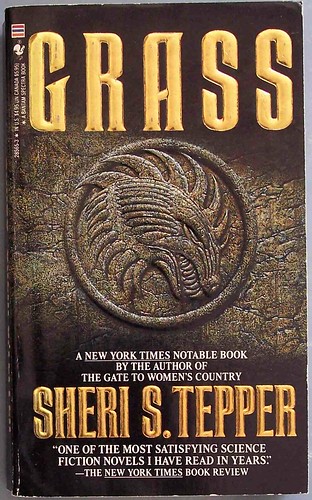
"Grass" by Sheri S. Tepper

(photo by Chris Drumm)

Note: This is a re-read for me. Grass was originally published in 1989, so I first read it maybe twenty years ago. I remembered the setting and the general idea of the story, but not the details. So it was a lot of fun to read again.

Plague, incurable and unstoppable, is loose on every human planet but - perhaps - this one, and Sanctity, the religious organization which rules humanity, needs to find out why. "Grass" is, reasonably enough, the name of a planet of vast grasslands, settled by minor European aristocrats whose main interest - only interest, really - is fox hunting. They've also become terribly insular, with no interest in anything or anyone elsewhere. Plague on other planets would not interest them, and it must be kept a secret, just a scary rumor for most people, anyway.

So Sanctity sends Roderigo Yrarier, along with his family, to Grass as ambassador, secretly assigned to determine if plague really is nonexistent on the planet. They're all skilled riders, and should fit in well with the local aristocrats, it's thought. But as it turns out, Sanctity knows very little about Grass. The aristocrats hunt, but the fox isn't really a fox, the mounts aren't horses, and the hounds aren't dogs. Indeed, there's far more going on here than it first appears.

This is a long book, 450 pages long, and it starts rather slowly. That's deliberate, I suspect. It's apparent from the beginning that things aren't quite what we might expect, especially in regard to the "fox hunting." But the truth is far stranger than even our initial suspicions, and far more serious - a matter of the survival of the entire human species, in fact. As the layers peel away, we start to understand what's really going on, and then the book becomes hard to put down. So I must say that the slow beginning suits the story very well.

Sheri Tepper is known for her feminist science fiction. I really like many of her books - The Gate to Women's Country, for example, is one of my favorites. But in some cases, she beats us over the head with her feminist perspective. Don't get me wrong, I generally agree with her philosophy, but I don't want it to get in the way of a good story.

Grass is one of her best novels. It's has a definite feminist slant, but not at all to excess. Her heroine, Marjorie Westriding Yrarier, is an appealing character struggling in an unhappy marriage. But her husband isn't really a bad guy. He has some admirable qualities, in fact. But he doesn't understand her, and she doesn't understand him. In general, it's just a bad match, made worse by their culture on Earth. Marjorie is truly the hero in this book, but her husband isn't a cartoon caricature of a villain - or any kind of villain, really. I like that.

Tepper certainly makes her point about patriarchal societies, and patriarchal religions, but she doesn't beat us over the head with it. For the most part, this is a fascinating story of an alien world. It's a mystery, too, in a way. There are secrets which must be uncovered before it's too late. There are villains, alien and human, but not all of the villains are fully responsible for their misdeeds.

Living here in Nebraska, I've become a fan of prairies. I've even learned to identify many species of native grasses, what I would have dismissed as just "grass," or even just "weeds," when I was young. So the description of this planet of varied grasses particularly appealed to me. Some of the grasses are like giant bamboo, towering far above human height and useful as building material. Others are more similar to our own tall-grass and short-grass prairies. And they come in all sorts of colors. It's a fascinating world (not especially plausible, perhaps, but still very neat).

Another detail that I loved was the relationship between the aristocrats and the commoners on Grass. In this respect, too, things are different from how they initially appear - or, perhaps more precisely, different from our unconscious assumptions about the relationship. As I mentioned, the aristocrats are very insular, and that applies even on their own world. So their own assumptions aren't necessarily accurate, either.

Grass is a long novel (though pretty typical in length these days), and it takes awhile before the story really grabs a reader. But it will grab you, and it's worth the effort, it really is. It's a fine book.

Thursday, August 5, 2010

Consequences of gay marriage


(graph by Aaron G, via TPM)

Perspective

Don't give up

The Daily Show With Jon StewartMon - Thurs 11p / 10c
I Give Up - 9/11 Responders Bill
www.thedailyshow.com
Daily Show Full EpisodesPolitical HumorTea Party

But don't give up. Yes, this is infuriating, maddening, and terribly, terribly depressing, but we can't give up. I don't understand how the American people can be this stupid, to let the GOP get away with this kind of thing - indeed, to reward them for it, if polls are to be believed. Yes, we were stupid enough to elect George W. Bush, but didn't we learn anything from that?

And it's frustrating that the Democrats have no spines, but I guess that courageous politicians soon find themselves out of work. (And that is our fault, too.) Well, incumbents have a huge advantage in elections, so politicians have a tendency to play it safe. That's the case on both sides of the aisle - just ask Bob Inglis if you think otherwise - but conservatives value obedience and order, so a cowardly Republican just follows the party line.

That means that Republicans can be completely spineless and still get things done - or, in the current situation, prevent anything useful from being accomplished - simply because they all stick together. They vote the party line even when they've long argued for the opposite. And they suck up to the far-right fanatics in their party, simply because they fear them. That is cowardice, it really is. It just plays out differently in the GOP.

Democrats value freedom and individuality, so they're never going to march in lockstep. Yes, I wish that Democratic politicians would show a little of the cohesiveness that Republicans routinely demonstrate, but I don't want them to turn into Republicans. After all, I don't especially value obedience to authority either.

But I do value courage, and passion. Will voters reward Anthony Weiner for his passion? Or will his Republican opponents be able to use that to discredit him? To me, the answer should be obvious. But clearly, most voters aren't like me (or we'd have a much better government).

A lot of this has to do with fund-raising, too. Typically, from a politician's first day in office, his overriding concern is to gather the campaign war-chest he needs to win re-election. Most voters aren't particularly knowledgeable and aren't especially smart or well-educated. They can be swayed by campaign ads. That means politicians must keep big donors happy. And now that corporations can directly buy their own politicians, rather than indirectly, as in the past, this is only going to get worse.

But we citizens have done this to ourselves. We elected Republicans - or, perhaps worse, couldn't be bothered to vote at all - who stacked the Supreme Court with right-wing fanatics. These are lifetime appointments, so we'll have to live with these mistakes for decades (even assuming that we don't make similar mistakes in the future). Depressing, isn't it?

We elected Republicans who gave tax cuts to the wealthy, who deregulated our financial industry, who started two wars, both with borrowed money and neither one with an exit strategy, who pushed supply side (trickle-down or voodoo) economics against all evidence, who politicized the Department of Justice, who tortured prisoners of war, and on and on. This mess - these messes - didn't just happen. They're our fault.

But the fact that we've done this to ourselves makes it clear that we can also change course. It's up to us. If politics bores you, if you can't be bothered to pay attention - and to vote - then our democracy will fail. It's that simple. It won't be easy. If you're easily discouraged, if you're a faint-hearted patriot, if you're naturally lazy and apathetic, then our chances diminish greatly. You can't rely on everyone else to fix your own country for you. A democracy of couch potatoes can't long survive.

And unfortunately, senior citizens - who tend to be the most conservative, the most gullible, and the easiest to scare - generally vote in large numbers. Younger people, more progressive and less fearful, don't. You'd think it would be the other way around, wouldn't you? Aren't young people supposed to be more active, more optimistic, more eager to accomplish something? Well, on average, it doesn't seem to work like that.

Non-voters can always think of excuses for not voting. I know. I've been there myself. You're too busy. You don't know enough about the candidates.* Your vote doesn't matter. All politicians are alike anyway (obviously untrue, but I hear it all the time). An ordinary person can't change anything. Yada, yada, yada. In fact, that's clearly wrong. Senior citizens generally get what they want because they vote.

True, no politician will agree with you about everything. So what? Even if it comes down to the lesser of two evils, at least there is a lesser. And if not, leave that race blank. You don't have to mark every spot on the ballot, just as long as you participate. This is your duty, but it is also a privilege. Our ancestors fought and died to give you that right. More importantly, perhaps, many spent their entire lives working to maintain this opportunity.

Besides, no one ever said that this would be easy. It won't be. It will be a long, hard haul, with many disappointments along the way. And it will never end. As long as our democracy exists, it will require continual effort to maintain. And it will require intelligence and education, too. Dummies can't maintain a functioning democracy, not for long.

This is up to you and me. This is up to all of us. It's our fault (collectively) for the messes we're in now, and it's our responsibility to fix them. The Tea Partiers might be complete lunatics, but even they understand that much. How can we do less? No matter what, we can't give up.


* PS. Trust me, you'll never know enough about the candidates until you start to vote. The first time you vote, when you feel like a complete idiot because you don't have a clue about most of the races on the ballot, that will encourage you to pay more attention. It's been my experience that the act of voting comes before political knowledge.

And after all, you don't have to mark the ballot in every single race. You just have to vote, in every single election, no matter what. You'll feel good about it, you really will. And then you'll start paying more attention to such things. It's almost inevitable.

Tuesday, August 3, 2010

Confessions of a Tea Party casualty

Bob Inglis is a Republican Congressman from South Carolina with a 93% lifetime rating from the American Conservative Union. But on June 22nd this year, he was defeated in the primary runoff for re-election 29% to 71% because he wasn't sufficiently loony conservative enough for the crazies who now control the GOP.

Hey, I can't feel too sorry for Republican leaders who've been hoist with their own petard. The GOP has been wooing the crazies for more than forty years (beginning with their "Southern Strategy" of appealing to southern white racists after the Democrats outlawed official segregation, and continuing with fundamentalist Christians during the Bush years). But here's a fascinating article about a right-wing politician who discovered that the lunatics really have taken control of the asylum:

It was the middle of a tough primary contest, and Rep. Bob Inglis (R-S.C.) had convened a small meeting with donors who had contributed thousands of dollars to his previous campaigns. But this year, as Inglis faced a challenge from tea party-backed Republican candidates claiming Inglis wasn't sufficiently conservative, these donors hadn't ponied up. Inglis' task: Get them back on the team. "They were upset with me," Inglis recalls. "They are all Glenn Beck watchers." About 90 minutes into the meeting, as he remembers it, "They say, 'Bob, what don't you get? Barack Obama is a socialist, communist Marxist who wants to destroy the American economy so he can take over as dictator. Health care is part of that. And he wants to open up the Mexican border and turn [the US] into a Muslim nation.'" Inglis didn't know how to respond.

A lesser man - say, nearly any other Republican politician - would have simply agreed with them and sent them away happy. I've got to give Inglis that.

Shortly before the runoff primary election, Inglis met with about a dozen tea party activists at the modest ranch-style home of one of them. Here's what took place:
I sat down, and they said on the back of your Social Security card, there's a number. That number indicates the bank that bought you when you were born based on a projection of your life's earnings, and you are collateral. We are all collateral for the banks. I have this look like, "What the heck are you talking about?" I'm trying to hide that look and look clueless. I figured clueless was better than argumentative. So they said, "You don't know this?! You are a member of Congress, and you don't know this?!" And I said, "Please forgive me. I'm just ignorant of these things." And then of course, it turned into something about the Federal Reserve and the Bilderbergers and all that stuff. And now you have the feeling of anti-Semitism here coming in, mixing in. Wow.

OK, so he didn't try to set them straight, either. But he apparently had some qualms about this kind of thing. Unfortunately, he was just about the only one.

Inglis found that ideological extremism is not only the realm of the tea party; it also has infected the official circles of his Republican Party. In early 2009, he attended a meeting of the GOP's Greenville County executive committee. At the time, Republicans were feeling discouraged. Obama was in the White House; the Democrats had enlarged their majorities in the House and Senate. The GOP seemed to be in tatters. But Inglis had what he considered good news. He put up a slide he had first seen at a GOP retreat. It was based on exit polling conducted during the November 2008 election. The slide, according to Inglis, showed that when American voters were asked to place themselves on an ideological spectrum—1 being liberal, 10 being conservative—the average ended up at about 5.6. The voters placed House Republicans at about 6.5 and House Democrats at about 4.3. Inglis told his fellow Republicans, "This is great news," explaining it meant that the GOP was still closer to the American public than the Democrats. The key, he said, was for the party to keep to the right, without driving off the road.

Inglis was met, he says with "stony" faces: "There's a short story by Shirley Jackson, 'The Lottery.'" The tale describes a town where the residents stone a neighbor who is chosen randomly. "That's what the crowd looked like. I got home that night and said to my wife, 'You can't believe how they looked back at me.' It was really frightening." The next speaker, he recalls, said, "'On Bob's ideological spectrum up there, I'm a 10,' and the crowd went wild. That was what I was dealing with."

Still, I don't want to give Inglis too much credit. As I say, this stuff has been building for years, and Inglis was right in there urging the crazies on:

Inglis acknowledges he's intimately familiar with extreme politics. He was part of the GOP gang that went after Clinton and impeached him for the Lewinsky affair:
I hated Bill Clinton. I wanted to destroy him. Then I had six years out [after leaving Congress in 1999] to look back on that, and now I would confess it as a sin. It is just wrong to want to destroy another human being and to spend so much time and effort trying to destroy Bill Clinton—some of it with really suspect information. We went on and on about Whitewater. We had talked about the strange things about Vince Foster's death. The drug dealing at Mena airport. So in the six years I was out, I looked back and realized, "Oh what a waste."

It's easy to say that you're sorry afterward. Meanwhile, you've gotten exactly what you wanted. Likewise, these are the statements of a man who knows that he has no political future. I give Inglis some credit, certainly, but he's no hero.

After all, this is what the Republican Party has been working towards for decades now. This is where their sick relationship with Fox "News" has led them. This is what comes from sucking up to white racists and right-wing religious fanatics. They tried to use the lunatics, and now they find that they're riding the tiger and can't dismount.

So I don't feel sorry for Republican politicians, not at all. I feel sorry for the rest of us.

Pocket protector


Ed Stein's commentary:
I’m still trying to get my head around how anyone can support the Republican Party in the upcoming elections. I know they have a big lead in the polls, and I understand that the party in power usually takes it on the chin when the economy is bad, and this economy is REALLY bad. Still, what has the GOP done to merit our trust? To date, opposed extending health insurance to the almost 50 million Americans without it, opposed the climate bill (Republicans supported cap and trade when it was their idea), opposed toughening offshore oil drilling regulations (even in the wake of the BP disaster), opposed extending unemployment benefits during the worst recession in our lifetime, opposed further stimulus (even though it clearly kept the economy from tanking even further), and the latest outrage, opposed transparency in campaign funding. The only thing the party has come out in favor of is extending the Bush tax cuts to the wealthiest Americans, even though that giveaway to the rich, enacted while we were fighting two unfunded wars, is largely responsible for the massive deficit the GOP now swears is our biggest problem. This is the same party, if you remember, that told us, when the tax cuts were enacted, that deficits don’t matter.
Somehow, though, they’ve persuaded a majority of Americans that they deserve another shot at wrecking the country. If you like oil in your oceans, melting ice caps and rising seas, larger deficits, greater unemployment, cuts in Social Security, Medicare and little what remains of the safety net, a shrinking middle class, the wealthy grabbing an ever larger share of the pie, and are fine with not knowing who funds political campaigns, then by all means, put these guys back in power. You’ll get what you deserve.

What can I add to that? I agree completely. How can anyone still support the Republican Party? They nearly destroyed our country during the Bush years,... and they haven't changed their policies one bit! Meanwhile, they're doing their best to keep the Democrats from accomplishing anything productive, because they know that ignorant voters will blame the party in power when things are bad.

So, not only has the GOP nearly destroyed our economy, our military, our system of government, our honor, and our national reputation, they're trying to make things even worse, just to advance their own political ambitions. Frankly, I don't know how Republican politicians - not to mention everyone working for Fox "News" - can look in a mirror these days. And I really don't understand how these cynical tactics could possibly be working!

But I disagree about one thing. Those Americans who vote to put these people back in power - not to mention those too lazy or apathetic to vote at all - may deserve what they get, but I don't. Nor do all the other sane people in America. Unfortunately, we're all in this together.

Sunday, August 1, 2010

Teaching nonsense

In Australia, fundamentalist Christians are teaching complete nonsense to elementary school children in public schools - yes, in public schools - in their Religious Instruction classes. Here are some excerpts from the article:

Primary school students are being taught that man and dinosaurs walked the Earth together and that there is fossil evidence to prove it.


Students have been told Noah collected dinosaur eggs to bring on the Ark, and Adam and Eve were not eaten by dinosaurs because they were under a protective spell.

Set Free Christian Church's Tim McKenzie said when students questioned him why dinosaur fossils carbon dated as earlier than man, he replied that the great flood must have skewed the data.

PhD researcher Cathy Byrne found in a NSW-based survey that scripture teachers tended to discourage questioning, emphasised submission to authority and excluded different beliefs. She said 70 per cent of scripture teachers thought children should be taught the Bible as historical fact.

A parent of a Year 5 student on the Sunshine Coast said his daughter was ostracised to the library after arguing with her scripture teacher about DNA.

"The scripture teacher told the class that all people were descended from Adam and Eve," he said.

"My daughter rightly pointed out, as I had been teaching her about DNA and science, that 'wouldn't they all be inbred'?

"But the teacher replied that DNA wasn't invented then."

Crazy, isn't it? Apparently, "any interested lay person" can conduct these half-hour classes. Although parents can opt out, their children tend to be ostracized and discriminated against. Well, sure. It's always difficult for any child who appears different than the rest.

According to the article, three in ten Australians think that dinosaurs and people coexisted in the past! Hard to believe, isn't it? But I'd hate to see the numbers here in America. At least we don't have religious nuts teaching this kind of lunacy in our public schools, not yet, anyway. But I hate to think of what children are being taught in private schools, or when being home-schooled.

Saturday, July 31, 2010

Target donating to right-wing candidate


Now that the Supreme Court's conservative wing has decided that corporations are just people, too, Target has donated $150,000 to the campaign of Tom Emmer, Republican candidate for governor of Minnesota. This is a homemade video by a Minnesota grandmother - and the mother of a gay son - who wasn't willing to let that go without protest.

Think about it. Even if you support Emmer, how do you think your $50 donation to his campaign stacks up against $150,000 from Target? Do you really think that Emmer will care two hoots for what you think, compared to the views of his corporate benefactor?

From Target's point of view, purchasing a politician might be just a good business investment. Or, alternately, this could be just because of the right-wing political views of its CEO, using corporate money to advance his own agenda. But what if you own shares of the company, perhaps through a mutual fund in your IRA. Technically, you're a part owner of the company, so it's partially your money going to fund this right-wing politician. But you've got absolute no say over the decision. (You'd have very little say over the decision even if you owned shares directly, not compared with, say, wealthy investors in Saudi Arabia or Hong Kong, who might be able to influence Target management.)

According to the right-wing fanatics on the Supreme Court (as usual, the Citizens United decision was 5 to 4), multinational corporations and their wealthy CEOs apparently didn't have enough power in our political system as it was. And the fact that such corporations are foreign-owned, at least in part, didn't dissuade them, either. Well, what's good for multinational corporations is good for America, right? Heck, why don't we just let them run for office themselves, and skip the middle-man?

The fact is, corporations aren't people. Corporations don't make decisions, their management does. Furthermore, ownership isn't control. You may own shares in a corporation without having any control over what they do. In fact, for most of us, that's almost always the case. So a CEO can give your money to a right-wing candidate who'll pledge to lower the CEO's taxes, and there's absolutely nothing you can do about it.

Well, you can protest. You can contact Target. You can cut up your Target charge card, like this woman did. But for the most part, you probably won't know when corporations do this kind of thing. And when they all start doing it, you might have trouble shopping anywhere.

Long-term, you can simply vote for progressive politicians, especially for President. The Supreme Court is making such loony decisions - this is far from the only one, all made on a 5-4 vote - because past Republican presidents have appointed far-right extremists to this lifetime position. Now, their decisions are making it easier to keep electing corporate shills. We're paying for our previous mistakes - paying in so very many ways.

For decades now, we've been on the wrong path in America. When will we citizens wake up and change course?

We need more Democrats like this


Sometimes we need to get angry. We need this passion. Frankly, the whole country should be angry about what the Republicans are doing, putting partisan politics above our country. I don't know how Weiner's outburst will play out politically, and I don't care. Sometimes, you just have to do the right thing.

In this case, it was a bill to provide health care aid to 9/11 rescue and recovery workers who've faced health problems since the attack. Republicans claimed that they supported the bill, but voted against it for "procedural reasons." In reality, the GOP is trying to stop - or at least delay - all legislation, simply because the Democrats are in charge. If it hadn't been this excuse, it would have been another.

There's an editorial in my local newspaper today which praises Sen. Mike Johanns (R - NE) for voting against the DISCLOSE Act, the current campaign finance bill. No, Johanns didn't actually vote against the bill, because - as usual - Republicans didn't even allow the bill to get a vote. (It would have passed easily if they'd permitted a vote.) He joined every other Republican in their filibuster, and his excuse was the exception carved out of the bill for the NRA. Seriously. That was his excuse.

Leaving aside the laughable suggestion that any Republican would object to giving the NRA exactly what it wanted, the fact is that Johanns, like every other Republican, would have filibustered the bill no matter what it included - just like they've filibustered everything. It has nothing to do with the contents of the bill and everything to do with partisan politics. After all, Republicans could always have proposed an amendment removing the exemption. Why didn't they, if that was their real objection?

Indeed, the only reason the exemption was included in the first place was in a vain attempt to get some Republican to put our country above partisan politics (and because, while the GOP continues to play its partisan political games, bills must try to get every single Democratic vote - even those from very conservative Democrats). That means that bills are weakened, and loaded with exemptions, in order to get every single Democrat in agreement - including some who are Democrats in name only - and in the further hope of getting just one Republican to do the right thing.

The pattern has been that one or two Republicans - no more - indicate that they might be willing to break a filibuster if the Democrats accede to their every whim. So the Democrats compromise, and the Republicans find new objections. Eventually (all this takes time, which is the whole point), there's only a small kernel of value still remaining in the bill,... and then the Republicans don't break the filibuster after all. It was all just a head-fake, just a political game, just a way to keep the Democrats beating their heads against a brick wall.

This is not how our government was ever designed to work, and it has never been this way in the past. Our democracy is broken because Republicans are playing political games and we citizens aren't holding them accountable. Indeed, hard as this is to believe, their disgusting political tactics actually seem to be working. How dumb can we be to not just let this continue, but to actually reward them for it?

Normally, when a political party moves to the extremes, as the Republican Party has, they lose in the general election. Normally, when a political party plays partisan games instead of working for the good of our country, they fail to get majority support. This tends to keep both parties near the political center. But when the economy is hurting like this, when times are really bad, voters almost always punish the party in power,... even when it was the other party which collapsed the economy in the first place!

Furthermore, these days we've got Fox "News" pushing right-wing propaganda day and night. Thanks to previous Republican administrations, we've got the Supreme Court packed with right-wing extremists who've decided that multinational corporations need even more power to influence our elections. Sure, none of this would work if we Americans were smart enough and courageous enough, but it seems that we're not. And with our first non-white president in office, racism is also a big part of this. It's easy for many whites to believe the worst of blacks, even when it's nonsensical.

But the biggest problem right now might be the enthusiasm gap. After nearly destroying America in recent years, thanks to the worst presidential administration in U.S. history, you'd think the right-wing would be hanging their heads in shame. But given this bad economy (which the Republicans are doing their best to prolong) the extremists sense blood in the water.

Progressives, on the other hand, are discouraged. Government is harder than they expected. Americans are dumber. And Democratic politicians are all too eager to compromise with people who have no interest in compromising. Democrats, you need to start behaving like Anthony Weiner if you ever hope to bridge this enthusiasm gap. Progressive politicians need to start fighting for what is right. What's the worst that could happen, you'd lose? You're losing already.