Tuesday, December 21, 2010

QOTD: The good part of Christmas

Quote of the Day:
The good part of Christmas is not always Christian--it is generally Pagan; that is to say, human, natural.

Christianity did not come with tidings of great joy, but with a message of eternal grief. It came with the threat of everlasting torture on its lips. It meant war on earth and perdition hereafter.

It taught some good things--the beauty of love and kindness in man. But as a torch-bearer, as a bringer of joy, it has been a failure. It has given infinite consequences to the acts of finite beings, crushing the soul with a responsibility too great for mortals to bear. It has filled the future with fear and flame, and made God the keeper of an eternal penitentiary, destined to be the home of nearly all the sons of men. Not satisfied with that, it has deprived God of the pardoning power.

And yet it may have done some good by borrowing from the Pagan world the old festival called Christmas.

Long before Christ was born the Sun-God triumphed over the powers of Darkness. About the time that we call Christmas the days begin perceptibly to lengthen. Our barbarian ancestors were worshippers of the sun, and they celebrated his victory over the hosts of night. Such a festival was natural and beautiful. The most natural of all religions is the worship of the sun. Christianity adopted this festival. It borrowed from the Pagans the best it has.

I believe in Christmas and in every day that has been set apart for joy. We in America have too much work and not enough play. We are too much like the English.

I think it was Heinrich Heine who said that he thought a blaspheming Frenchman was a more pleasant object to God than a praying Englishman. We take our joys too sadly. I am in favor of all the good days--the more the better.

Christmas is a good day to forgive and forget--a good day to throw away prejudices and hatreds--a good day to fill your heart and your house, and the hearts and houses of others, with sunshine. - Robert G. Ingersoll (1891)

Death of the DREAM Act


Chan Lowe's commentary:
You have to wonder what kind of poison is coursing through Republicans’ minds right now for them to torpedo the DREAM act.

This is a hugely important issue to the fastest growing demographic in the nation, so it makes absolutely no long-term political sense for the GOP to brand themselves for years to come—if not forever—as anti-Latino.

In the short term, if they want to display their xenophobic bona fides to their base, what’s the point of doing it right after the election? Two years from now, everyone will have forgotten about the death of DREAM except the Latino community.

On the moral side, the idea of leaving young people, whose legal status is in limbo through no fault of their own, to twist in the wind is unjustifiable. Calling DREAM “amnesty” is disingenuous; the idea was to have illegal aliens earn their citizenship, and that’s exactly what the act would have provided for.

Many of the people who would be affected by this legislation are as American as native-born citizens. They speak English with no accent, and American culture is all they have ever known. In some cases, they don’t even speak the language of their parents. If allowed to assimilate legally, they would likely become wealth-producers, not consumers, particularly if they were to earn college degrees.

And what about the military service angle? On the same weekend that gays were finally allowed to serve openly, why kick another willing group of enlistees right in the teeth, when a nation fighting two wars needs them the most?

Is the need to fan the flames of prejudice in the electorate really that pressing? Wouldn’t it make more sense for Republicans to come up with a coherent, credible, equitable program designed to rid this country of its many problems? Now that would attract some votes.

"Now that would attract some votes."  Not from the Republican base, though. That's the only part of this commentary I disagree with. Among the GOP base, bigotry and... idiocy are far more attractive.

And Republicans still have to get past a primary vote, so they're terrified of seeming too rational, too "moderate" - apparently for good reason these days. Xenophobia has taken complete control of their party.

I also wonder if Latinos will remember this. Lowe is right that everyone else will forget about it within two years. Heck, that's obvious. Most of America has forgotten about the disastrous results the last time Republicans held power, and that's less than two years back. Do Latinos have better memories than the rest of us? Well, I sure hope so.

Monday, December 20, 2010

QOTD: Winning the class war

Quote of the Day:
There is no way to bring America’s consumer economy back to robust health if unemployment is chronically high, wages remain stagnant and the jobs that are created are poor ones. Without ordinary Americans spending their earnings from good jobs, any hope of a meaningful, long-term recovery is doomed.

Beyond that, extreme economic inequality is a recipe for social instability. Families on the wrong side of the divide find themselves under increasing pressure to just hold things together: to find the money to pay rent or the mortgage, to fend off bill collectors, to cope with illness and emergencies, and deal with the daily doses of extreme anxiety.

Societal conflicts metastasize as resentments fester and scapegoats are sought. Demagogues inevitably emerge to feast on the poisonous stew of such an environment. The rich may think that the public won’t ever turn against them. But to hold that belief, you have to ignore the turbulent history of the 1930s. ...

Extreme inequality is already contributing mightily to political and other forms of polarization in the U.S. And it is a major force undermining the idea that as citizens we should try to face the nation’s problems, economic and otherwise, in a reasonably united fashion. When so many people are tumbling toward the bottom, the tendency is to fight among each other for increasingly scarce resources.

What’s really needed is for working Americans to form alliances and try, in a spirit of good will, to work out equitable solutions to the myriad problems facing so many ordinary individuals and families. Strong leaders are needed to develop such alliances and fight back against the forces that nearly destroyed the economy and have left working Americans in the lurch.

Aristocrats were supposed to be anathema to Americans. Now, while much of the rest of the nation is suffering, they are the only ones who can afford to smile. - Bob Herbert

Scrubbing history at the AIE

Here's an interesting article at Yahoo Finance on Scrubbing History at the American Enterprise Institute, a right-wing think-tank.

Author Daniel Gross first points out that the four Republicans on the Financial Crisis Inquiry Commission are trying to ban these words from the final report: Wall Street, shadow banking, interconnection, and deregulation. Well, why learn from history when you can just rewrite it?

It gets better:
Barry Ritholtz at the Big Picture has an interesting post today on the bio and affiliation of one of those GOP-appointed members: Peter Wallison of the American Enterprise Institute.

Wallison, a longtime critic of Fannie Mae and Freddie Mac, is generally of the opinion that government policy was responsible for the financial crisis. (Never mind that Fannie and Freddie had nothing to do with AIG, credit default swaps, the implosion of Bear Stearns, the huge losses in private equity, the commercial real estate debacle, etc.) A firm believer in financial deregulation, he was co-director of the American Enterprise Institute's Financial Deregulation Project. But Ritholtz notes that AEI has scrubbed Wallison's bio to remove any reference to deregulation. He writes: "Indeed, any reference to his participation on the Financial Deregulation Project is gone from Wallison's AEI bio.  Instead, the language has been replaced with the more benign 'co-director of AEI's program on financial policy studies.'"

Here's Barry Ritholtz himself:
The language change is a poor attempt to hide Wallison’s role in the radial deregulation of derivatives, banking, leverage and sub-prime mortgages from casual inspection.

This Intellectual dishonesty is telling, but unnecessary. Many people from across the political spectrum agree with the AEI that the bank bailouts were wrong, that corporate giveaways are inappropriate, and that the government created Moral Hazard.

However, some of those people consider data, facts, details, as part of their analysis.

Wallison, like most idealogues (on the Right and the Left), suffers from cognitive dissonance: When presented with facts that challenge or contradict his ideology, their brains get flummoxed. Rather than accept the possibility that deeply held beliefs are wrong, the mind fabricates rationales and excuses for the evidence in front of them. The same cognitive factors that lead sports fans to blame the referees when their teams fail to impress also lead idealogues to ignore facts and focus on beliefs. Hence, the wingnut obsession with the CRA, Fannie Mae, even Acorn as the prime cause of the crisis.

Of course, the right wing is busy trying to blame the whole economic collapse on Fannie Mae and Freddie Mac since they can point to Democratic support of those organizations - and, incidentally, whitewash their own culpability. Well, that certainly deserves criticism, I'm sure (although that promotion of home ownership was hugely popular with the general public at the time). But that really can't explain the worldwide nature of this crisis.

After all, Fannie Mae and Freddie Mac only affect mortgages in the United States. So how could they be responsible for an economic collapse of worldwide scope?


In a separate post, Ritholtz makes this point, too, with reference to the above chart:
Pray tell what caused the same boom and bust in these other nations?

And how could Fannie/Freddie or the CRA be responsible — that only applies to the US — when you have the same, global, coordinated rise in prices?  (And you can add Korea and New Zealand to the chart above).

For those of you who still believe the political talking point that it was FNM/FRE/CRA’s fault, the question remains: What caused these other nations to boom the same time the USA did? ...

The US Federal Reserve’s monetary policy, on the other hand, did have a global impact. The US has the world’s reserve currency, the biggest economy and the most important central bank.  When the Fed took rates down to 1%, it had an ginormous impact on everything priced in debt, dollars or leverage. That includes housing, around the world.

And here's Nobel Prize-winning economist Paul Krugman:
Barry Ritholtz expresses amazement at the way the Fannie-Freddie-CRA lie — the claim that gubmint bureaucrats forced all those poor bankers into making bad loans — not only persists, but seems to be growing in influence.

But this story is hardly unique. Ever since I began writing for the Times — and probably before, but I wasn’t paying so much attention then — I’ve been struck over and over again by the unkillability of zombie lies.

I mean, supply-side economics should have been killed by the Clinton years: he raised taxes on the rich, everyone on the right predicted catastrophe, and what followed was 8 years of rapid growth and surging revenues, with the budget actually moving into surplus for the first time in three decades. But no: the right interpreted all the good stuff as a lagged effect of the 1981 tax cut (which meant that LBJ deserved credit for Morning in America, but who’s counting?)

Or consider the California electricity crisis of 2001-2002. Years after we actually had tapes in which Enron traders could be heard telling power plants to shut down, news reports continued to repeat the conservative line that it was all about excessive regulation that wouldn’t let the power companies build capacity — with no mention at all of the market manipulation.

Something similar is happening on the foreign policy front; how likely is it that a random news article on the march to war in Iraq will actually describe what we know actually happened, as opposed to offering a whitewashed version? And so on and so on.

The right-wing refuses to learn from history, because they believe what they believe. It's the triumph of faith-based thinking over common sense. No evidence is going to change their mind. If they're right, despite the evidence, as they just know they are, it follows that they need to expunge the record. After all, if no one knows about the contrary evidence, it can't be used against them.

Deregulation? Heaven forbid! How could anyone think that the right-wing pushed financial deregulation in the years leading up to this economic collapse? And how could Wall Street have had anything to do with the financial crisis?

Well, for people who get all their "news" at Fox, history is exactly what the right-wing wants it to be. It was those sneaky Democrats who caused this collapse, despite Republican control of all three branches of the federal government in the years leading up to it. (Even in 2006, there were only 49 Democrats in the U.S. Senate, along with 49 Republicans and two Independents - hardly enough, as we've seen this year, to get their own way in anything.)

But we all know how those Democrats stick together and fight for what they believe, right? It's amazing how disciplined they are. Heck, they didn't even need to filibuster everything in those years. Amazing, isn't it? Almost... unbelievable, in fact.

You know something? History would have been a lot easier in school if you could just make it up as you went along. Maybe Republicans are onto something here. But how do they sleep at night?

-
Edit: Another very good post from Barry Ritholtz about this is here. You might also check out the New York Times article, by Joe Nocera, he references.

The supply side won


Tom Toles' commentary:
If you took conservatives at their word, they would be calling for more taxes on the wealthy now, which is only one of the reasons we don't take conservatives at their word.

Think back to the whole premise behind the tax cut religion. The supply-side of the economy was out of balance! Too much money was being driven into consumption and there was not enough capital left over to invest! Whether or not this ever made sense is beside the point; it was their explanation, and let's see where things stand today. The rich have so much money to invest that they can't figure out what to do with it all. Bubbles would be nice! Let's have some bubbles, because we can make even MORE money riding them up, and the government catches us on the way down! Corporations are sitting on MOUNTAINS of unused cash. Their emperor-sized mattresses can't HOLD anymore! But they hesitate to invest it because....CONSUMERS HAVE NO MONEY TO SPEND!

And so? And so? And so? And so the supply-side is out of balance again, but the other way around! But conservatives aren't SAYING THAT! Maybe their supply-side theory was JUST MADE UP to get more money to the rich! You think maybe?

Sunday, December 19, 2010

QOTD: Our place in the cosmos

Quote of the Day:
We don't believe the universe has been granted a grand purpose by some kind of deity, something central to the Abrahamic religions, at least, and we do offend Christians by our denial of a key tenet of their faith.

And that's just fine. We not only deny it, we're proud of our understanding of reality. It's not just atheists that reject his god-granted purpose, but the nature of the universe that repudiates him. So let's be clear: here is an atheist's understanding of our place in the cosmos.
  • You are like a wave in the ocean, like a gust of wind, like a lightning bolt — each one unique, yet at the same time, part of a pattern of forces. But none of us have any special privilege in the universe.
  • Your mind is the product of intricate, interlinked chemical process. It is complex, but it is also fragile, requiring a delicate balance of minute quantities of ions and molecules to function properly.
  • You are impermanent. The wave will crash on the shore, the wind will dissipate, the lightning will flash and fade…and they will never return. One day, we all will die, and we each will simply cease to exist.
That's the core of the matter, the piece [Cardinal George] Pell has right. The rest he has completely wrong.

We are not afraid. It takes courage to confront and accept reality. The person who has the perspective to appreciate his true place in the world, who can reconcile themself to their mortality and work forthrightly for the truth, is not the frightened one. Courage isn't a product of lying to oneself about one's situation, but of recognizing reality and going on anyway.

We're also not the ones tryint to paper over the abyss with wishful thinking about magical father-figures who are somehow invisible and intangible and never make a scrap of material difference in the world. We aren't the ones deluding ourselves with fantasies about immortality as a ghost, or with getting our wishes granted by angels.

I can understand why people like Pell are upset. We're tearing away the lies they use to cover over a fearful truth. - PZ Myers

The big revelation in WikiLeaks


I'm not a fan of the Boy Scouts, since the organization engages in religious discrimination, but I thought this cartoon was pretty good. Really, these leaked diplomatic cables show America's diplomats in a pretty good light, I'd say. And our government, too.

You might argue that you don't like everything in those leaked cables, but think about it. Imagine shining a light in the deepest, darkest, most secretive parts of our government and finding... nothing too disturbing at all. Frankly, the complete absence of shocking revelations is pretty great, don't you think? Sure, there are minor issues, but that's all.

It could have been worse. And at other times in our history, it would have been worse. Maybe we're not as bad as we sometimes think.

DADT ends, but so does the DREAM

Well, the U.S. Senate effectively ended "Don't Ask, Don't Tell" yesterday. That's impressive. If the Democrats had acted like this during the past year and a half, maybe they wouldn't have been defeated so badly last month.

Since the House of Representatives has already passed the bill - trying to get something accomplished before the GOP takes over next year - this will go to President Obama's desk and be signed into law next week. Good job! It took awhile, but better late than never.

The final vote was 65 to 31, with eight Republicans voting with the majority. Ironically, only six of them were brave enough to vote against the Republican filibuster, which has become the real vote in the Senate (any bill that can overcome nonstop filibustering by the GOP is all but guaranteed to pass). Personally, I think that's unconstitutional, but I've blogged about that before.

And this isn't a post about Democratic spinelessness, not today. Today, they can be proud of what they've done. Expect the right-wing to start frothing at the mouth (almost the best part of this).

Unfortunately, the DREAM Act died yesterday, on a vote of 55 to 41. Note that that's 55 Yes votes, in favor of passing the act, and only 41 against. But majority vote means nothing in the U.S. Senate anymore. You need a super-majority to pass anything (which is, as I say, completely unconstitutional).

This was a bipartisan bill when it was first introduced in the Senate in 2007 (by, among others, Nebraska's Republican senator at the time, Chuck Hagel). But as the whole GOP has run hysterically to the right since then, only three senate Republicans were brave enough to break party lines on the filibuster yesterday, and two of those had already been repudiated ("refudiated"?) by rabid Tea Partiers in GOP primaries this year.

Yesterday, both of Nebraska's senators voted to maintain the filibuster against this superb bill, including Republican wannabe Ben Nelson, quite possibly the worst Democrat in Congress. Remember, we're just talking about allowing the Senate to vote on the bill itself - which would have passed, comfortably. (There's something seriously wrong with the Senate these days, and it's not what our founding fathers intended.)

Furthermore, the denial of the DREAM Act just shows how hysterical we've become about illegal immigration in this country, and how far we've retreated from our principles. We used to be a nation where immigrants were welcome. Now, we shoot ourselves in the foot when it comes to anything dealing with immigration, even the most reasonable and timid little reform you could imagine.

So,... one small step forward yesterday, but no more than that. We Americans need to be marching forward, proudly, boldly, consistently. One timid little step is much better than nothing, of course, but I'm afraid it's not nearly good enough. We are a nation in decline, and we seem determined to continue on that path.

But today we should celebrate. If we can do one thing right, we can do others. It's not easy - in fact, it's damned hard - but it is possible, as long as we don't give up.

Saturday, December 18, 2010

What's really the outrage here?


What's really funny is that this is a right-wing bill, a Republican bill. It's based on health care proposals of Republicans in the 1990s. Right-wing think tanks were proposing exactly this kind of bill as an alternative to the Bill Clinton plan. Heck, Mitt Romney pushed a similar bill through the Massachusetts legislature, when he was governor.

And I'll point out that two federal judges had already decided the bill was constitutional before the latest judge decided it wasn't (and, from what I hear, with some obvious errors of judgment). But as loony as our Supreme Court has become, I don't expect good judgment or respect for precedence from them. Well, that's what happens when your judicial system becomes politicized.

QOTD: Holding America's security hostage

Quote of the Day:
Probably the most serious long-term threat to American security is the possibility that terrorists will acquire an unsecured nuclear weapon. It's therefore terrifying that Republicans are holding up the START Treaty that secures that material:

Let's start with START, the proposed nuclear pact with Russia that Senate Republicans such as Jon Kyl (Ariz.) are attempting to derail, at least until the next Congress. Since the expiration of the previous START treaty last December, there have been no U.S. inspectors in Russia to keep an eye on the country's thousands of nuclear warheads. If the Senate doesn't come up with the 67 votes needed for ratification, says Travis Sharp of the Center for a New American Security, there's a risk Russia will retaliate by removing its logistical support for the U.S. war in Afghanistan, abandoning its cooperation in preventing nuclear proliferation, and thwarting U.S. efforts to keep Iran from gaining nuclear weapons.

But don't take his word for it. Listen to Richard Lugar, top Republican on the Senate Foreign Relations committee and one man who still puts the national interest above political considerations. "We're talking today about the national security of the United States of America," he pleaded on Wednesday. "[T]his treaty must be ratified and be ratified in this session of the Congress.... We're talking about thousands of warheads that are still there, an existential problem for our country. To temporize at this point I think is inexcusable."

Or listen to Bob Gates, the Bush/Obama defense secretary. "The new START treaty has the unanimous support of America's military leadership," he wrote in the Wall Street Journal, calling for a strong bipartisan majority to support the treaty because of "the security it provides to the American people."

What's so hair-pulling about it is that our security apparatus is filled with wildly expensive and/or intrusive measures that bring minimal benefit, but the one security intervention with an enormous cost-benefit ratio may get held up because you need the consent of an intransigent and largely insane party. - Jonathan Chait

Friday, December 17, 2010

We're #1... at self-promotion!


I had to post this, because it brings up a weird point about America these days. We don't have to be exceptional - we can abandon our principles and torture prisoners like the Gestapo, our children can be near the bottom of global rankings in education, and we can look like a banana republic in terms of income inequality - but there's no one better at claiming to be exceptional.

As usual, Republicans are the biggest offenders. Through cowardice, they abandoned our standards of civilized behavior after 9/11. Through ignorance and superstition, they continue to reject science. And in order to give tax cuts to the wealthiest Americans - the only people who are actually doing well in our country - they've given up on even maintaining our old, crumbling infrastructure, let alone building anything new and impressive.

But heaven help anyone who's insufficiently exuberant about claiming how great we are! "American exceptionalism" is a huge rallying cry on the right. The substance of that means nothing to them. Only the PR.

Yeah, we're a people who've let advertising take over everything, haven't we? Reality has stopped being important to us. Now it's only our fantasies that matter.

Flat and imbalanced


This cartoon, of course, is in reference to orders by Fox "News" executives to cast doubt on global warming whenever possible (not the only way they've been caught slanting the news recently).

Coincidentally, a study released this week found that Fox "News" viewers are the most misinformed of any news consumers. Imagine that!

Worst responders

The Daily Show With Jon StewartMon - Thurs 11p / 10c
Worst Responders
www.thedailyshow.com
Daily Show Full EpisodesPolitical Humor & Satire Blog</a>The Daily Show on Facebook

The second part of this, Jon Stewart's interview with four 9/11 first responders, is here.

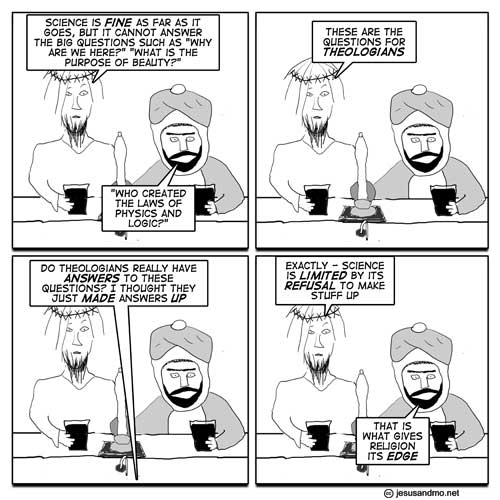
What gives religion its edge


Yeah, this is two years old, part of his "anniversary comics thing," but it's too good - and too true - not to post.

QOTD: Unraveling the magic

Quote of the Day:
Abdulmutallab is the failed Nigerian “underwear bomber” of last Christmas. He joins the failed shoe bomber and failed shampoo-and-bottled-water bombers in a remarkable success: adding another blanket layer of T.S.A checks, including dubious gropes, to the daily humiliations of travelers.

Whether or not these explosive devices were ever actually operable remains a matter of dispute, just as it remains a mystery that the enemy — if as powerful as portrayed — has not contrived a single terrorist act on U.S. soil since 9/11. What is not in doubt is an old rule: Give a bureaucrat a big stick and a big budget, allow said bureaucrat to trade in the limitless currency of human anxiety, and the masses will soon be intimidated by the Department of Fear.

Lavrenti Beria, Stalin’s notorious secret police chief, once said, “Show me the man and I’ll find you the crime.” The T.S.A. seems to operate on the basis of an adapted maxim: “Show me the security check and I’ll find you the excuse.”

Anyone who has watched T.S.A. agents spending 10 minutes patting down 80-year-old grandmothers, or seen dismayed youths being ordered back into the scanner booth by agents connected wirelessly to other invisible agents gazing at images of these people in a state of near-nakedness, has to ask: What form of group madness is it that forsakes judgment and discernment for process run amok?

I don’t doubt the patriotism of the Americans involved in keeping the country safe, nor do I discount the threat, but I am sure of this: The unfettered growth of the Department of Homeland Security and the T.S.A. represent a greater long-term threat to the prosperity, character and wellbeing of the United States than a few madmen in the valleys of Waziristan or the voids of Yemen.

America is a nation of openness, boldness and risk-taking. Close this nation, cow it, constrict it and you unravel its magic. - Roger Cohen

How to survive a nuclear attack

(US Navy via National Geographic)

From the New York Times:
Suppose the unthinkable happened, and terrorists struck New York or another big city with an atom bomb. What should people there do? The government has a surprising new message: Do not flee. Get inside any stable building and don’t come out till officials say it’s safe.

The advice is based on recent scientific analyses showing that a nuclear attack is much more survivable if you immediately shield yourself from the lethal radiation that follows a blast, a simple tactic seen as saving hundreds of thousands of lives. Even staying in a car, the studies show, would reduce casualties by more than 50 percent; hunkering down in a basement would be better by far.

Yes, this is unthinkable. But I grew up when people were seriously worried about global thermonuclear war. At every school event, there were stacks of civil defense pamphlets, urging citizens to build bomb shelters. Terrorism is frightening, to be sure - that's the whole point, after all - but we have far less to worry about these days.

Terrorism works best against cowards, of course. Even the threat of terrorism gets cowards to overreact - to invade innocent countries, to torture prisoners, to abandon their own values in a fruitless search for guaranteed safety. And one of the ways we can fight it is by being reasonable. In this case, we should recognize that there's a vanishingly small chance that we'll ever need to know this information.

And yet, it's still good to know. There's nothing you can do if you're sitting on top of a nuclear bomb - or any other kind of bomb, for that matter - when it goes off. But the immediate blast radius is not the biggest problem from nuclear weapons. It's the radioactive fallout that causes the most deaths - by far. If worse comes to worst, hunker down and wait for help. According to the article, even a few hours would greatly increase survival rates.

And despite that mushroom cloud graphic I added to this post, if terrorists ever do get radioactive material, the most likely scenario is a "dirty bomb." Rather than a nuclear explosion, we'd likely just see an ordinary bomb designed to spread radiation. Yes, that would be terrible, but there would be relatively few casualties if people just stayed put and avoided the debris.

And remember, things have been worse. In my childhood, when we worried about global thermonuclear war, hunkering down and waiting for help wasn't an option. We soon realized that thousands of hydrogen bombs would wipe us out - wipe out both sides - no matter what we tried to do. The only way to survive that was to keep the peace.

We got past that, and we'll get past this - if we don't lose our courage and our common sense.

Thursday, December 16, 2010

2010 holiday sale at GOG.com

If you want to try some great old games, or just re-play some fondly remembered classics - all set up to play on modern computers - this is the sale for you. GOG.com claims to have 290 games on sale, at between 30% to 50% off their normally low prices.

We're talking about real classics here, games like Master of Orion, Planescape: Torment, Baldur's Gate 1 & 2, The Temple of Elemental Evil, Icewind Dale, Neverwinter Nights, Heroes of Might & Magic, and so many, many more - all at prices of $2.99 to $6.99.

No, that's not a typo. As far as I can tell, none of them cost as much as $7.

At that price, you can really afford to take a chance on a game. Of course, there are also user ratings and reviews of each game. (For example, 3131 people rated Planescape: Torment - average rating 5 out of 5 stars - and 176 wrote reviews.)

Heck, at that price, I'm tempted to buy games I already own, just so I don't have to mess with getting the originals installed and running correctly. (However, I'm so involved with Dragon Age: Origins right now that I really shouldn't be buying any more computer games.)

I don't have a financial interest in GOG.com, I assure you. I've bought games from them before, but that's it. But I love what they do there. And this is really a great sale. Take a look.

But remember, these are old games. The great gameplay is still there, but they don't have modern graphics. Still, if that matters to you, some are newer than others. And there are screenshots of every game. So they make it pretty easy to see what you're getting. GOG.com is a class act, it really is.

QOTD: Devaluing history

Quote of the Day:
Menzie Chinn goes after Paul Ryan’s challenge: “Name me a nation in history that has prospered by devaluing its currency.” But why go back to the 1930s?

How about:

-Britain, which recovered strongly from its early 90s doldrums after it devalued the pound against the mark in 1992. (At the time, some wags suggested putting a statue of George Soros in Trafalgar Square.)

- Sweden, which recovered from its early 90s banking crisis with an export boom, driven by a devalued kronor.

- South Korea, which roared back from the 1997-1998 crisis with an export boom, driven by a depreciated won.

- Argentina, which roared back from its 2002 crisis with an export boom, driven by a depreciated peso.

And more. The truth is that every recovery from financial crisis I know of since World War II was driven by currency depreciation. In fact, that’s the biggest reason for pessimism now: because of the global scope of this crisis, the usual exit is blocked.

Now, I’m sure that the goldbugs will come up with ways to explain away all of these events. But at that point we’re not learning from history; on the face of it, history seems to suggest many cases of countries prospering through devaluation.

So what’s going on with Ryan? First, it’s a good bet that he doesn’t actually know much about monetary history. Beyond that, though, what you often see among hard-money types is a sort of Lives of the Saints approach to history: they’ve got their iconic examples (Weimar Germany! Zimbabwe!) which they pull out on every occasion, while remaining utterly ignorant of all the examples that go the other way.

And no, it’s not symmetric: people like me have heard about hyperinflation, while people like Ryan apparently have never heard about post-crisis Korea or Argentina. - Paul Krugman

To boldly go...


The future's not quite what we expected, is it? Well, not yet. But there's still time, if we have the intelligence, the courage, and the resolve to move forward, instead of back.

The future looks bleak, in many ways. Even science fiction seems depressing, these days. I think popular culture is embracing fantasy instead, because it doesn't have to even seem real.

But the future is always up to us. Our ancestors went though tough times, too - far tougher, in fact. And if we lack courage, lack ambition, lack determination,... well, we probably deserve the kind of future we're going to get.

Wednesday, December 15, 2010

Defending the sanctity of marriage


Here are excerpts from David Horsey's commentary, along with a few comments of my own:
Wouldn't it be great if, for once, the U.S. Congress took the lead in social change instead of being dragged kicking and screaming to a decision long after most of the country has moved on?

Apparently, that's not the nature of politics. Still, my holiday wish is for the military's Don't Ask, Don't Tell policy to be voted away by Christmas. Polls prove the country is ready. Surveys show the military is ready. Experience in the British and Israeli armed forces demonstrates no crisis is created by homosexuals serving openly. It is unlikely anyone fighting for this country in Afghanistan has failed to figure out if the guy next to him is gay, while also appreciating how that soldier is a tough son-of-a-gun.

The only ones who seem to fret about gay and lesbian soldiers are Republican senators and House members catering to a loud contingent of social conservatives who think national policy should be dictated by 3,000-year-old religious taboos.

Oh, and then there's John McCain. Just as he has with tax cuts for the wealthy and immigration policy, McCain has flip-flopped on gays in the military. Ever the maverick, he now has gone "all mavericky," in Sarah Palin's phrase, against his own better self. He is one old soldier who should have just faded away.

Looking back through our history, it has seldom been Congress that has led the way to social progress. The disenfranchised and disdained have had to push and protest and struggle and die in order to get the politicians to finally move. Black Americans and other minorities put their lives on the line time after time to win their liberties, one by one. The legislation that gave women the vote, workers the right to organize, children the right not to be exploited and all citizens the right to clean air and water and food did not come because a majority of lawmakers simply got together to do the right thing.

I recognize that past realities are hugely complicated, but today it seems insane that Americans had to fight against each other in their bloodiest war in order to end slavery.

Slavery? How could anyone have ever thought slavery was right? Well, there are these passages in the Bible that said it was OK, so…

This is a great point, don't you think? We have these vicious battles - literally, in the case of slavery - over issues that seem obvious in retrospect. How could anyone have thought that slavery was right? After all, you'd be hard-pressed these days to find anyone far enough to the right that they still support slavery (although there are still slavery apologetics, especially in the South).

The other big social issues of our history are similar. How could anyone have ever thought segregation was right? How could anyone have ever thought anti-miscegenation laws were right? How could anyone have ever thought that women should not be allowed to vote or to hold public office?

Afterward, even conservatives abandon such ridiculous positions, though they fought like hell to support them at the time. We look back at that in astonishment. How could they have been so blind?

Gay rights is the same thing. How could anyone think that it's fair to discriminate against homosexuals? How could anyone think that it's even their business if a gay or lesbian couple - consenting adults - want to get married? How could anyone be so blind that they can't see this as a civil rights issue, with the solution... obvious?

Americans in the future will see this as just as astonishing as the opposition to women's suffrage or to racial integration. They will see this as absolutely no different than anti-miscegenation laws in the early 20th Century - which, astonishingly, weren't overturned until 1967! (Hard to believe, isn't it?) Even conservatives will have moved forward, just as they have with these other issues. They'll wonder how these things could have ever sounded reasonable to anyone.

If only we could recognize where history is taking us and nimbly leap the ramparts of the dying order. Future Americans will look back on this moment with disdain, wondering why anyone would have thought it made sense to deny gays and lesbians the opportunity to serve their country in battle. And, not only that, but generations to come will also find it curious that those who hold the institution of marriage sacred fought so hard to keep homosexuals from becoming old married folks.

That's another good point. If you really value the institution of marriage, why wouldn't you want to see gay and lesbian couples getting married? Frankly, marriage does seem to be struggling in this country, but why wouldn't conservatives want to see more marriages, rather than denying homosexuals such a fundamental right?

Do they think we'll all turn gay if that option becomes available? (Or are they just afraid that they might be tempted?)

The fact is, they are losing this battle, anyway. Opinions about gay rights are changing rapidly, so it's clearly only a matter of time. For one thing, now that homosexuals are coming out of the closet, a lot of people are finding family and friends who are gay. Unlike racial minorities, these people look just like you do. They're clearly "us," not "them."

Here's another good point:
Still, until recently, I really did not see why civil unions were not an adequate vehicle for gays and lesbians who sought to commit to each other and enjoy the same legal rights and obligations as straight couples. Plenty of liberals, including President Obama, continue to see it that way. But an essay by Andrew Sullivan began to turn my thinking around.

Sullivan, a gay man, right-leaning columnist and former editor of the New Republic, has been a passionate advocate for gay marriage. He makes many intelligent points, but the one that hit home with me was his most personal. He described the experience of taking his partner along on visits to his family. No matter how committed and how caring the relationship, the partner was always the boyfriend, someone welcomed but still outside the family circle. Only when gay marriage began to be legalized in a few states and Sullivan was able to come home and announce he was getting married to the person he loved did the dynamic change. Marriage suddenly made that person part of the story, part of the heritage, fully integrated into the family's identity.

Ironically, it was a matter of family values. I could see how this mattered and it flipped my thinking from "why do they need to marry?" to "why not?"

Why not, indeed? Purely on legal terms, it is no longer a winning argument to say the government has a right to bar certain people from a state-sanctioned domestic arrangement available to all other citizens. As the challenge to California's gay marriage ban moves through the courts, it becomes ever more clear that the legal rationale for this discriminatory practice is disintegrating. Even the conservative majority on the U.S. Supreme Court may fracture on this issue when it is finally brought before them.

I don't know about the Supreme Court, since the GOP has packed it with right-wing lunatics. Hey, I'm not exaggerating. Anyone who thinks that corporations are no different than people is a complete lunatic. It's not just a "conservative" Supreme Court these days. It's a court with a (narrow) majority which has gone completely off the rails.

Nevertheless, Republicans seem to be fighting a holding action on this issue, an issue they will eventually lose. So, why? Well, the party is controlled by extremists. Republicans in general aren't so strongly in opposition to gay rights, and America as a whole certainly isn't. But the people who are opposed are fiercely committed to that opposition. In politics, that matters.

They seem to be fighting a battle they're almost certain to lose. But let's not get complacent. Nothing is inevitable. And they can still do a great deal of harm to gay Americans while we continue to deny them equal rights.

Our descendants - liberal and conservative alike - will wonder how anyone could have thought discrimination was a good idea. But that doesn't help the people who suffer from it now.