Well, all this is interesting to me, anyway, and that's what matters here. The Internet is a terrible thing for someone like me, who finds almost everything interesting.
Imaginary concerns about imaginary problems seems to be all the Republican Party has these days, and that's abundantly clear when it comes to the Trump campaign. For example:
While listing the reasons why his father ran for president in an interview published Thursday, Eric Trump pointed to the tree on the White House lawn and claimed it was renamed the "Holiday tree."
However, in his attempt to explain his father's commitment to combating political correctness and the "War on Christmas," Eric Trump incorrectly accused the White House of renaming the Christmas tree.
"He opens up the paper each morning and sees our nation’s leaders giving a hundred billion dollars to Iran, or he opens the paper and some new school district has just eliminated the ability for its students to say the pledge of allegiance, or some fire department in some town is ordered by the mayor to no longer fly the American flag on the back of a fire truck," Eric Trump told The Stream's James Robinson. "Or, he sees the tree on the White House lawn has been renamed 'Holiday tree' instead of 'Christmas tree.' I could go on and on for hours. Those are the very things that made my father run, and those are the very things he cares about."
The tree that stands near the White House (on the Ellipse) each winter is still called the National Christmas Tree and has never been renamed, as Buzzfeed News noted. And the White House blog also referred to the tree kept inside the residence as a Christmas tree just last year.
PS. I hope I don't have to point out what bullshit the rest of that is. Obviously, we never gave Iran a hundred billion dollars. It was their own money, used to force them to negotiate (successfully, I might add).
Furthermore, we very wisely held back on returning the money until several hostages were freed - not as payment for the hostages (again, it was Iran's money, which had already forced them to do what we wanted them to do), but because it was still potential leverage.
Trump claims to be such a great negotiator. Why wouldn't he recognize effective negotiation when he sees it?
Yeah, here's more about the Starbucks coffee cup war on Christmas. Sorry, but I think this is just hilarious!
As Bristol Palin says, this isn't all Christians. But it is the front-runner in the Republican campaign for president. And did you hear that crowd response? If it's a tiny fringe group, that apparently describes a large proportion of the Republican Party.
In conclusion, here's Stephen Colbert:
I have to admit that, these days, my absolute favorite part of the holiday season is the Christian right's war on the war on Christmas. :)
When it comes to weird Christmas traditions, this takes the cake:
Of all the odd mutations of American culture to be exported abroad, Japan’s KFC Christmas tradition may be one of the oddest. This month, KFC Japan will bring in revenue up to ten times greater than what it earns during other months of the year. Life-size Colonel Sanders statues—a staple in the country—will be dressed in red attire and Santa hats. On Christmas eve, Kentucky Fried Chicken’s lines will snake down the block, and those unlucky enough not to pre-order their special chicken buckets a month in advance may have to go without KFC’s signature blend of 11 herbs and spices.
And not having KFC on Christmas in Japan is a real bummer. In what appears to be one of the most successful fast food marketing campaigns of all time, KFC has for more than thirty years maintained a uniquely on-brand alternate history in Japan, one that makes fried chicken ubiquitous on the day of Jesus’ birth.
“The prevailing wisdom here is that Americans eat chicken on the 25th,” a friend wrote from Tokyo last week. He said he has “blown countless Japanese minds” by suggesting that Western KFCs may even close on Christmas. In Japan, where only a tiny fraction of the population is Christian and the holiday is a secular-slash-commercial affair, yuletide cheer goes hand in hand with a Christmas-branded bucket of chicken—or, as the Japanese call KFC, simply “Kentucky.” ...
If America is oversaturated with fast food empires and too well-acquainted with the Old South’s history to reinterpret it as a fun and exotic myth, in Japan there has been no such problem. There are currently more than 1,200 KFC locations in the country, including an “Adult Kentucky Fried Chicken” bistro serving pasta dishes with beer and “KFC Route 25,” a posh KFC in Tokyo stocked with a full whiskey bar. Not to mention the whole Christmas thing. There’s a countdown to Christmas on KFC Japan’s website and banners celebrating “Kentucky Christmas 2014.”
Funny, isn't it? Not that other countries wouldn't be amused by our reinterpretation of them (American 'Chinese food,' for example). But it's still pretty funny.
Decades ago, when I was in Europe, I was surprised by the Japanese tourists I saw there. To a man (and woman), they looked more American than we Americans do - blue jeans, cameras, etc. It was like they were all wearing a costume - and a pretty nearly identical costume, at that.
Don't get me wrong; it wasn't because they were Japanese. There are plenty of Japanese-Americans, but they didn't dress like that, even when they wore blue jeans and owned cameras. Japanese-Americans looked American. I'm not sure I can describe the difference, but it was obvious.
I suspect that it was just Japanese fashion at the time, but it certainly seemed weird to me.
I like this better than the original reply to Virginia O'Hanlon, though I guess that taught her not to believe everything she read in the newspaper, huh? After all, once you start asking questions, you're not going to believe for long.
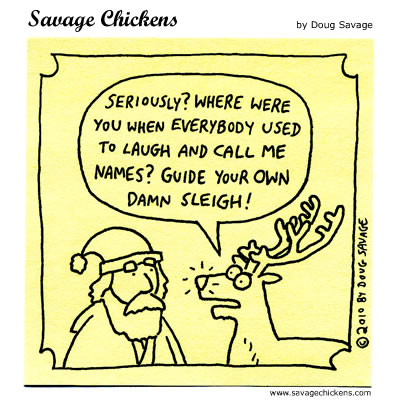
But the thing is, most Americans want to believe in Santa Claus. When they get a little older, they can't, because Santa is supposed to do real things, specific things, in the real world. Well, I suppose they could believe that they're just no longer good enough to get Christmas presents from Santa, but who wants to believe that? :)
But they can believe in a god, if they don't ask questions, because God doesn't give you your gift until after you die. Therefore, no one is ever disappointed, and no one can ever point out that it doesn't actually happen.
You can pray for something in this life, of course, but if you don't get it, "God works in mysterious ways." Well, these are defense mechanisms for people who really, really want to believe what there's no good reason to believe.
The original editorial was popular because Americans wanted to believe in their own Santa Claus. All minds are "little minds," therefore why use them? And even if Santa Claus doesn't exist, life would be "dreary" without him (i.e. he has to exist, just because we so very much want him to exist). Besides, just because you don't see Santa Claus, that's not proof he doesn't exist, right?
Well, our minds may be "little," but they're the only minds we've got. We use our minds, as best we can, for most things, so why not for this? After all, we might be wrong if we use our minds, but we're almost guaranteed to be wrong if we don't.
And my little mind tells me that wanting something to be true isn't a good reason for thinking that it is true. In fact, it's a good reason to look skeptically - especially skeptically - at the question, because it's all too easy for us human beings to believe what we really, really want to believe, even when we have no good reason to believe it.
And finally, no one has to prove that Santa Claus doesn't exist, because the burden of proof is always on the person making a claim. Do you believe in leprechauns, just because no one has shown you proof that they don't exist? Do you believe in werewolves, unicorns, fairies, gremlins, fire-breathing dragons, or talking snakes? Have you actually seen proof that they don't exist?
I don't like to talk about "proof" anyway, since what can you really prove, beyond any possibility that you could be wrong? Maybe nothing really exists except you, and you're just hallucinating all this. No, I like to talk about evidence. And it's the person making a claim who needs to demonstrate that his claim is true.
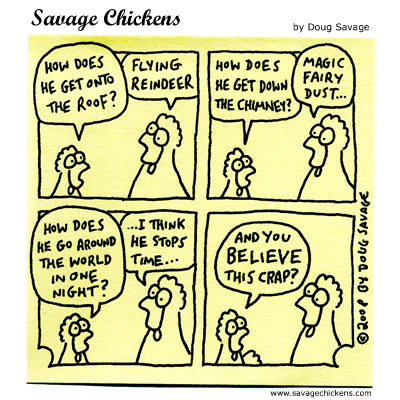
Now, if you tell me that it's snowing outside on Christmas Day - here in Nebraska, at least - I probably won't require especially good evidence before I'll believe you. After all, there was a good chance of snow in the forecast. But if you tell me there's a man who delivers toys to every child in the world in one night - using flying reindeer, no less - I'm going to need pretty good evidence before I'll believe that.
Of course, I did believe that when I was a child. There did seem to be evidence for Santa Claus. Someone, after all, brought me presents with his name on them. And there was a lot of eyewitness testimony, there really was. As it turned out, that wasn't good evidence. Furthermore, I hadn't learned that a lot of poor evidence doesn't add up to even one speck of good evidence. That's not how it works.
Virginia O'Hanlon was starting to ask questions, and they lied to her. They lied, not because they believed in Santa Claus themselves and not because she wasn't going to discover the truth soon enough anyway, but because the truth would demonstrate that their own beliefs had no more validity than her belief in flying reindeer. That's why the editorial became so popular, I suspect.
Well, I have no problem will telling children stories about Santa Claus and the Easter Bunny, and I have no problem with parents who tell them the truth, either. Either way is fine with me. Personally, I don't see any problem with children enjoying fantasy, and I certainly have no problem with children enjoying Christmas.
Indeed, I hope they always enjoy Christmas (or whatever holiday your family celebrates). I do. But when we grow up, we put childish beliefs behind us. We still enjoy our holidays, but we don't have to believe in magic to do that.
It's not so bad growing up, it really isn't. And while childish beliefs might be appropriate for children, they're not appropriate for adults. Faith-based thinking causes a lot of problems in our world. So, Virginia, when you get old enough to start asking questions, you should be told the truth.
And the truth is that people often lie, even to themselves - maybe even especially to themselves. The truth is that you can't always believe what you're told, that you often must overcome your own wishful-thinking to discover uncomfortable truths, and that you can never stop asking questions.
The truth is that Christmas can be good, that life can be good, even when you know that magic isn't real. Merry Christmas, Virginia!
___
PS. Here's where I got the picture of me in holiday garb. :)
Merry Christmas! Or, if you prefer, Happy Holidays! I don't care. It's entirely up to you.
But I do celebrate Christmas. Here in America, Christmas is a secular holiday. For many Americans, of course, it's also a religious holiday, but that's their business, not mine.
I understand that, if you believe in some other religion - or if your family traditions are simply different from mine - you might not celebrate Christmas. Certainly, Christians do their damnedest to make the holiday all about them (something we atheists need to resist, I'd say).
But I'm always glad to wish my Jewish friends a Happy Hanukkah. (Whether that's actually appropriate, I don't know, but I'm sure they all understand my good intentions.) I'm always willing to say Happy Winter Solstice or Happy Kwanza or... Happy Saturnalia, I guess.
But really, Happy Holidays pretty well covers it all, doesn't it? And obviously, when I say "Happy Holidays," I don't mean to exclude Christians. Of course not! Pull that stick out of your butt and understand that I'm just trying to wish you well.
Of course, the vast majority of Christians understand that. It's only the professional Christians, the right-wing Christians on talk radio and Fox "News," who seem to have a problem with Happy Holidays. And in general, I think I'd prefer that their holidays be miserable, anyway. Heh, heh.
But I usually say "Merry Christmas." It is, after all, my holiday, too. It's a federal holiday here in America and, given our Constitution, that pretty much makes it secular by definition. And as you know, Christians didn't invent the holiday. They just changed the name.
The church tried to capture an existing holiday for its own exclusive use. But Christmas has been struggling towards freedom for many years. Santa Claus, snowmen, lighted trees, elves, eggnog, candles, flying reindeer, candy canes, mistletoe, Jingle Bells - there's very little about Christmas these days that's not secular.
But if it's a religious holiday for you, no problem. Merry Christmas. You can believe whatever you want. We may need to agree to disagree, but so what? I wish you well, whatever I might think about your belief.
This is almost too realistic to be funny. OK, it's still funny, but it's especially appropriate during the Christmas season.
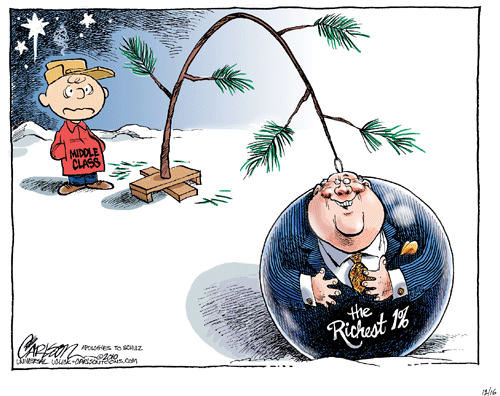
Obviously, when it comes to Christmas, I probably disagree with devout Christians about most things. But we still might agree on the idea that Christmas has become too commercial. However we might disagree about the "reason for the season," we probably agree that it's not to "shop until you drop."
But there's a reason why Christmas - and other holidays, too, to a lesser extent - has become more and more a shopping extravaganza. Businesses make a profit from that, so they have a real incentive to push it.
Stores start advertising even before Halloween sometimes, and many companies make their entire profit the last couple months of the year. Media companies push Christmas, because they make money on advertising. The media would no more question commercializing Christmas than they'd admit that it doesn't really matter who wins a sports match - and for the same reason.
The idea behind gift-giving is fine, no doubt, but we are constantly encouraged that way only because people make money from it. It's funny, but there's a very selfish reason behind this push to be generous. And we're gullible enough that people often go into debt to finance Christmas in the manner to which the media have convinced them is appropriate.
My parents used to tell me that, when they were children, they typically received one toy at Christmas. Mom said she received a doll one Christmas,... and the doll clothes the next Christmas.
When we were kids, we had lots of gifts under the tree, but that paled next to the mountain of gifts my nephew and nieces received in later years. Partly, that was a matter of increased family wealth, of course. But a lot of it was different expectations of Christmas, too, I suspect.
It's not just gifts, since we're constantly urged to spend money on decorations and everything else, too. And it's not just Christmas, since we are increasingly bombarded at nearly every holiday to spend more money. Well, as I say, it's a conspiracy - or maybe just a synergy - between the media and other corporations. Everyone wants a cut of the pie, and it's to everyone's benefit that the pie be as large as possible.
I suspect that even non-profit groups benefit. When there's lots of money flying around, it's easier for pretty much anyone to snag some of it. We tend to be more generous at Christmas, at least in part because we're already spending a lot of money on other things.
But does this benefit you and your family? It certainly doesn't if you go into debt. It certainly doesn't if this leaves you short of money to save for your retirement - or for your children's education. Whatever the real "meaning of Christmas," is it all about money? Not for me.
My Christmases have gotten so much better since I stopped exchanging gifts. Oh, I'd still give gifts if there were young children in the family, of course. And for older children, I send money. Even for adults, I might give a token gift of candy or flowers. I'm not a fanatic about this.
But there used to be a lot of stress at Christmastime. I'd spend weeks worrying about what gifts to buy, struggling to get just the right thing for everyone. Then, at Christmas, at least half the time my gifts would clearly fall flat - and I'd be given things I didn't really want, myself.
Eventually, I realized that we were giving each other items that we simply didn't want badly enough to buy for ourselves - just because that's what we'd been led to believe was the right thing to do at Christmas.
And I don't like to shop. Some people do. Some people apparently love to shop. But not me. For me, it was an unwelcome chore, and a stressful one. You can't imagine how much nicer my Christmases are these days!
I love Christmas. I don't necessarily love everything about it, but it's always been one of my favorite holidays. But I've never liked being manipulated by other people for their own advantage, and that's what seemed to be happening at Christmas. There was a reason why Christmas was becoming too commercial.
Well, I'm not a parent, either, and Christmas is all about children. So maybe that has something to do with it. At any rate, you can celebrate Christmas any way you want. I have no desire to dictate to anyone else, none at all. But this works for me.
For today's Quote of the Day, I quoted Ricky Gervais, an excerpt from his superb "holiday message," Why I'm an Atheist. I highly recommend that you read the whole thing. It really is good.
And in the six days since it's been posted online at the Wall Street Journal, there have been 5862 comments! Heh, heh. No, I haven't read them all - or even more than a handful. But the column was so popular that they followed up with another, where Ricky Gervais answers some of the questions he received.
It's short, and it's very good, too. I recommend you read it as well (and there are only 704 comments there, so far). In fact, it's so good that I'm having trouble deciding what excerpts to post. How about starting with this?
What does a comedian really know about God anyway?
Since there is nothing to know about god, a comedian knows as much about god as any one else.
Yes, he's right. There are no experts when it comes to gods. There are experts when it comes to religions, true. But that's just being an expert in the history or ideas of a particular belief system.
After all, people who do claim to be experts about God disagree vociferously. Unlike in science, which relies on evidence, there's no consensus in religion. That's because there's no way to tell when you're wrong - or when anyone else is wrong, either - when you rely only on wishful thinking faith.
Science doesn’t concern itself with the non-existence of something. The periodic table of imaginary things would be too big for a classroom- infinitely big in fact, and rather pointless. It’s not trying to prove the non-existence of anything supernatural. All it knows is there is no scientific proof of anything supernatural so far. When someone presents a jar of God it will test it. If it finds some evidence of “godness” it will follow the evidence till it knows everything it can.
The fact that science can say “we don’t know” is exactly my point. Science doesn’t start with a set of convenient conclusions and try to justify them. It follows evidence. In fact, it tries to prove itself wrong. When it can’t, it’s right. Superstition, religion and blind faith cherry pick the evidence and justify the results by changing the goal posts.
This is very good stuff, which - as Gervais well knows - will likely change no minds at all. It still should be said, and said often.
But since it's Christmas, let me close with one more excerpt that really speaks to me:
How do you plan on celebrating Christmas?
Eating and drinking too much with friends and family. Celebrating life and remembering those that did, but can no longer.
They are not looking down on me but they live in my mind and heart more than they ever did probably. Some, I was lucky enough to bump into on this planet of six billion people. Others shared much of my genetic material. One selflessly did her best for me all my life. That’s what mums do though. They do it for no other reason than love. Not for reward. Not for recognition. They create you. From nothing. Miracle? They do those every day. No big deal. They are not worshiped. They would give their life without the promise of heaven. They teach you everything they know yet they are not declared prophets. And you only have one.
For a fact, the Christians stole Christmas. We don't mind sharing it with them, but we don't like this pretense of theirs that it is the birthday of Jesus. It is the Birthday of the Unconquered Sun - Dies Natalis Invicti Solis. Christmas is a relic of sun worship.
The customs of this time of year endure because they are pleasant customs. It's fun to hear from distant family and friends, to gather, to feast, to sing. Gifts, as Robert Ingersoll once said, are evidences of friendship, of remembrance, of love.
The evergreens displayed now as in centuries past flourish when all else seems dead, and are symbols, as is the returning sun, of enduring life.
In celebrating the Winter Solstice, we celebrate reality. - Anne Nicol Gaylor
The good part of Christmas is not always Christian--it is generally Pagan; that is to say, human, natural.
Christianity did not come with tidings of great joy, but with a message of eternal grief. It came with the threat of everlasting torture on its lips. It meant war on earth and perdition hereafter.
It taught some good things--the beauty of love and kindness in man. But as a torch-bearer, as a bringer of joy, it has been a failure. It has given infinite consequences to the acts of finite beings, crushing the soul with a responsibility too great for mortals to bear. It has filled the future with fear and flame, and made God the keeper of an eternal penitentiary, destined to be the home of nearly all the sons of men. Not satisfied with that, it has deprived God of the pardoning power.
And yet it may have done some good by borrowing from the Pagan world the old festival called Christmas.
Long before Christ was born the Sun-God triumphed over the powers of Darkness. About the time that we call Christmas the days begin perceptibly to lengthen. Our barbarian ancestors were worshippers of the sun, and they celebrated his victory over the hosts of night. Such a festival was natural and beautiful. The most natural of all religions is the worship of the sun. Christianity adopted this festival. It borrowed from the Pagans the best it has.
I believe in Christmas and in every day that has been set apart for joy. We in America have too much work and not enough play. We are too much like the English.
I think it was Heinrich Heine who said that he thought a blaspheming Frenchman was a more pleasant object to God than a praying Englishman. We take our joys too sadly. I am in favor of all the good days--the more the better.
Christmas is a good day to forgive and forget--a good day to throw away prejudices and hatreds--a good day to fill your heart and your house, and the hearts and houses of others, with sunshine. - Robert G. Ingersoll (1891)
I'm a skeptic. I think it makes sense to have reasons for what I believe, so I apportion my belief to the evidence. You're welcome to disagree. Please, tell me I'm wrong. I probably don't agree with anyone about everything. Why should disagreement be a problem? Check the Pages section below for series posts and links to book reviews and game posts, as well as contact info. Unfortunately, I rarely blog at all, anymore. So don't expect new posts. - Bill
We've all heard that a million monkeys banging on a million typewriters will eventually reproduce the entire works of Shakespeare. Now, thanks to the Internet, we know this is not true. - Robert Wilensky
It doesn't matter how beautiful your theory is, it doesn't matter how smart you are. If it doesn't agree with experiment, it's wrong - Richard Feynman
The general root of superstition is that men observe when things hit, and not when they miss, and commit to memory the one, and pass over the other. - Sir Francis Bacon
When a whole nation is roaring Patriotism at the top of its voice, I am fain to explore the cleanness of its hands and purity of its heart. - Ralph Waldo Emerson
Speculation is perfectly all right, but if you stay there you've only founded a superstition. If you test it, you've started a science. - Hal Clement
No matter how many times a theory meets its tests successfully, there can be no certainty that it will not be overthrown by the next observation. This, then, is a cornerstone of modern natural philosophy. It makes no claim of attaining ultimate truth. In fact, the phrase "ultimate truth" becomes meaningless, because there is no way in which enough observations can be made to make truth certain and, therefore, "ultimate". - Isaac Asimov
The government of the United States of America is not in any sense founded on the Christian Religion. - Treaty of Tripoli, passed unanimously by the U.S. Senate and signed by President John Adams (1797)
I don't doubt the sincerity of dowsers, but even after we've demonstrated that they can't produce results that are any better than chance they'll still go away believing in their abilities... It is like the mother whose son is caught shoplifting on tape. She wonders why someone would want to frame her child by producing a fake video. - James Randi
During many ages there were witches. The Bible said so. The Bible commanded that they should not be allowed to live. Therefore the Church ... imprisoned, tortured, hanged, and burned whole hordes and armies of witches, and washed the Christian world clean with their foul blood. Then it was discovered that there was no such thing as witches, and never had been. One does not know whether to laugh or to cry. - Mark Twain
Aristotle maintained that women have fewer teeth than men; although he was twice married, it never occurred to him to verify this statement by examining his wives' mouths. - Bertrand Russell
A casual stroll through the lunatic asylum shows that faith does not prove anything. - Friedrich Nietzsche
I have been thinking that I would make a proposition to my Republican friends... that if they will stop telling lies about the Democrats, we will stop telling the truth about them. - Adlai E. Stevenson, Jr.
This is not about proof. Science does not use proof. We favor evidence, and the work consists largely of the slow accumulation of evidence in support of ideas, not magically potent proofs that establish an idea as unassailable. - PZ Myers
No, people don't expect government to solve all their problems. But they sense, deep in their bones, that with just a slight change in priorities, we can make sure that every child in America has a decent shot at life, and that the doors of opportunity remain open to all. - President Barack Obama
The formula was very simple: build this really flexible, really open economy, tolerate creative destruction so dead capital is quickly redeployed to better ideas and companies, pour into it the most diverse, smart and energetic immigrants from every corner of the world and then stir and repeat, stir and repeat, stir and repeat, stir and repeat. - Shekhar Gupta
We are prodding, challenging, seeking contradictions or small, persistent residual errors, proposing alternative explanations, encouraging heresy. We give our highest rewards to those who convincingly disprove established beliefs. - Carl Sagan
We are all atheists about most of the gods that societies have ever believed in. Some of us just go one god further. - Richard Dawkins
120 million of us place the big bang 2,500 years after the Babylonians and Sumerians learned to brew beer. - Sam Harris
To kill a man is not to defend a doctrine, but to kill a man. - Michael Servetus, burned at the stake in 1553
Democracy is not about majority rule; it is about minority rights. If there is no culture of not simply tolerating minorities, but actually treating them with equal rights, real democracy can't take root. - Thomas L. Friedman
We cannot absolutely prove that those are in error who tell us that society has reached a turning point, that we have seen our best days. But so said all who came before us and with just as much apparent reason. - Thomas Macauley, 1830
It may be true that the law cannot make a man love me, but it can stop him from lynching me, and I think that's pretty important. - Martin Luther King, Jr.
We will not walk in fear, one of another. We will not be driven into an age of unreason if we dig deep into our history and remember we are not descended from fearful men. - Edward R. Murrow
The deepest sin against the human mind is to believe things without evidence. Science is simply common sense at its best - that is, rigidly accurate in observation, and merciless to fallacy in logic. - Thomas Huxley
There is no absurdity so obvious that it cannot be firmly planted in the human head if you only begin to impose it before the age of five, by constantly repeating it with an air of great solemnity. - Arthur Schopenhauer
Because religious belief, or non-belief, is such an important part of every person's life, freedom of religion affects every individual. ... Erecting the "wall of separation between church and state," therefore, is absolutely essential in a free society. - President Thomas Jefferson
To be elected in America, no matter from what party, the candidates have no choice but to year after year pledge to lower taxes further and further. We have become the nation of Ken and Barbie, looking good but very poor at the math. - Rack Jite
Invisible Pink Unicorns are beings of great spiritual power. We know this because they are capable of being invisible and pink at the same time. Like all religions, the Faith of the Invisible Pink Unicorns is based upon both logic and faith. We have faith that they are pink; we logically know that they are invisible because we can't see them. - Steve Eley
We have always known that heedless self-interest was bad morals; we know now that it is bad economics. - President Franklin D. Roosevelt
I have been attacked by Rush Limbaugh on the air, an experience somewhat akin to being gummed by a newt. It doesn't actually hurt, but it leaves you with slimy stuff on your ankle. - Molly Ivins
In this world of sin and sorrow there is always something to be thankful for; as for me, I rejoice that I am not a Republican. - H. L. Mencken
Success is not final, failure is not fatal: it is the courage to continue that counts. - Winston Churchill
The Iris of Your Eye- Throwing Copper
-
The Iris of Your Eye- Remembering the Alternative music I loved.
I grew up in the 90s. I spent nearly all the money I earned from working at
a superma...
The SFF Blog
-
To all readers of my blog: I have decided that this will be my final post.
Not that I am about to expire in the near future (I hope) but I have become ...
Pickleball Mania!
-
Not long after moving to Arizona, I met a guy who invited me to take a
pickleball lesson. I hadn't seen the game in person, but I'd heard of it,
and watch...





 Posts
Posts


