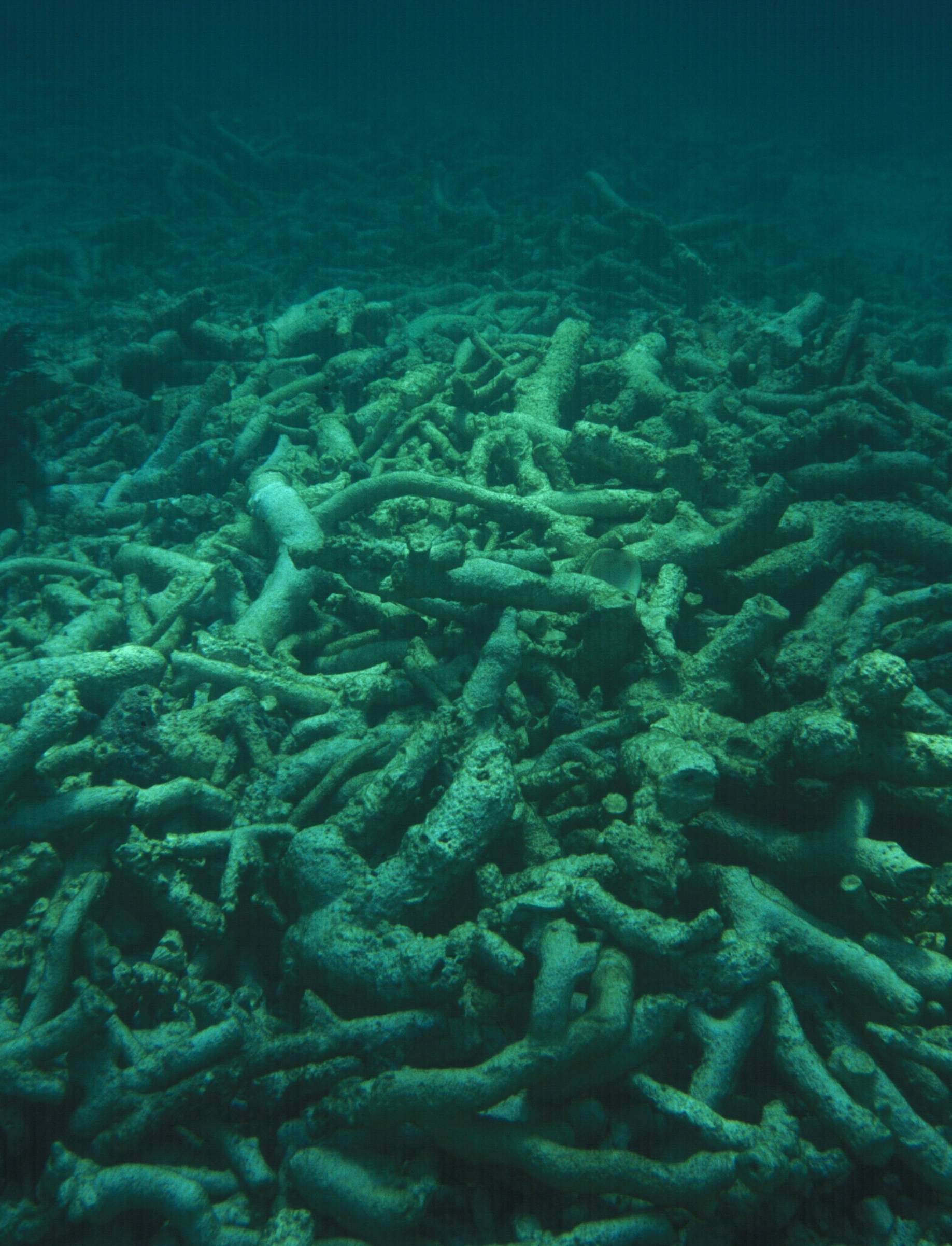
Showing posts with label oceans. Show all posts

Wednesday, October 16, 2013

Our oceans are dying

(via Daily Kos)

From Daily Kos:
Oxygen levels are dropping and ocean waters are acidifying at the fastest rate in at least 300 million years when the greatest marine extinction in earth's history took place according to The State of the Ocean Report 2013 written by an international panel of marine scientists.

Today's explosive increase in human CO2 emissions and warming of the oceans are recreating the conditions of the great Permian extinction 300 million years ago when massive volcanic eruptions in Siberia triggered the release of enormous amounts of stored carbon. A leading theory is that deoxygenation and acidification of the oceans led to the bacterial production of toxic hydrogen sulfide gas which poisoned species dependent on oxygen. By the end of this natural catastrophe 90% to 95% of all marine species were extinct. The biodiversity of the oceans took 30 million years for to recover.
the scale and rate of the present day carbon perturbation, and resulting ocean acidification, is unprecedented in Earth’s known history. Today’s rate of carbon release, at approximately 30Gt of CO2 per year, is at least 10 times faster than that which preceded the last major species extinction (the Paleocene Eocene Thermal Maximum extinction, or PETM, ca. 55 million years ago), while geological records indicate that the current acidification is unparalleled in at least the last 300 million years. We are entering an unknown territory of marine ecosystem change, and exposing organisms to intolerable evolutionary pressure. The next mass extinction event may have already begun.

Human CO2 emissions directly cause both global warming and ocean acidification. But that's just the beginning. Mixing tends to decline in warming waters because a warm fresh surface layer is substantially lighter than colder middle and deep water. The surface layer tends to float and not mix. Organic carbon is always falling from the surface to deeper waters. Bacteria oxidize the fallen carbon to CO2. This process reduces oxygen levels and increases the acidity of the water. When the rate of mixing declines the residence time of water in a layer increases, so acidity levels tend to rise and oxygen levels drop in layers below the surface as the climate warms.

There's lots more, including examples of consequences we're seeing right now. And the article doesn't even mention over-fishing, pollution, or any of the other ways we're destroying our oceans. Nor does it mention how many millions of people depend on our oceans for survival. This is a matter of life or death to millions of men, women, and children.

But it does explain how slowly natural processes change. This isn't something we'll be able to undo in an instant, when we finally wake up to how much damage we're doing to our own environment.
Moreover, because processes in the ocean are slow to change this deadly water would continue to affect the Pacific northwest for another 50 years if all human CO2 emissions stopped today. It will take 30 to 50 years for the most acidic water already present along the west coast to well up. This is the beginning of a disaster that we cannot stop. The best we can do is to keep it from growing far larger and far more deadly. The changes happening in the waters of the Pacific northwest are the first stages of a global marine catastrophe if CO2 emissions are not rapidly reduced.

Obviously, all CO2 emissions aren't going to be stopped today. Or tomorrow. Or ever, probably. But whatever we do or don't do, our descendants will be living with the consequences for generations - at a minimum!

Thursday, May 24, 2012

Deep sea jellyfish


You might have seen that video clip of a gelatinous blob, undulating around the camera of a deep sea oil rig, which recently went viral. (It's had more than 5 million hits on YouTube.)

Well, this is the one which really should go viral. That blob was apparently Deepstaria reticulum, a deep sea jellyfish. To my mind, the explanation makes the whole thing even more fascinating.

You'd better learn to enjoy jellyfish, anyway, because as we're destroying the ocean - through over-fishing, habitat destruction, and global warming - jellyfish seem to be benefiting (maybe not this particular species, of course).

We may end up with nothing but jellyfish. Of course, a lot of human beings will likely starve to death before then. But that's not stopping us, is it?

Wednesday, August 31, 2011

The last fishing boat on Lake Michigan

Here's a depressing article in the Los Angeles Times about the end of commercial fishing on Lake Michigan:
Today, for the first time since the 1800s, there are no commercial fishing boats operating out of Milwaukee.

The boats are gone because the fish are gone.

The lake appears from the shore as blue and beautiful as ever, but that's not the lake Dan Anderson sees through eyes creased and scorched from decades spent on the water and under the sun.

He sees a liquid desert. ...

This was once the wild, wooded Northwest, and the lake harbored one of the most spectacular freshwater fisheries in the world. Plump lake trout reigned atop a food web loaded with species such as perch, sturgeon, lake herring, whitefish and chubs.

As the article states, by 1900, commercial fishermen were hauling 41 million pounds of fish out of the lake every year. Through overfishing and pollution, the catch declined dramatically, but the real kiss of death for the lake was the invasion of quagga mussels, brought in the ballast water of ocean-going freighters.

Unfortunately, this is just one small sample of what's happening worldwide. In particular, we're rapidly destroying our oceans. Overfishing - and the use of fishing techniques that destroy as much as they catch - pollution, acidification (from increased amounts of carbon dioxide in the air),... it's really a combination of factors.

But the result is going to be catastrophic. As much food as we used to pull from Lake Michigan, it's a drop in the bucket compared to ocean catches. And because we're not fishing sustainably, sooner or later it will collapse.

We've already seen collapsing fish stocks of one species after another, but what do we do when the whole ocean is filled with jellyfish and little else? We're looking at a future of widespread starvation for people around the planet who depend on fishing for survival.

We know it's coming, and we're doing little or nothing to prevent it. What does that say about us?

Of course, Republicans want to gut the Environmental Protection Agency and end pretty much all governmental regulations. As you know, corporations will just naturally do the right thing. (Yeah, how'd that work out with mortgage banks?)

In fact, we should have had stronger regulations. Maybe then, there'd still be fish to catch in Lake Michigan.

Saturday, February 26, 2011

Coral reefs heading for disaster


From the BBC:
Three-quarters of the world's coral reefs are at risk due to overfishing, pollution, climate change and other factors, says a major new assessment.

Reefs at Risk Revisited collates the work of hundreds of scientists and took three years to compile.

The biggest threat is exploitative fishing, the researchers say, though most reefs will be feeling the impact of climate change within 20 years.

Nice, huh? These aren't just pretty, biologically diverse curiosities which most of us will never see for ourselves. We're talking about over-fishing, primarily (and destroying our oceans in other ways, too, of course). We get a great deal of our food from the ocean. What happens when it's gone?

How can we, as a species, be this dumb? How can we be this shortsighted? After all, it's nothing new.
The report revisits some of the territory explored in the original Reefs at Risk project, published in 1998, but in much greater detail.

Over the 13 years intervening, the area at risk of destruction has increased by nearly a third.

The main reason for that change has been a massive increase in damage from exploitative fishing, particularly in the Indian and Pacific Oceans.

In 13 years, the area at risk of destruction has increased by nearly a third. Think about that! How foolish can we be? And we haven't even seen the worst effects of global warming yet.

I remember as a child in grade school learning about the passenger pigeon, the whooping crane, the vast herds of bison slaughtered indiscriminately. I remember learning about how we'd driven the whales to near extinction. The implication was that we'd learned something since then.

But we've learned nothing. We're still just as greedy. We're still just as ignorant. We're still just as foolish as ever. We're lemmings going over a cliff - seeing the edge of the cliff getting closer and closer and closer,... and still too dumb to change course! It's maddening!

And frankly, it makes me embarrassed to be a human being.
Against this bleak backdrop, the researchers have been at pains to emphasise that there are things that can be done to reduce the damage.

"There are reasons for hope," said Lauretta Burke, senior associate at WRI and a lead author of the report. ...

"The report is full of solutions - real world examples where people have succeeded to turn things around," said Dr Spalding.

Right. "Reasons for hope." Except that we won't do what needs to be done. Heck, look at how much worse it's gotten since their first report 13 years ago.

I'm not a young man, not anymore, and throughout my entire life, we haven't been willing to do what needs to be done, not in this and not in most situations. After awhile, you kind of lose hope.

I don't give up. Giving up is not an option. It's cowardly, and it guarantees the worst possible result. But hope? No, I've lost that. I think stubbornness is all I have left.

Tuesday, February 1, 2011

Haven't we learned anything?

(Paul J. Richards, via The LA Times)

Remember, as a child in school, learning about the dodo, the passenger pigeon, the whooping crane? Remember learning about the slaughter of the buffalo, which once seemed inexhaustible? Or the whales, likewise? Even the forests in America were once thought too abundant for mankind to ever log out.

Remember learning about the mistakes we made in the past? Didn't you assume that we knew better now? Didn't you figure that we'd actually learned something from those mistakes? Weren't you really naive?

Here's a sobering article in The Los Angeles Times about the plight of the polar bear:
In one of the most dramatic signs ever documented of how shrinking Arctic sea ice impacts polar bears, researchers at the U.S. Geological Survey in Alaska have tracked a female bear that swam nine days across the deep, frigid Beaufort Sea before reaching an ice floe 426 miles offshore.

The marathon swim came at a cost: With little food likely available once she arrived, the bear lost 22% of her body weight and her year-old female cub, who set off on the journey but did not survive, the researchers said. ...

Polar bears spend much of their waking lives on the shifting Arctic sea ice floes. They survive mainly on the ringed seals that are also dependent on sea ice and swim in abundance in the relatively shallow coastal waters of the continental shelf.

But sea ice has been melting dramatically in recent years, forcing polar bears during the fall open-water periods to either forage from shore or swim longer distances in search of sea ice.

Bears that retreat to land usually find little or no food there, and "typically … spend the duration fasting while they await the re-formation of ice needed to access and hunt seals," according to a 2008 government study.

Polar bears are a dramatic, majestic species. They're not one of those nondescript species which are dying off, nearly without notice, every day. They're not hidden beneath the surface, like the ocean life we're wiping out through overfishing. If we're not willing to do something to protect polar bears, what chance does any other species on Earth have?

Yeah, but... it will cost us money!
In any case, they say, the bears are imperiled.

"They're drowning and starving now, and all the scientific studies show an incredibly high likelihood of extinction of two-thirds of the world's polar bears in the next 40 years … and that includes all the bears in Alaska," said Kassie Siegel, who is arguing the case for the Center for Biological Diversity.

But Alaska Gov. Sean Parnell, who is leading the charge against the Endangered Species Act protections, has said the critical-habitat designation will cost the state hundreds of millions of dollars in lost economic development and tax revenue.

Yes, you were hopelessly naive back then, back when you were in school, weren't you? We never learned anything from our past mistakes. It's just that we could criticize our ancestors, because it didn't cost us anything to do so. And we could criticize other peoples for failing to protect tigers or elephants or tropical rainforests, because we didn't have to pay for that, either. (And, indeed, we were busy clear-cutting our own rainforests at the time, here in the wealthiest nation on Earth.)

In the future, assuming we can still afford schools, our descendants will learn how terrible it was that we let the polar bears die out. They'll learn what a tragic mistake we made in destroying our oceans, and of the horrible consequences of that. They'll learn of the immense biological diversity of the Earth years ago, much of it lost forever due to our greed, our foolishness, our incredible ignorance.

And those children will assume that people had finally learned better. Yes, no doubt they'll be just as naive as you were.

Tuesday, May 25, 2010

Destroying our oceans

(photo from Farm Forward)

I've posted about this before, but the problem is becoming critical. We are destroying our oceans for short-term gain. How can that seem like a good idea?

How about this opening paragraph from an article in Time magazine?

The oceans are being emptied of fish. A forthcoming United Nations report lays out the stark numbers: only around 25% of commercial stocks are in a healthy or even reasonably healthy state. Some 30% of fish stocks are considered collapsed, and 90% of large predatory fish — like the bluefin tuna so prized by sushi aficionados — have disappeared since the middle of the 20th century. More than 60% of assessed fish stocks are in need of rebuilding, and some researchers estimate that if current trends hold, virtually all commercial fisheries will have collapsed by mid century.

This isn't a matter of just skipping your sushi, after we've destroyed our oceans. The oceans feed a lot of people, and provide a livelihood for many more. Of course, that's one reason why it's so difficult to move to sustainable fishing, because it will put some fishermen out of work. But how many fishermen will lose their livelihoods when fish populations collapse entirely?

But there's also a major problem with overcapacity — or the simple excess of fishermen — thanks to the $27 billion in subsidies given to the worldwide fishing industry each year. Those subsidies — especially the billions that go to cheap diesel fuel that makes factory fishing on the high seas possible at all--have created an industry bigger than the oceans can support. The U.N. estimates that the global fleet consists of more than 20 million boats, ranging from tiny subsistence outfits to massive trawlers. Together they have a fishing capacity 1.8 to 2.8 times larger than the oceans can sustainably support. Our tax money is essentially paying fishermen to strip mine the seas.

Get this? We're not just destroying our oceans; we're paying tax money to have our oceans destroyed. I'm speaking about worldwide practices, of course, but the problem is worldwide. Fishing fleets don't just fish in their home waters. In fact, a big problem is factory fishing off the coasts of developing nations, where they destroy the fish that locals need for survival (and where corruption and/or lack of regulation let factory fleets do whatever they want).

As this article states, part of the problem is illegal fishing. But that's not the only problem, since even legal catches are set far, far too high. And indeed, fishing regulations often seem to be designed to let illegal practices flourish.

Right now, for example, fishing boats aren't required to have an identification code from the International Maritime Organization, the only globally recognized identifier for shipping. Establishing the requirement would help distinguish the good guys from the bad guys, particularly if the information is shared among all ports. "Accountability," Flothmann writes, "requires transparency."

Clearly, we aren't serious about this. We are winking at illegal fishing (probably due to rampant corruption in many countries), and we're encouraging overfishing even by legal means. Unfortunately, everyone involved sees a short-term gain in raping our oceans, while the long-term disaster will fall on someone else's watch.

Farm Forward has a good article on this, too:

Humans are consuming marine animals in such massive numbers that the balance of ocean life has already been drastically upset since the beginning of large-scale industrial fishing in the 1950s.

The culprit for this sudden change in the ocean’s ecosystem is what University of British Columbia scientist Daniel Pauly describes as “fishing down the marine food webs.”1 What this means is that overfishing of alpha-predators like tuna and salmon—whose populations are rapidly dwindling—has caused us to begin eating lower down the ocean’s food chain. In the absence of their predators, species a step further down the chain experience a temporary population boom, creating an illusion of abundance for fishers, who begin the process of fishing them out of existence—and so on, all the way down to bottom-feeders and, eventually, plankton.

If this trend continues unabated, Pauly suggests, the future of seafood will be an unvarying supply of “jellyfish sandwiches.”2 An initially skeptical scientific community has confirmed Pauly’s fears, even going so far as to project an approximate date by which the world’s seafood supply will have run out based on the current rate of ocean fishing: That date could be as soon as 2050, according to a 2006 paper on the effects of overfishing published in the journal Science.3

And fish are not the only marine animals to suffer from aggressive commercial fishing practices. Techniques such as “bottom trawling” (in which nets are dragged thousands of miles across the ocean floor) and longlining (using large numbers of baited hooks on an extended line) indiscriminately destroy entire habitats of deep-sea species and devastate populations of dolphins, whales, sea turtles, seabirds, and other marine animals who are trapped in the nets or hooks as “bycatch.”

It's not just overfishing, of course. Global warming is destroying coral reefs, not simply because of increasing ocean temperatures but also from ocean acidification. But even here, overfishing is also a culprit. Removing one species can change a whole underwater ecosystem. And the cumulative impact is just devastating.

(photo from SurfThereNow)

We're not talking about the far future here. Many of us will still be alive a few decades from now, when projections warn of an almost complete collapse of ocean fisheries. Certainly, our children and grandchildren will face the tragic results of our ignorance, apathy, and greed.

I'm a science fiction fan, as well as an environmentalist. One prominent SF theme has always involved turning to the oceans, after we've made the land uninhabitable. But in reality, we seem to be destroying our oceans even faster than we are the rest of the planet. This wasn't the future I'd hoped to see, not at all.

And I remember as a child learning about the old whale hunters, how they'd driven whales to the verge of extinction, until the industry itself collapsed for lack of new prey. But you know, that was taught to me as a lesson that we'd learned. Now that I'm an adult, I realize that's not true. We still haven't learned that lesson. I'm both astonished and disgusted to realize that.

Will we ever learn it? More to the point, will we learn it before it's too late? Or will our descendants look back in astonishment at how stupid we were?

Monday, April 5, 2010

Bathynomus Giganteus


Look who wants his belly rubbed.  :)

It's a giant isopod, an ocean-dwelling crustacean, but I really don't have anything to say about it. I just liked the photo (from the NOAA VENTS Program via National Geographic, with a tip of the hat to Pharyngula).

Tuesday, March 30, 2010

Unsustainable Fishing

 (bluefin tuna photo from Greenpeace via this site)

Earlier, I noted an article about red grouper, how scientists had discovered their constructive role in ocean ecosystems. When we over-fish red grouper, we don't just damage populations of that fish, we affect an entire community of creatures.

Of course, fishing interests objected. Right now, we're over-fishing pretty much everything, and if we stop, some people will lose their livelihoods. That's true. But if we continue, fisheries will collapse and everyone will lose - for years and years. So it's a no-brainer, right? Surely everyone realizes we must bite the bullet and start managing our fisheries so they're sustainable, with rebuilt populations and healthy ecosystems.

No, not at all. We're talking about human beings here, so of course we're less concerned about disaster in the future than our own pocketbooks right now. But I came across a couple of articles that show some of what we've lost already.

Cod are one species that used to be abundant, before they were over-fished. And they used to be much larger than those left alive today. I thought this excerpt from an article in The Boston Globe was interesting:


University of New Hampshire researchers studying 19th century schooner logbooks — some smudged with cod oil from the fingerprints of the Yankee skippers who kept them — established that New England fishermen landed 20 times more cod in 1860 than commercial fleets catch today.

“Even farther back, in early Colonial times, cod were so thick they would sometimes stop a vessel dead in the water,’’ said the UNH’s Karen Alexander, coordinator for the Gulf of Maine Cod Project. “It’s clear, when you pore through the archives, that commercial species were not only more abundant, they were physically bigger.’’

Meaner, too. Alexander cited a terse (and ungrammatical) 1866 log entry by Beverly fishing captain Samuel Wilson: “Rugh weather but plenty of fish [I] took a man’s foot out of a large codfish.’’

Unfortunately, even where cod fishing has been halted entirely, populations don't seem to be rebuilding very well. Removing one species almost entirely from an ecosystem tends to affect the whole ecology. These aren't just living things we're affecting, but living communities.

Incidentally, that article, which describes a new census of sea life, talks about some interesting discoveries from that, too:

Among other things, they have found tubeworms that imbibe crude oil; a crustacean so shaggy it might be answering a casting call for Broadway’s “Hair’’; and a sort of singles cafe for sharks where great whites cruise hungrily for sex.
I talk about other articles - and other species - below the fold.

Monday, March 15, 2010

More Than Just Meat

Here's an article from The Washington Post (registration required, though it's free) that explains how scientists have recently learned that "the red grouper off Florida's east and west coasts and throughout the Gulf of Mexico have created entire ocean communities by digging large holes in the sea's sandy bottom. In the same way beavers construct dams, red grouper excavate and maintain distinct holes whose rocky surfaces provide a place for coral, sponges and other marine life to congregate."

Why is this important? Well, it helps us understand that fish live in ecosystems. As one person says, "We now see fish as living, breathing entities, not only as meat." The fact is, we've been despoiling the seas, and one reason for that is because we catch fish without considering the impact on their entire ecosystem.


By building complex, three-dimensional structures that expose the hard rock beneath the sand, Miller said, red grouper create an environment in which seaweed, coral and sponges can thrive. These communities then attract everything from cleaner fish to female grouper seeking a mate.

"It's just a very cool ecological story," Miller said. "They really have this tremendous ability in getting these diverse communities of organisms to exist in a place that otherwise wouldn't be there."

Steve Bortone, executive director of the Gulf of Mexico Fishery Management Council, said he and other managers need to consider the environmental impact of red grouper digging patterns when they set future commercial and recreational catch quotas for the species. "We need to take into account this community aspect, which I think has been neglected," Bortone said.

We've been destroying one species of sea life after another for decades now, and it's only getting worse. We decimated the whales long ago, but that same sort of thing continues still. We over-fish a desirable species until the population crashes, at which point we switch to another and do the same thing. (That's why we see formerly undesirable fish like slimeheads - renamed to "orange roughy" for obvious reasons - becoming popular for awhile, until their numbers also plummet.)

These species often don't recover, because their numbers just get too small, and removing them from the ecosystem causes too many changes. They're not just meat, they're living species. They live in a particular environment, and they also affect that environment. Through our greed, our extreme myopia, and our willful ignorance, we are decimating our planet, and nowhere worse than in the oceans. Well, maybe it's easier to overlook when it's underwater.

"If you remove that fish, it puts into motion a whole chain of events," said Don deMaria, who used to fish for red grouper near Key Largo, Fla., but no longer does. "There's a whole lot of other critters that are affected. I'm not saying you can't catch them. But you can't do it to the extent we've been doing for the last 20 years." 

That's just it. We must learn to fish sustainably. Otherwise, we are just raping the planet and stealing from our grandchildren. And we must look at ecosystems, not just individual species. If we don't wise up, the next species to crash might well be our own.

Edit: see also this post on Unsustainable Fishing.